
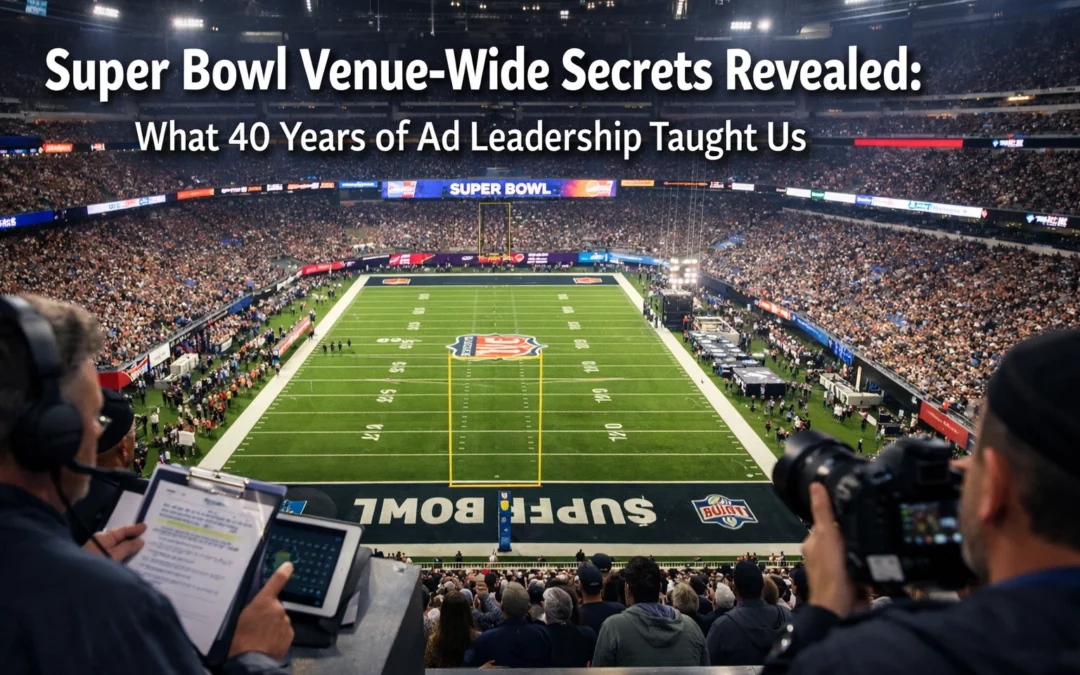
The Super Bowl remains the ultimate stage for advertising. As the dust settles on the 2026 season, looking back at the last four decades provides a clear picture of how the game has changed. It is no longer just about a 30 second television spot. In today’s landscape, success depends on a venue-wide strategy that captures attention from the parking lot to the stadium floors.
For forty years, leadership in this space has moved from simple product mentions to full scale cultural takeovers. This evolution shows that while the price tag for a commercial has climbed to a staggering $10 million for 30 seconds, the real value is found in the physical and digital spaces where fans live and breathe.

The Forty Year Journey of Advertising Excellence
In the 1980s, Super Bowl ads were mostly about explaining what a product did. Brands focused on features and benefits. That changed forever in 1984 when Apple released a commercial that felt more like a movie than a pitch. It aired only once, but it proved that a single moment could define a brand for decades. This shift toward entertainment-driven storytelling is the foundation of modern sports marketing.
During the 1990s, the "golden age" arrived. This was the era of catchphrases and memorable characters. Whether it was the Budweiser frogs or Ray Charles for Pepsi, advertisers learned that emotional resonance was the key to lasting impact. These ads did not just sell soda or beer, they became part of the cultural conversation.
A major lesson from this era came from Master Lock. Between 1973 and 1994, the company spent almost its entire marketing budget on a single Super Bowl ad every year. The results were undeniable. Sales grew from $35 million to $200 million. This validated the idea that the Super Bowl is an unmatched investment for those who know how to use it. More information on these types of strategic shifts can be found on the OOH Sports blog.
Venue-Wide Domination: Beyond the Screen
By the time the 2000s rolled around, it became clear that the stadium itself was an untapped goldmine. Advertising leadership began to realize that fans spend hours at the venue, but only a fraction of that time is spent looking at the main scoreboard. This realization birthed the concept of venue-wide coverage.
Today, in 2026, the strategy involves every square inch of the stadium. This includes:
- Floor Graphics: High impact visuals on the concourse floors that guide traffic while building brand awareness.
- Elevator Wraps: Capturing a captive audience during the transition between stadium levels.
- Concourse Billboards: Large scale displays that dominate the high traffic areas where fans buy food and merchandise.
- Restroom Digital Screens: Ensuring the brand message never stops, even during a quick break.
This approach creates a surround-sound effect for the brand. When a fan sees an ad on their phone, then walks over a floor graphic, and finally looks up at a billboard, the brand becomes synonymous with the event experience itself.

The Power of Direct Engagement
The modern era of the Super Bowl is defined by interaction. The goal is no longer to just talk at the audience, but to talk with them. Leading agencies now focus on ads designed to go viral on social media, recognizing that the conversation after the game is just as valuable as the game itself.
Check out this look at how sports advertising has reached new heights:
https://www.youtube.com/watch?v=l6J-0zileKE
This video highlights how the integration of digital and physical assets creates a seamless brand journey. It is a philosophy that has guided the most successful campaigns of the last decade.
Technical Precision and Programmatic DOOH
The rise of Digital Out-of-Home (DOOH) has completely changed the playbook. Traditional stadium ads were static and required weeks of planning. Now, programmatic DOOH allows brands to change their creative in real time based on the score, the weather, or even the mood of the crowd.
Case studies show the massive impact of these technologies. For example, White Claw’s programmatic campaign saw a 74 percent lift in purchase consideration. Similarly, AB InBev’s Mike’s Hard Iced Tea achieved a 119 percent lift in positive brand image by using targeted digital displays. These are the results that 40 years of leadership have made possible.
In the context of the Super Bowl, this means a brand can congratulate the winning team the moment the clock hits zero across every screen in the city. This level of speed and relevance is what separates the leaders from the followers. You can see more about how these sportrons work to deliver these results.

Why Venue-Wide Coverage Wins the ROI Battle
With the cost of a TV spot reaching $10 million in 2026, many brands are looking for better ways to spend their budget. While the TV spot offers massive reach, venue-wide OOH offers massive frequency and physical presence.
When a brand takes over a venue, they are not just a guest at the party, they are the host. This strategy creates a sense of authority. The fan perceives the brand as a major player because the brand is everywhere they look. This leads to higher brand recall and a stronger emotional connection.
Strategy and planning are essential here. A successful campaign is not just about buying space, it is about creating a cohesive narrative. The same messaging seen on a marketing billboard should be reflected on the digital floor graphics and the stadium’s social media feed. This omnichannel approach is the gold standard for 2026 and beyond.
Looking Toward the $50 Billion Future
The future of sports advertising is bright. Experts predict that DOOH sports advertising will hit $50 billion by 2030. This growth is driven by the increasing sophistication of data and the ability to measure results with precision. Brands can now see exactly how many people were exposed to an ad and how many of those people eventually made a purchase.

As the industry moves forward, the lessons from the last 40 years remain relevant. The technology will continue to change, but the core principles of great advertising remain the same:
- Storytelling is King: People remember how a brand made them feel, not just what it sold.
- Location is Everything: Being in the right place at the right time (like the Super Bowl venue) is half the battle.
- Integration is Necessary: The physical and digital worlds must work together to create a single brand experience.
Companies that want to capture their share of this $50 billion market must start planning now. The secrets revealed by four decades of leadership show that those who dominate the venue are the ones who win the game.
Final Thoughts on Ad Leadership
The Super Bowl is more than a game, it is a cultural phenomenon. To lead in this space, one must understand the history of the medium while embracing the technology of the future. From the simple billboards of the past to the programmatic, venue-wide takeovers of 2026, the goal has always been to connect with the fan in a meaningful way.
OOH Sports continues to lead this charge by providing the tools and strategies needed to succeed on the world's biggest stage. Whether it is through a detailed case study or a cutting edge digital campaign, the focus remains on delivering measurable results and iconic brand moments.
For more information on how to build a winning strategy for the next big game, visit the contact page or learn more about the history of innovation in the advertising industry. The next 40 years of Super Bowl history are being written today, and the venue is waiting.