
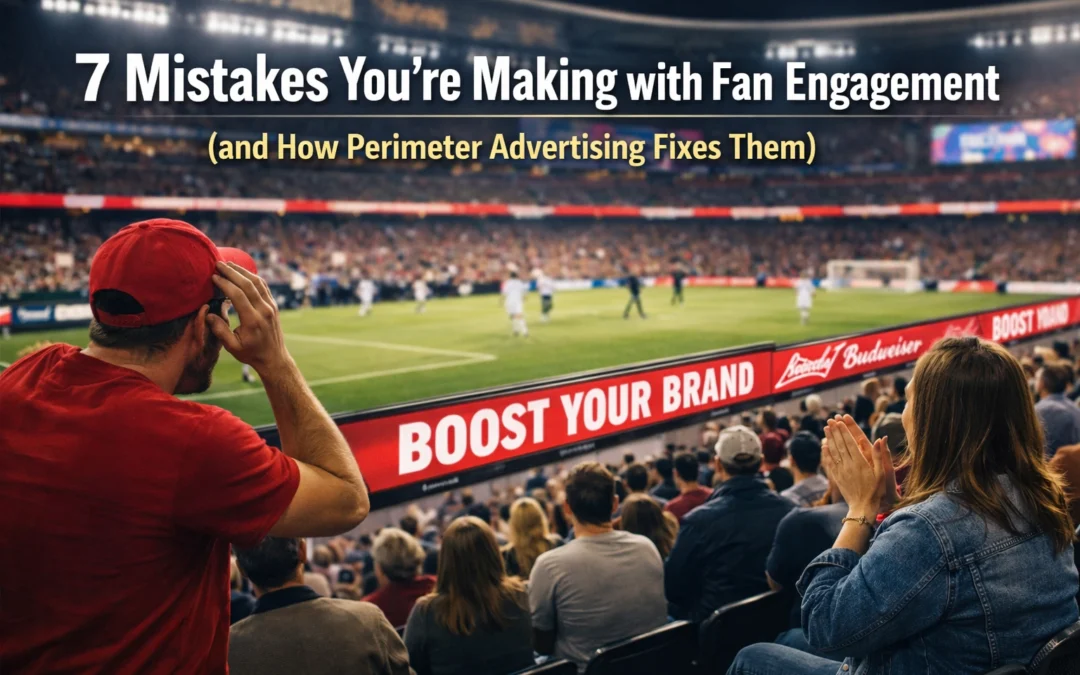
Sports marketing is an environment of high emotional stakes and massive audience fragments. While billions of dollars are poured into sponsorship and digital activations, many brands struggle to convert fan passion into measurable brand equity. Traditional methods often fail because they do not account for the specific behaviors of fans inside a stadium.
The transition from traditional static signage to digital out of home (DOOH) perimeter advertising represents a fundamental shift in how brands interact with spectators. By identifying common pitfalls in fan engagement, marketing leaders can leverage stadium technology to drive significant increases in purchase consideration and brand sentiment.
1. Broadcasting Without Interaction
The most prevalent mistake in sports marketing is treating the audience as passive spectators rather than active participants. Many campaigns focus on broadcasting a message one way, which fails to capitalize on the communal energy of a live event. Research indicates that when fans feel like participants, their connection to the brand deepens.
Perimeter advertising fixes this by serving as a visual bridge between the physical and digital worlds. Modern digital boards can display QR codes, social media handles, or live polling results that encourage fans to use their mobile devices to interact with the brand in real time. This transforms a static message into a two way conversation. By integrating perimeter displays with mobile engagement, brands can move beyond simple visibility and toward active participation.

2. Ignoring the Reality of the Second Screen
Over 85% of sports fans interact with a mobile device while watching a game. Many marketers view this as a distraction to be fought, rather than an opportunity to be seized. The mistake lies in creating stadium ads that exist in a vacuum, completely disconnected from what is happening on the fan's phone.
Perimeter advertising addresses the second screen phenomenon by providing a high impact visual anchor. When a brand dominates the perimeter of the field, it remains in the peripheral vision of the fan even when they are looking down at a mobile device. Furthermore, programmatic DOOH allows for synchronized campaigns where the stadium display prompts a specific action on a mobile app. This creates a cohesive ecosystem where the physical environment and the digital experience work in tandem rather than competing for attention.
3. Relying on Generic, Non-Personalized Messaging
Treating a crowd of 50,000 people as a single demographic is a missed opportunity for relevance. Current data shows that approximately 76% of sports fans have no identifiable data linked to their stadium presence. This makes personalization difficult for organizations that rely solely on email or ticketing data.
Perimeter advertising, particularly through programmatic DOOH, allows brands to tailor content based on real time variables. Messaging can change based on the score of the game, the weather, or even the specific phase of the event (pre game, halftime, or overtime). This level of contextual relevance ensures that the creative feels "in the moment" rather than pre recorded and generic.
4. Over-Reliance on Rented Social Media Space
While social media is a powerful tool, it represents "rented space" where algorithms dictate reach and visibility. Many brands make the mistake of building their entire fan engagement strategy on platforms like Instagram or X, where they are subject to constant policy changes and noise from competitors.
In contrast, perimeter advertising offers a dominant physical presence that cannot be skipped or scrolled past. Within the stadium, the brand owns the visual landscape. Strategic placement on digital perimeter boards ensures that the brand is captured in every broadcast angle and fan photo shared on social media. This effectively turns the fans' social media accounts into a secondary distribution channel for the brand's physical presence. Successful campaigns, such as Nike’s NYC Marathon strategy, demonstrate how a brand can dominate a space and capture mindshare without being the primary official sponsor.

5. Neglecting Real-Time Cultural Context
Fans invest emotionally in their teams. A common mistake is running a "happy" or "energetic" ad immediately after a devastating play or a controversial call. When brand messaging is out of touch with the emotional tone of the crowd, it creates a sense of inauthenticity.
Digital perimeter advertising allows for immediate creative adjustments. If a game enters a high tension moment, the advertising can shift to a minimalist or supportive tone. This agility ensures that the brand remains aligned with the cultural climate of the venue. Detailed execution of dynamic creative optimization allows brands to react to on field events within seconds, maintaining a seamless emotional connection with the audience.
6. Absence of Data-Driven ROI Tracking
A significant portion of sports advertising spend is still allocated based on "gut feeling" or historical precedent rather than hard data. Organizations often deploy content without a clear framework for measuring how that content resonates with the audience. This leads to wasted spend and missed opportunities for optimization.
Perimeter advertising through OOH Sports provides a more rigorous approach to measurement. By using mobile location data and device ID tracking, brands can measure the lift in purchase consideration and brand image following exposure to stadium ads. For example, White Claw’s programmatic campaign achieved a 74% lift in purchase consideration by utilizing targeted DOOH. Similarly, brands like AB InBev have seen a 119% lift in positive brand image by moving toward data driven stadium placements.
7. Ignoring the Synergy of Traditional and Digital
Many marketers treat stadium ads as "old school" and social media as "new school," leading to a fragmented strategy. The mistake is failing to see how traditional stadium assets have evolved into sophisticated digital platforms.
Perimeter advertising now functions as a high performance digital asset. It combines the massive reach of traditional out of home media with the targeting and measurement capabilities of digital advertising. As the industry moves toward a projected $50 billion sports advertising market by 2030, the integration of these channels will be the primary differentiator for successful CMOs.

Strategic Implementation for Creative Directors
For creative directors, the challenge is to design for a medium that is both high impact and peripheral. Perimeter advertising requires a specific design hierarchy:
- High Contrast Visuals: Because the boards are located at ground level, they must stand out against the green of the grass or the court's surface.
- Short, Impactful Copy: Fans have a limited attention span during play. Messaging must be digestible in under three seconds.
- Dynamic Triggers: Creative should be developed in "states" that can be triggered by game data (e.g., a "Goal" state, a "Timeout" state, or a "Victory" state).
By moving away from static images and toward dynamic, data driven creative, brands can ensure their perimeter advertising is not just background noise but a core component of the fan experience.
The ROI of Integrated Perimeter Advertising
The shift to programmatic DOOH on the perimeter allows for a level of accountability previously unavailable in sports marketing. Brands can now compare the ROI of programmatic DOOH versus traditional stadium ads to see exactly where their spend is most effective.
By avoiding the common mistakes of broadcasting in a vacuum, ignoring the second screen, and failing to use data, brands can leverage OOH Sports to create a modern fan engagement strategy. The perimeter of the field is no longer just a place for a logo. It is a high tech interface for connecting with fans at the height of their emotional journey.

Strategic marketing leaders who recognize these shifts will be best positioned to capture a share of the growing sports advertising market. The focus must remain on authenticity, real time relevance, and measurable outcomes to turn stadium spectators into lifelong brand advocates. For more information on how to implement these strategies, visiting the OOH Sports marketing page provides further insight into the technology driving these results.