
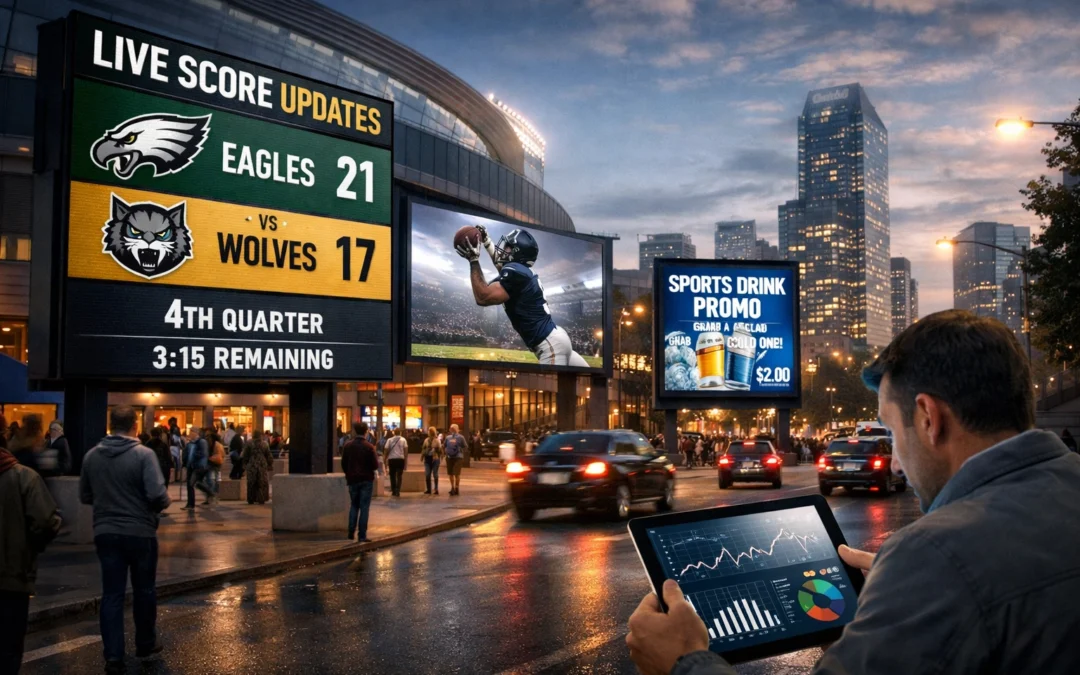
The landscape of sports advertising is undergoing a fundamental shift as static billboards give way to data-driven, responsive installations. In a market where fan attention is highly fragmented, the ability to deliver relevant messaging in the physical world is becoming a primary differentiator for major brands. Digital Out-of-Home (DOOH) advertising has transitioned from a passive medium to an active, real-time participant in the sports ecosystem. This evolution is driven by the integration of sophisticated data feeds and programmatic technology, allowing sports brands to communicate with precision.
The Evolution of Sports Visibility
Traditional out-of-home advertising relied on long lead times and static creative that remained unchanged for weeks or months. For sports brands, this approach often resulted in missed opportunities. A campaign featuring a star athlete might become irrelevant due to an injury, or a promotion for a championship game might lose its impact once the final whistle blows. Real-time data integration solves these challenges by synchronizing messaging with the actual events taking place on and off the field.
Sports fans are characterized by their high level of emotional investment and their tendency to consume content in real-time. Whether they are at the stadium, traveling through transit hubs, or gathering at local bars, their attention is focused on the immediate. By leveraging live data, OOH Sports enables brands to tap into these moments of peak engagement. Research indicates that sports-focused DOOH can drive more than 47 percent immediate brand usage, demonstrating how contextual placement and emotional relevance shape consumer behavior in the real world.

Strategic Implementation of Real-Time Data
The effectiveness of modern DOOH lies in its ability to react. This is achieved through the use of dynamic creative triggers. These triggers are programmed to change the content of an advertisement based on specific data inputs without requiring manual intervention.
Live Score Updates and Match Outcomes
One of the most effective uses of real-time data in sports marketing is the integration of live scoreboards. By connecting DOOH screens to official sports data feeds, brands can provide value to fans while maintaining high visibility. When a team scores or a match ends in an upset, the creative can update instantly to reflect the excitement. This creates a reason for consumers to look at the screen repeatedly, increasing the frequency of brand exposure.
Contextual Triggers: Weather and Time
Beyond the game itself, external factors play a significant role in consumer decision making. For instance, a sports apparel brand might trigger advertisements for rain gear when local weather stations report a downpour near a stadium. Similarly, beverage brands can adjust messaging based on the time of day or the temperature. This level of granularity ensures that the advertising is always helpful and never intrusive.

Quantifiable Impact on Brand Sentiment
The move toward smarter insights is not merely a matter of aesthetics. It is a strategic choice backed by significant performance metrics. When advertising reflects the current reality of the consumer, brand favorability increases.
In recent years, programmatic DOOH campaigns have demonstrated a consistent ability to move the needle on key performance indicators. For example, a campaign for Mike’s Hard Iced Tea saw a 119 percent lift in positive brand image by utilizing programmatic DOOH to reach consumers in relevant environments. You can view the details of that execution at https://oohsports.com/2024/10/21/ab-inbevs-mikes-hard-iced-tea-sees-a-119-lift-in-positive-brand-image-with-programmatic-dooh-campaign.
The success of these campaigns is often tied to the "recency effect." By reaching a consumer shortly before a purchase decision, such as near a retail outlet or a stadium entrance, brands can capitalize on the mental availability created by the real-time nature of the ad. This is particularly effective for high-velocity categories like beverages, snacks, and sports betting.
Technological Infrastructure and Programmatic Scale
The backbone of real-time DOOH is programmatic technology. This allows for the automated buying and selling of ad space, similar to how digital display ads operate. However, in the OOH space, this technology is combined with physical locations that offer high-impact, unskippable visibility.
The Role of Programmatic DSPs
Demand-Side Platforms (DSPs) are essential for managing real-time campaigns across multiple markets. These platforms allow marketers to set specific parameters for when and where their ads should appear. For example, the use of the StackAdapt DSP has been instrumental in driving adoption of programmatic DOOH by offering omnichannel capabilities. This ensures that the message a fan sees on a billboard in New York City is consistent with the digital ads they see on their mobile devices. More information on these capabilities can be found at https://oohsports.com/2025/02/21/spotlight-on-stackadapt-dsp-driving-programmatic-dooh-adoption-in-omnichannel-campaigns.
Automated Data Feeds
To maintain the "real-time" aspect, OOH Sports utilizes automated data feeds that update content continuously. This technology manages the logistics of refreshing creative across thousands of screens simultaneously. This is a significant leap forward from traditional methods, where a change in creative would require physical replacement or manual uploads to individual network players.

Case Studies in High Performance
The transition to smarter DOOH insights is proven by the results seen across various sports and lifestyle sectors. These case studies highlight the versatility of the medium when combined with precise data targeting.
White Claw: Driving Purchase Consideration
White Claw utilized programmatic DOOH to launch a new vodka product, achieving a 74 percent lift in purchase consideration. By targeting specific geographic areas and utilizing data to optimize screen selection, the brand was able to penetrate a competitive market effectively. The full analysis of this campaign is available at https://oohsports.com/2024/09/21/white-claws-programmatic-digital-out-of-home-campaign-drives-74-lift-in-purchase-consideration-for-vodka-launch.
Sea-Doo: Reaching the Outdoor Enthusiast
In its first digital OOH campaign, Sea-Doo targeted outdoor enthusiasts by placing ads in locations where their target demographic was most likely to be active. The result was a 144 percent increase in purchase consideration. This success demonstrates that even for high-consideration purchases like recreational vehicles, the visibility provided by DOOH is a powerful tool for moving consumers through the sales funnel. Detailed results are hosted at https://oohsports.com/2024/11/21/how-sea-doos-first-digital-ooh-campaign-increased-purchase-consideration-by-144.
Strategic Placement and the Fan Journey
Understanding the fan journey is critical for effective DOOH. Real-time data allows brands to intervene at the most influential moments of this journey.
- Pre-Game Anticipation: Screens in transit hubs and on commuter routes capture fans as they head toward the venue. Messaging here can focus on excitement and preparation.
- At the Venue: Utilizing high-impact screens like Sportrons within or around stadiums ensures the brand is part of the live experience. Information on Sportrons technology is available at https://oohsports.com/sportrons.
- Post-Game Celebration or Commute: As fans leave the venue, their emotional state is high. This is an ideal time for retailers or quick-service restaurants to push limited-time offers to a hungry, mobile crowd.
By mapping data triggers to these specific phases, a campaign becomes a narrative that follows the consumer, rather than a single, isolated impression.

Future-Proofing the Sports Marketing Mix
The trajectory of the industry suggests that the reliance on real-time data will only increase. Projections indicate that DOOH sports advertising will hit 50 billion dollars by 2030. To capture a share of this growth, brands must move beyond static strategies. Strategic insights into these future trends can be explored at https://oohsports.com/2025/03/29/dooh-sports-advertising-will-hit-50-billion-by-2030-7-strategies-to-capture-your-share.
Smarter DOOH insights also allow for better ROI comparison. When compared to traditional stadium sponsorships or static billboards, programmatic DOOH often delivers better ROI due to its flexibility and reduced waste. Marketers can shift budgets in real-time to the screens that are performing best, a level of agility that was previously impossible in out-of-home advertising. An in-depth comparison of these models is available at https://oohsports.com/2025/04/30/programmatic-dooh-vs-traditional-stadium-ads-which-delivers-better-roi-for-sports-marketing-2.
Conclusion: The Necessity of Relevance
In the modern advertising environment, relevance is the ultimate currency. For sports brands, relevance is tied to the clock, the scoreboard, and the atmosphere of the game. Real-time data provides the bridge between the digital world of sports statistics and the physical world of consumer movement.
By integrating smarter insights into their DOOH strategies, brands can ensure their messaging is not just seen, but felt. The transition from general awareness to immediate brand action is fueled by the data that defines the sports experience. As technology continues to evolve, the brands that successfully harness these real-time insights will be the ones that stay ahead of the competition and resonate most deeply with the modern sports fan. For those ready to implement these strategies, more information on launching rapid-response campaigns can be found at https://oohsports.com/2025/05/01/how-to-launch-real-time-sports-betting-dooh-campaigns-that-convert-in-under-24-hours.