
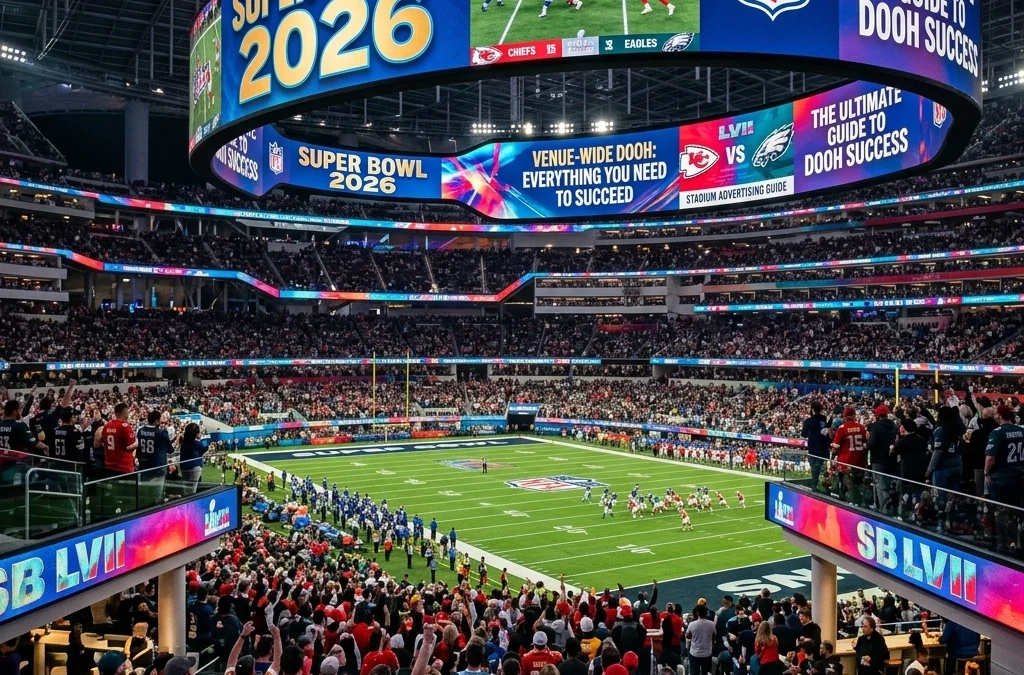
Super Bowl LX has arrived at Levi's Stadium in Santa Clara, California, marking one of the most significant marketing milestones of the decade. For advertisers looking to capture attention in 2026, the landscape has shifted toward high impact, venue wide digital out-of-home (DOOH) strategies. While the televised broadcast remains a staple, the real world environment surrounding the stadium offers a unique opportunity for brands to connect with fans in a physical, unskippable way.
OOH Sports has spent 40 years leading the industry in sports advertising. This experience has shown that success at major events requires more than just a single billboard. It requires a comprehensive approach that covers every touchpoint of the fan journey, from the moment they land at the airport to the second they step onto the stadium floor.
Forty Years of Advertising Leadership
The evolution of sports marketing has been dramatic over the last four decades. OOH Sports has navigated the transition from static vinyl boards to the sophisticated, programmatic digital displays used today. This deep history provides a unique perspective on what actually drives consumer behavior during high pressure events like the Super Bowl.
Leadership in this space is defined by the ability to secure premium placements and integrate new technologies. In 2026, this means utilizing data driven targeting and real-time creative updates. Brands are no longer restricted to a single message for the entire weekend. Instead, they can adapt to the energy of the crowd and the events unfolding on the field.

The Venue-Wide Coverage Strategy: From Floors to Billboards
A venue wide DOOH strategy ensures that a brand remains at the forefront of the fan experience. This involves a multi layered approach that utilizes different formats for different purposes.
- High-Impact Billboards: Large format displays on major highways leading to Santa Clara build massive awareness. These serve as the "broad strokes" of a campaign, reaching fans, locals, and commuters.
- Transit and Hub Exposure: Digital screens in transit shelters and airport terminals capture fans during the "dwell time" of their journey.
- Floor Graphics and Interior Kiosks: Once inside the stadium perimeter, eye level digital kiosks and innovative floor graphics provide a high frequency of touchpoints.
- Retail and Hospitality Zones: Placements in nearby shopping centers and fan zones target consumers when they are in a "buying" mindset, whether they are grabbing gear or food.
The following video showcases the scale and impact of these venue-wide activations:
https://www.youtube.com/watch?v=l6J-0zileKE
A Cost-Effective Alternative to Official Sponsorships
One of the most compelling reasons to choose DOOH for Super Bowl 2026 is the significant cost advantage. Official stadium sponsorships and 30-second television spots have reached record highs, with TV ads often exceeding $10 million.
Research indicates that perimeter DOOH advertising costs approximately 80% less than official sponsorships. This allows brands to achieve a massive presence without the prohibitive entry costs of traditional "official" partner status. By leveraging programmatic DOOH, brands can bid on specific time slots and locations, ensuring that every dollar spent is optimized for maximum exposure.

Programmatic Precision and Real-Time Optimization
The technology behind marketing in 2026 allows for a level of precision that was previously impossible. Programmatic DOOH enables advertisers to buy screens based on audience data, such as "sports enthusiasts" or "luxury shoppers."
One of the most powerful tools in the 2026 playbook is real-time creative optimization. Brands can swap messaging instantly based on live game scores, weather conditions, or social media trends. This dynamic capability leads to significantly higher ad recall. In fact, street level digital presence has been shown to achieve up to 84% ad recall among stadium goers.
Measuring Success with Data
In the past, out-of-home advertising was often criticized for a lack of measurable data. Today, OOH Sports utilizes advanced attribution methods to prove the value of every campaign.
- Device ID Passback: By identifying mobile devices that have been exposed to a DOOH screen, brands can retarget those same users on their phones later. This creates an omnichannel experience that drives fans from the physical world to a digital conversion.
- Brand Lift Studies: These studies quantify how a campaign has changed consumer perception or purchase intent.
- Foot Traffic Attribution: Measuring how many people visited a specific retail location after seeing a DOOH ad.
For example, a programmatic DOOH campaign for White Claw saw a 74% lift in purchase consideration. Similarly, Sea-Doo increased purchase consideration by 144% through targeted digital OOH efforts. These results demonstrate that a well executed DOOH strategy is a full funnel marketing victory.

Strategic Objective and Execution
The primary objective for any Super Bowl campaign is to stand out in a crowded marketplace. The strategy used by OOH Sports focuses on "format diversity." This means combining massive awareness building displays with targeted, eye level activations.
Logistics and Targeting:
Execution begins months in advance by securing key inventory along the most traveled routes to Levi's Stadium. In 2026, the focus is on the SoFi Stadium complex and surrounding Santa Clara hubs. The targeting parameters are refined using historical fan data and real-time movement patterns.
Technology Partners:
By collaborating with leading programmatic platforms, OOH Sports ensures that ads are served at the optimal moment. This technology allows for "bid shading" and budget pacing to ensure the campaign remains active throughout the entire Super Bowl weekend, not just during the game itself.

The Impact of Eye-Level Digital
While the massive highway billboards provide the "wow" factor, the eye level digital kiosks and sportrons are what drive action. These screens are located where fans stop, talk, and congregate. Because these displays are at eye level, they feel more personal and engaging.
Brands like AB InBev have seen a 119% lift in positive brand image by using these types of programmatic DOOH campaigns. The key is to blend high impact storytelling with the precision of digital targeting.
Planning for the Future
The success of Super Bowl 2026 serves as a blueprint for all future major sporting events. Whether it is a holiday shopping season in New York City or a championship game in California, the principles of venue wide coverage remain the same.
OOH Sports continues to push the boundaries of what is possible in the advertising world. With 40 years of experience and a commitment to the latest technology, the company remains the top choice for brands that want to dominate the physical space of the world's biggest stages.
For more information on how to leverage these strategies for your next campaign, visit the OOH Sports blog or explore our case studies. If you are ready to start planning, you can contact us today to discuss your vision.
The Super Bowl is more than just a game. It is the ultimate platform for brand storytelling. By using venue wide DOOH, brands can ensure they are not just part of the conversation, but the center of it.
Detailed information regarding company policies can be found at our terms of service and privacy policy pages. OOH Sports is dedicated to maintaining the highest standards of integrity and performance in the advertising industry.