
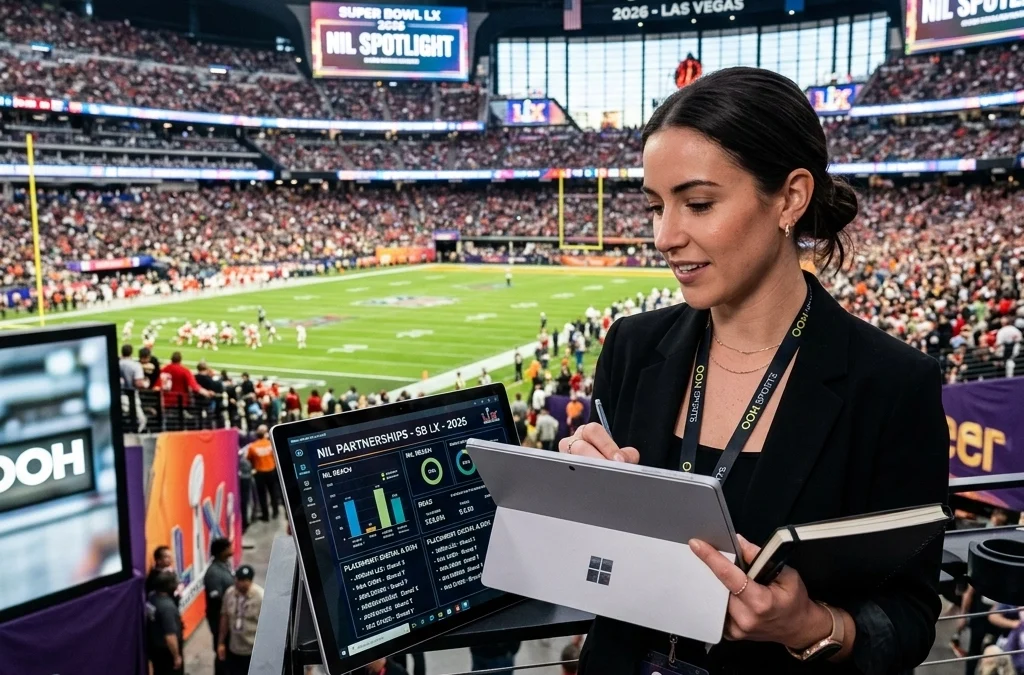
The landscape of sports advertising shifted significantly during the 2026 Super Bowl. While traditional 30-second television spots remained a fixture for legacy brands, media buyers increasingly pivoted toward Name, Image, and Likeness (NIL) strategies to capture a more fragmented and digitally active audience. The cost of a single television commercial exceeded 7 million dollars, prompting a migration toward more agile, data-driven alternatives.
Success in the 2026 cycle was not defined by a single high-production moment. Instead, it was defined by the ability to orchestrate thousands of authentic voices across multiple platforms simultaneously. This guide outlines the blueprint used by top-tier media buyers to master NIL during the largest sporting event of the year.
The Strategic Shift to 20,000 Voices
The primary advantage of the OOH Sports NIL platform is scale. Traditional celebrity endorsements often rely on a single persona to carry a brand message. In contrast, the 2026 strategy leveraged over 20,000 student-athletes. These athletes provide something a global superstar often lacks: local authenticity and high peer-to-peer engagement.
When a student-athlete from a major university posts about a brand, the engagement is often 3 to 5 times higher than that of a professional athlete with millions of followers. This is due to the relatability of the creator. For media buyers, this meant shifting budget away from a single "all-or-nothing" talent deal and distributing it across a massive network of micro-influencers. This approach mitigates risk and ensures that the brand message permeates various regional and demographic niches simultaneously.
Phase 1: The Pre-Game Build (Mid-January)
Expert media buyers did not wait for February to begin their campaigns. The "Pre-Game Positioning" phase began roughly four weeks before kickoff. The objective during this period was to build warm audiences and establish retargeting pools at a fraction of the cost of game-day traffic.
During this phase, student-athletes shared narrative-driven content. This included training sessions, preparation routines, and "Road to the Championship" vlogs. By the time Super Bowl Sunday arrived, the audience was already familiar with the brand through these organic stories. This phase focused on:
- Social Listening: Using the NIL platform to identify which athlete segments were generating the most organic buzz.
- Audience Priming: Releasing teaser content that encouraged fans to follow the brand’s "Game Day Takeover."
- Cost Efficiency: Buying impressions in mid-January is significantly cheaper than competing for the same eyes during the week of the game.
Strategic planners recognized that traditional stadium sponsorships were often overpriced for the reach they provided. Many shifted budgets toward digital avenues, as seen in the discussion on why traditional stadium sponsorships may no longer deliver the same value.
Phase 2: Game Day and Second-Screen Dominance
Statistics from the 2026 Super Bowl show that over 70% of viewers engaged with a second screen, typically a smartphone, while the game was in progress. This behavior created a massive opportunity for NIL-driven engagement. While the TV screen showed the game, the second screen was where the conversation happened.
Media buyers used the NIL platform to deploy real-time reactions. As significant plays occurred, student-athletes across the country posted unscripted, authentic reactions to their feeds. This created a "surround sound" effect for the brand. Fans felt like the brand was part of the community, reacting to the game alongside them.

The agility of NIL creators allowed brands to pivot instantly. If a specific moment went viral, thousands of athletes could be activated to join the trend within minutes. This level of speed is impossible with traditional commercials, which require months of legal and creative approvals. The integration of video content was a key component of this real-time strategy.
https://www.youtube.com/watch?v=l6J-0zileKE
The Digital-Physical Handshake
The most successful campaigns in 2026 did not stop at social media. They utilized a "Digital-Physical Handshake," combining NIL influencer content with programmatic digital out-of-home (DOOH) advertising. This allowed brands to follow the consumer from their home to the fan zones, and eventually to the vicinity of the stadium.
By using geographically targeted DOOH, media buyers could display athlete content on screens near primary venues and gathering points. This created a cohesive brand experience. A fan might see a student-athlete's post on Instagram in the morning and then see that same athlete on a digital billboard outside the stadium in the afternoon. This synergy has been shown to increase purchase consideration significantly. For instance, brands have seen a 74% lift in purchase consideration by using similar multi-channel tactics.
Phase 3: Post-Game Saturation and ROI Extension
One of the biggest mistakes in sports marketing is stopping the campaign as soon as the trophy is hoisted. The 2026 blueprint included a "Post-Game Saturation" phase that lasted for two weeks following the event. This phase focused on extending the ROI of the initial spend.
Athletes shared recap content, "best of" reels, and post-game celebrations. This was also the prime time for direct-to-consumer (DTC) offers. By using athlete-specific promo codes and tracked links, media buyers could attribute sales directly to the NIL campaign. The emotional high of the game’s conclusion provided a fertile ground for conversion.

Data-Driven Talent Selection
The selection process for the 20,000 athletes was not random. It was driven by granular metrics. Media buyers focused on "fit over followers." The OOH Sports platform allowed for the evaluation of:
- Engagement Rates: Prioritizing athletes who actually move their audience to action rather than those with inflated follower counts.
- Geographic Influence: Ensuring a strong presence in both the host city and the home markets of the competing teams.
- Audience Sentiment: Aligning brand values with the athlete’s personal brand to ensure authenticity.
This analytical approach ensures that every dollar spent is optimized for reach and impact. The rise of these strategies is part of a larger trend where sports advertising is projected to reach massive valuations by 2030.
Measuring the NIL Impact
Unlike traditional television advertising, where reach is often estimated using broad ratings, NIL and DOOH provide precise data. In 2026, media buyers utilized AI-powered analytics to track device IDs exposed to both digital ads and social content. This allowed for a clear view of the "Fan-Centric" journey.
The results from these integrated campaigns often outperformed traditional stadium ads. Analysis shows that programmatic DOOH can deliver better ROI by targeting fans where they actually spend their time and attention, rather than relying on a static perimeter board.

Critical Factors for Future Success
To master NIL at the Super Bowl or any major sporting event, media buyers must adhere to a few non-negotiable rules:
- Authenticity is King: The content must feel native to the athlete’s channel. Over-produced, corporate-style videos tend to underperform in an NIL context.
- Timing is Everything: Start early and stay late. The game day is just one part of a multi-week narrative.
- Scale is Necessary: To compete with the noise of a $7 million TV spot, you need the volume of 20,000 voices. A few dozen influencers are not enough to move the needle on a national scale.
- Integrate the Physical and Digital: Use DOOH to reinforce the digital message and create a physical presence in the real world.
The 2026 Super Bowl proved that the most effective way to reach the modern sports fan is through the voices they already trust. By leveraging a massive network of student-athletes and supporting that reach with smart, programmatic advertising, media buyers can achieve a level of engagement and ROI that traditional methods simply cannot match.
As the industry moves forward, the reliance on these distributed, authentic networks will only grow. The blueprint is now established. The question for media buyers is no longer whether to use NIL, but how to scale it effectively for the next big kickoff.