
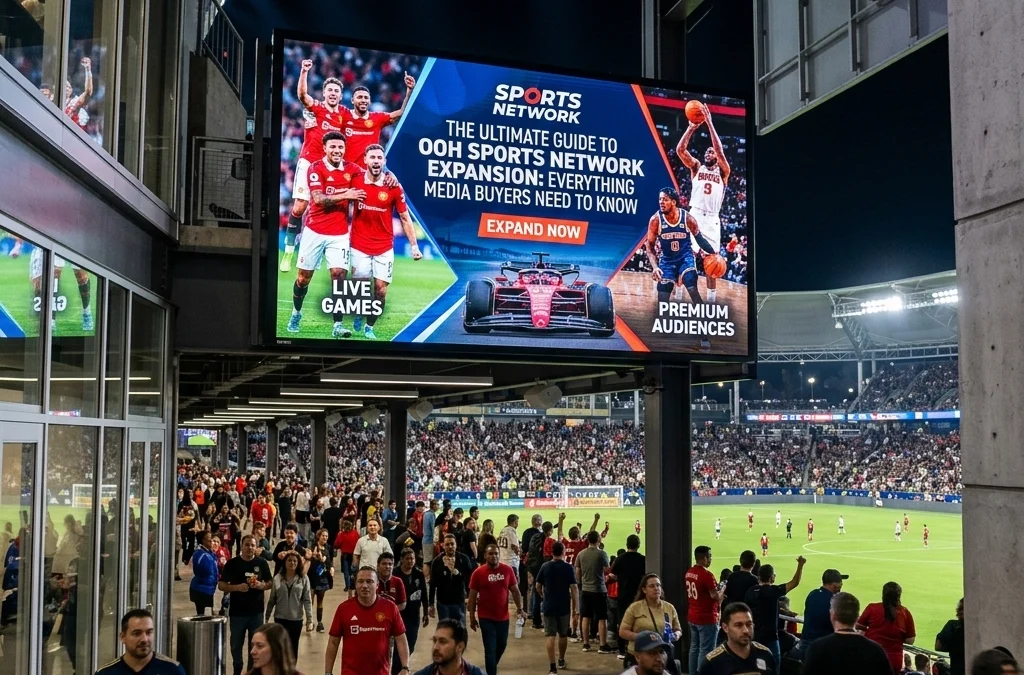
The landscape of sports advertising is undergoing a fundamental transformation. What was once a market dominated by multi-million dollar stadium naming rights and static billboards has evolved into a high-precision digital ecosystem. The expansion of the OOH Sports network marks a significant milestone in this evolution, providing media buyers with unprecedented access to sports fans through a network that now encompasses more than 25,000 digital screens nationwide.
This expansion represents more than just a localized increase in inventory. It signifies a strategic shift in how brands can interact with consumers during high-engagement sports moments. For media buyers, the growth of this network offers a scalable solution to reach targeted audiences in environments where attention is naturally high and the consumer mindset is receptive to brand messaging.
The Scale and Reach of the Expanded Network
The OOH Sports network expansion has established a presence that bridges the gap between traditional home viewing and the live stadium experience. By deploying digital screens across a diverse array of venues, the network captures the "fan journey" in its entirety. The infrastructure now covers a wide variety of high-traffic locations, including sports bars, restaurants, entertainment complexes, bowling alleys, golf entertainment centers, and fitness facilities.
This geographic layering ensures that a brand’s presence is not limited to the four walls of a stadium. Instead, the network follows the fan from the gym in the morning to the sports bar in the evening. This ubiquitous presence allows for a frequency of exposure that traditional sports marketing often lacks. By placing screens in venues where fans gather to socialize and watch games, OOH Sports creates a bridge between the physical world and the digital advertising space.

Strategic Venue Positioning
The effectiveness of the OOH Sports expansion lies in the specific types of venues selected for screen placement. Each category offers a unique demographic profile and dwell time, allowing media buyers to tailor their creative strategy to the environment.
- Sports Bars and Restaurants: These locations offer the highest dwell times, often exceeding two hours during major games. The social nature of these venues makes them ideal for brands in the beverage, food delivery, and entertainment sectors.
- Fitness Facilities: Reaching fans in an active environment provides a natural alignment for health, wellness, and athletic apparel brands.
- Entertainment Complexes: Locations like bowling alleys and golf centers attract families and groups, offering a broader demographic reach beyond the core sports enthusiast.
By diversifying venue types, the network reduces the risk of audience fatigue and ensures that messaging reaches consumers in various states of mind, from the high-energy atmosphere of a viewing party to the focused environment of a workout.
Programmatic Capabilities for Media Buyers
The core of the OOH Sports network expansion is its integration with sophisticated programmatic technology. Media buyers no longer need to navigate manual insertion orders or long lead times. Through partnerships with leading demand-side platforms (DSPs), such as the StackAdapt DSP, inventory can be purchased and optimized in real time.
This programmatic approach allows for a level of agility previously unseen in out-of-home advertising. Campaigns can be launched, paused, or adjusted based on live triggers. If a specific team wins a game or a certain player hits a milestone, creative can be updated across the entire 25,000-screen network almost instantly. This real-time capability ensures that brand messaging remains relevant to the immediate context of the sports world.
Precision Targeting and Audience Layering
The expanded network offers media buyers a suite of targeting tools designed to minimize waste and maximize impact. Rather than a "spray and pray" approach, campaigns can be fine-tuned using several key parameters:
- Geographic Targeting: Media buyers can select inventory down to the specific ZIP code or venue level, allowing for hyper-local activations around specific stadiums or retail locations.
- Dayparting: Ad delivery can be scheduled to coincide precisely with game times, pre-game shows, or post-game celebrations when fan engagement is at its peak.
- Venue Filtering: Brands can choose to appear only in specific types of venues, such as high-end golf clubs or popular sports bar franchises, to ensure brand safety and alignment.
- Audience Demographics: By layering mobile device data and location analytics, the network can provide insights into the types of consumers frequenting specific venues, allowing for more accurate persona targeting.
This level of precision is why many media planners are shifting budgets toward digital out-of-home. For a deeper look at this shift, research shows that 67% of media planners are shifting budgets by 2026 to capitalize on these technological advancements.

Enhancing ROI through Measurable Outcomes
One of the historical challenges of out-of-home advertising was the difficulty of measurement. The OOH Sports expansion addresses this by utilizing data-driven attribution models. Media buyers can now track the effectiveness of their campaigns through brand lift studies, foot traffic attribution, and purchase consideration metrics.
The impact of this measurement-first approach is evident in recent campaign results across the industry. For instance, White Claw’s programmatic campaign saw a 74% lift in purchase consideration, while other brands have seen even higher engagement levels. By providing clear data on how many "eyes" were on a screen and what those consumers did afterward, the network offers a level of accountability that justifies increased investment.
Use Cases for High-Impact Categories
The OOH Sports network expansion serves a wide range of industries, each finding unique ways to leverage the scale of 25,000 screens.
- Sports Betting: With the legalization of sports betting in various regions, platforms can use real-time triggers to display live odds and promotional offers directly to fans while they are watching the game.
- Automotive: Manufacturers use the high-definition screens to showcase vehicle features during breaks in play, reaching a demographic that over-indexes for automotive interest.
- Consumer Goods: Quick-service restaurants can trigger ads based on game scores, such as offering a "winning team" discount code that is only valid for a few hours after a game ends.
These use cases highlight the flexibility of the network. It is not just a place for an ad; it is a platform for a dynamic, context-aware marketing strategy.
Comparing Network Expansion to Traditional Stadium Ads
A critical consideration for media buyers is the cost-benefit analysis of the OOH Sports network versus traditional stadium sponsorships. While stadium ads offer high prestige, they often come with high entry costs and limited flexibility. In contrast, the OOH Sports digital network provides a more efficient entry point with higher frequency and better targeting.
The debate of programmatic DOOH vs. traditional stadium ads is increasingly leaning toward digital solutions. The ability to reach fans in 25,000 locations provides a cumulative reach that often exceeds the capacity of a single stadium, all while maintaining the ability to optimize the campaign on the fly.

Future-Proofing the Sports Marketing Mix
The growth of the OOH Sports network is a response to the increasing demand for automation and data in the advertising industry. As the sector moves toward a projected 50 billion dollar valuation by 2030, the infrastructure provided by this expansion ensures that media buyers have the tools necessary to compete in a crowded market.
The move toward an evergreen, digital-first approach allows brands to maintain a consistent presence in the lives of sports fans without being tied to a single season or a single event. The expansion of the OOH Sports network provides the scale, the technology, and the strategic venue placement required to deliver impactful messages at the exact moment they matter most.
By focusing on the fan journey, leveraging programmatic efficiency, and insisting on measurable results, the OOH Sports network has created a new standard for sports media. For media buyers, the message is clear: the opportunity to reach fans is no longer confined to the arena. It is happening everywhere fans gather, and with 25,000 screens, the network is ready to deliver.