
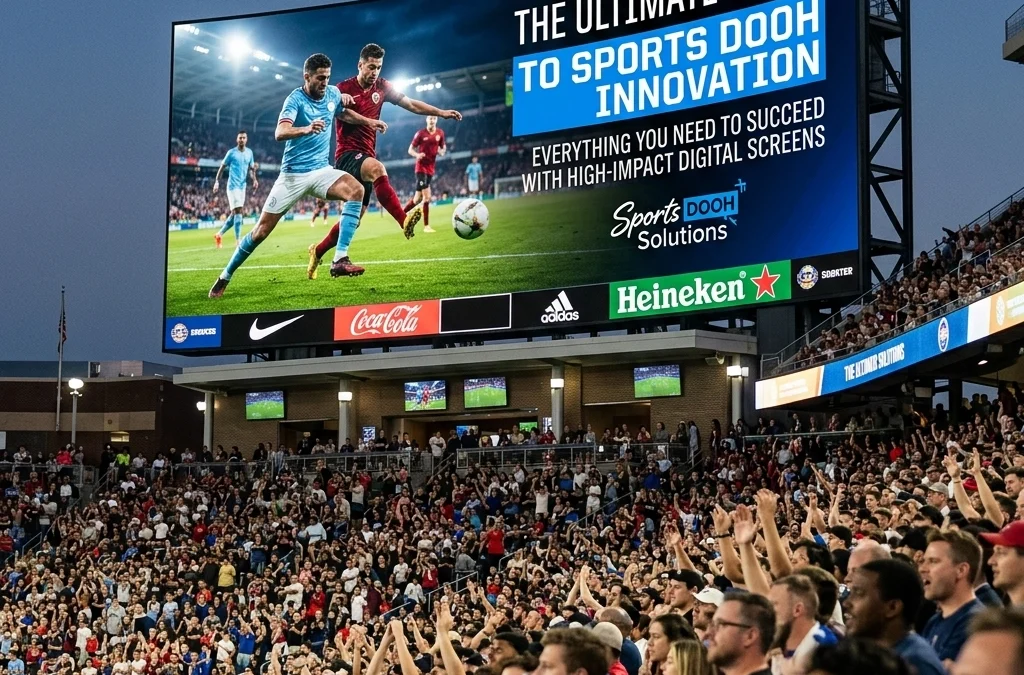
Sports marketing is undergoing a significant transformation. The era of static, one size fits all billboards is giving way to a more sophisticated, data-driven approach. Digital Out-of-Home (DOOH) advertising has emerged as a powerhouse for brands looking to connect with passionate fans. This guide explores the innovations driving this shift and provides the strategic framework media buyers and brand managers need to achieve high-impact results.
The Evolution of Sports Advertising
Historically, sports advertising relied on heavy investments in stadium sponsorships and traditional television spots. While these methods offer broad reach, they often come with high entry costs and limited flexibility. Modern sports DOOH changes the equation by combining the massive scale of traditional out-of-home media with the precision and agility of digital technology.
Innovation in this space is no longer just about moving pictures on a screen. It is about context, relevance, and timing. Brands now have the ability to launch campaigns that react to real-time events, such as a last-minute goal or a change in weather conditions near the stadium. This level of responsiveness ensures that the advertising remains a relevant part of the fan experience rather than an interruption.

Why High-Impact Digital Screens Outperform Traditional Media
The primary advantage of DOOH in a sports context is its unblockable nature. In an age where digital fatigue is common and ad-blockers are standard on most personal devices, large-scale digital screens provide a refreshing and unavoidable canvas.
Attentive and Passionate Audiences
Fans attending a sporting event or gathering at a sports bar are in a high-state of emotional engagement. Research indicates that consumers are more likely to remember brand messaging when it is delivered during these peak emotional moments. High-impact digital screens capitalize on this by placing brand messages in environments where the audience is already focused and excited.
Immunity to Ad-Blockers
Unlike social media or web advertising, DOOH cannot be skipped or scrolled past. It exists in the physical world, commanding attention through sheer scale and vibrant creative. When positioned strategically in high-traffic areas like transit hubs, stadium perimeters, and fan zones, these screens ensure consistent visibility.
Contextual Relevance
Digital screens allow for dynamic creative optimization (DCO). This technology enables brands to swap creative assets instantly based on external triggers. For example, a beverage brand might display an ad for a cold drink when the temperature rises above eighty degrees, or a sports betting platform might update live odds as a game progresses.

Strategic Implementation: The Fan Journey
Successful sports DOOH campaigns look beyond the four walls of the stadium. While internal placements are valuable, a comprehensive strategy considers the entire fan journey from the moment a person leaves their home to the moment they return.
The Transit Phase
The fan journey begins long before kick-off. Media buyers can target transit hubs, train stations, and airports where fans congregate. By capturing attention during the commute, brands can "prime" the audience, building brand recall that will be reinforced later in the day.
Stadium Perimeter Targeting
Targeting the area immediately surrounding a venue is often more cost-effective than an official stadium sponsorship. Digital screens in these locations reach fans as they walk to the gates, wait in lines, or celebrate at nearby bars. This approach allows brands to achieve a "surround-sound" effect, making the brand feel like a major presence without the multimillion-dollar price tag of an official partnership. Learn more about how perimeter targeting compares to traditional sponsorships.
Post-Game Reinforcement
The journey does not end when the game does. DOOH placements in high-traffic exit routes and entertainment districts allow brands to have the last word. This is an ideal time for conversion-focused messaging, such as promoting a post-game meal or a limited-time apparel discount.
The Role of Programmatic DOOH and AI
The integration of programmatic technology has revolutionized how media buyers purchase and manage sports DOOH. Programmatic DOOH (pDOOH) allows for automated buying based on specific criteria, such as audience demographics, location, and time.
Precision and Efficiency
Programmatic platforms enable brands to be highly selective about when and where their ads appear. Instead of buying a static block of time, a brand can bid on individual impressions that align with their target audience's behavior. This minimizes waste and ensures that the budget is spent on the most impactful moments.
AI-Powered Analytics
Artificial intelligence is now used to analyze fan movement patterns and engagement levels. By using anonymized device ID data, OOH Sports can help brands understand exactly how many people were exposed to a campaign and how many of those individuals later visited a store or website. This level of attribution provides the hard data necessary to justify marketing spend.

Case Studies: Quantifying Impact
The effectiveness of sports DOOH is best demonstrated through measurable outcomes. Recent campaigns across various industries have shown significant lifts in key performance indicators.
- Beverage Industry Success: A campaign for Mike's Hard Iced Tea utilized programmatic DOOH to reach fans during peak social hours. The campaign resulted in a 119% lift in positive brand image, demonstrating how digital screens can shift consumer perception in real-time. Read the full case study here.
- Product Launches: When White Claw launched its vodka line, it used DOOH to drive awareness. The campaign saw a 74% lift in purchase consideration, proving that high-impact screens are highly effective for introducing new products to a competitive market. View the White Claw results.
- High-End Consumer Goods: Sea-Doo leveraged digital out-of-home for its first major campaign in the space. The results were a 144% increase in purchase consideration, highlighting the platform's ability to drive intent for high-ticket items. Explore the Sea-Doo campaign details.
Technical Specifications and Creative Best Practices
To succeed with high-impact digital screens, the creative execution must be optimized for the medium. DOOH requires a different approach than social media or television advertising.
Visual Clarity
Screens are often viewed from a distance or while the viewer is in motion. Messaging must be concise and visually striking.
- Resolution: Content should be produced at high definition, typically 1920×1080 or higher, depending on the specific screen dimensions.
- Typography: Use bold, sans-serif fonts. Headline text should be large enough to be read from at least fifty feet away.
- Contrast: High contrast between the background and the text ensures legibility in various lighting conditions, including direct sunlight.
Motion and Duration
While motion is effective for drawing the eye, it should not be overly complex.
- Spot Length: Most DOOH spots are between ten and fifteen seconds. The core message should be delivered within the first three seconds.
- Looping: Ensure that the creative works well as a continuous loop.
- Video Codec: Use H.264 for the best balance of quality and file size.
Call to Action (CTA)
Digital screens are excellent for driving immediate action. The use of QR codes has become a standard practice, allowing fans to scan a code to enter a sweepstakes, download an app, or receive a coupon. This creates a direct bridge between the physical screen and the consumer's mobile device.

Future Outlook: Hyper-Personalization
The future of sports DOOH lies in hyper-personalization. As AI and data processing continue to evolve, screens will become even more responsive to the specific audiences standing in front of them. We are moving toward a world where a digital screen in a stadium concourse can identify the general demographic of the crowd and adjust its messaging to match their preferences in real-time.
Furthermore, the integration of 5G technology ensures that even the most high-resolution, data-heavy content can be delivered without latency. This allows for seamless live-streaming of content directly onto OOH assets, further blurring the line between the game and the advertisement.
Conclusion
The ultimate goal of sports DOOH innovation is to create a seamless connection between brands and the fans who drive the sports industry. By leveraging high-impact digital screens, programmatic buying, and real-time data, media buyers can move beyond traditional limitations and deliver campaigns that are as dynamic as the sports themselves.
Success in this space requires a strategic focus on the entire fan journey, a commitment to high-quality creative, and a data-driven approach to measurement. For those who master these elements, the rewards are clear: higher engagement, better brand recall, and a significant return on investment.
To learn more about how to capture your share of the growing sports DOOH market, visit OOH Sports.