
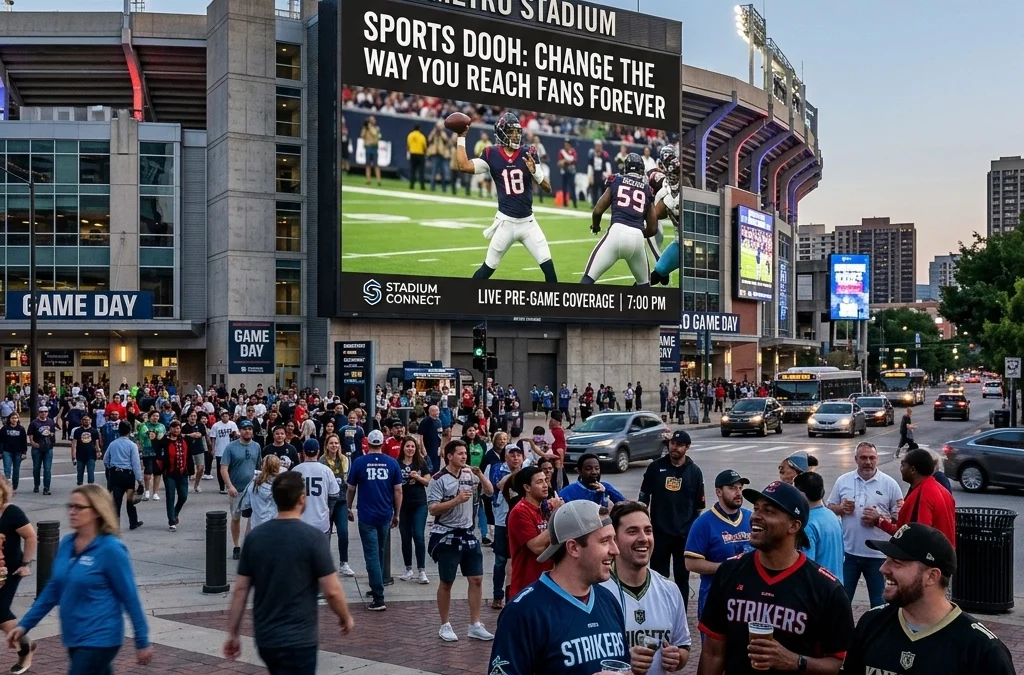
Sports marketing is no longer just about buying a thirty-second spot during the big game or putting a logo on a jersey. The way people consume sports has shifted. Fans are more mobile, more connected, and more distracted than ever before. To keep up, brands need to be where the fans are, not just where the game is being played.
This is where Digital Out-of-Home (DOOH) advertising comes in. Specifically, Sports DOOH is changing the game for media buyers and brand managers. It is a way to reach fans throughout their entire day, using high-tech screens, real-time data, and locations that matter.
At OOH Sports, we see this shift happening every day. It is about more than just a screen on a wall. It is about capturing the energy of the game and bringing it into the real world.

Reaching Fans Beyond the Stadium
For a long time, sports marketing was stuck inside the arena. If you wanted to reach a football fan, you had to be inside the stadium or on the television broadcast. But the modern fan journey starts hours before the first whistle and continues long after the final score.
A fan might start their day by grabbing a coffee, taking a train to the city, meeting friends at a sports bar, and then heading to the venue. Along that path, there are dozens of opportunities to connect with them. Sports DOOH allows brands to place ads in transit hubs, street furniture, and local gathering spots where fans congregate.
Research shows that capturing fans throughout this journey is much more effective than a single touchpoint. In fact, brands can activate these touchpoints hours before the game begins. This creates a cohesive story that follows the fan from their home to the street and finally to the seat. By the time they see an ad inside the stadium, they have already encountered the brand three or four times in the real world.
The Power of the "Un-skippable" Experience
In a world of ad-blockers and "skip" buttons, DOOH is one of the last forms of advertising that people actually look at and enjoy. You cannot skip a digital billboard when you are walking down the street or waiting for a bus.
This is especially true for sports fans. When people are in "fan mode," they are hyper-aware of their surroundings. They are looking for scores, updates, and news. When a brand provides that information through a digital screen, it is seen as a service rather than an interruption.

Statistics show that among sports fans who see out-of-home ads, a staggering 90 percent take some form of action. Whether that is searching for the brand on their phone, visiting a website, or making a purchase, the engagement is incredibly high. About 61 percent of those fans even go a step further and post about the experience on social media. This turns a single digital screen into a viral marketing opportunity.
Real-Time Data and Dynamic Creative
One of the biggest reasons Sports DOOH is a game changer is the ability to use real-time data. In the past, a billboard was a static piece of vinyl that stayed up for a month. If the team lost or the weather changed, the ad stayed the same.
With digital technology, that has all changed. Media buyers can now use dynamic triggers to update ads instantly. Imagine an ad for a cold beverage that only appears when the temperature at the stadium hits eighty degrees. Or a sportswear ad that changes its copy based on who just scored a touchdown.
This level of relevance is what makes Sports DOOH so effective. It allows brands to stay contextually relevant. If a game goes into overtime, the ads can react to that excitement. If a local hero breaks a record, the brand can be the first to congratulate them on a screen right outside the arena. This makes the brand feel like a part of the community and the conversation.
You can learn more about how these specialized screens work by checking out our page on Sportrons.
Building Brand Affinity Through Passion
Sports are emotional. People have deep, lifelong connections to their favorite teams. When a brand shows up in a sports context, some of that positive emotion rubs off on the brand.
Research indicates that 81 percent of consumers feel more positive toward brands that sponsor the sports they love. Furthermore, 66 percent are more likely to buy from those brands. This is not just about reach, it is about trust. By appearing on high-quality digital screens in and around sporting events, a brand signals that it is a serious player that supports the things the fans care about.
This "halo effect" is a powerful tool for brand managers. It is the reason why brands like Nike or White Claw invest so heavily in these spaces. They know that being part of the sports culture is a shortcut to winning over a loyal audience.

Programmatic DOOH: Making Buying Easy
One of the hurdles for out-of-home advertising used to be the complexity of buying. It involved a lot of phone calls, manual contracts, and long lead times. That is no longer the case.
Programmatic DOOH has brought the ease of online advertising to the physical world. Media buyers can now use platforms to buy screen time in real-time, just like they would buy a Facebook ad or a Google search ad. This allows for incredible flexibility. You can turn campaigns on or off based on game results or even move your budget to different cities where the "hype" is higher.
For example, platforms like the StackAdapt DSP are driving the adoption of programmatic DOOH by making it a simple part of an omnichannel campaign. This means a brand manager can manage their digital ads and their physical billboards from the same dashboard. You can read more about how this integration works in our spotlight on StackAdapt.
Proven Results in the Real World
At the end of the day, media buyers care about results. Does this actually move the needle? The data says yes.
We have seen incredible success stories across various categories. For instance, White Claw used a programmatic DOOH campaign to launch a new vodka product. By placing ads in high-traffic areas and using digital screens to reinforce their message, they saw a 74 percent lift in purchase consideration. You can dive into the details of that in our White Claw case study.
Similarly, Mike's Hard Iced Tea used DOOH to improve their brand image. Their campaign resulted in a 119 percent lift in positive brand image. These are not small numbers. They show that when you combine the power of sports with the visual impact of digital screens, people notice and they change their minds.
Other brands, like Sea-Doo, have used DOOH for the first time and seen immediate impact, with one campaign increasing purchase consideration by 144 percent. If you want to see more examples of how this works in practice, visit our case study library.

Why Sports DOOH is the Future
The world is only getting noisier. People are spending more time outside as they seek out real-world experiences like live sports. At the same time, the technology behind digital screens is getting better, cheaper, and more connected.
The combination of a high-affinity audience, "un-skippable" content, and real-time data makes Sports DOOH a must-have for any modern marketing plan. It is no longer a "nice to have" experimental budget item. It is a core strategy for reaching the most engaged people on the planet.
Whether it is a massive event like a world tournament or a local rivalry game, the fans are going to be there. They are going to be excited, they are going to be looking at screens, and they are going to be ready to act. The only question is whether your brand will be there to meet them.
If you are ready to explore how Sports DOOH can work for your brand, you can contact us to learn more about the possibilities. We are here to help you navigate the landscape and find the best way to reach your fans forever. For more insights on the latest trends, feel free to browse our blog.