
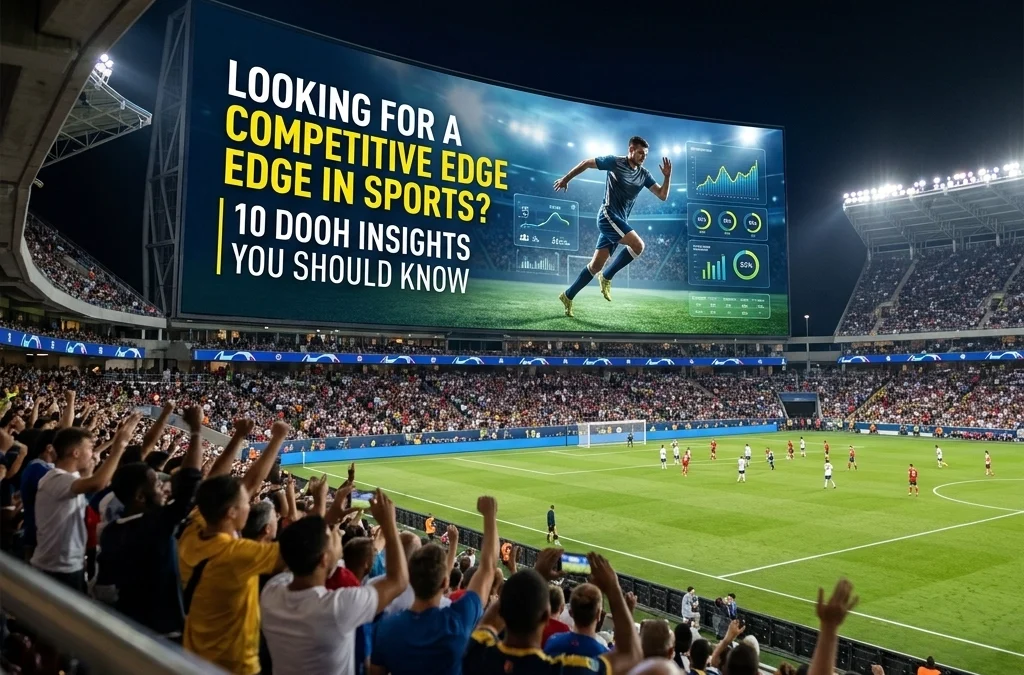
The landscape of sports marketing is undergoing a significant transformation as digital out-of-home (DOOH) advertising takes center stage. For brands seeking to connect with high-affinity sports fans, the shift from static billboards to dynamic, data-driven screens offers a clear competitive advantage. The ability to reach fans at the right moment with relevant content is no longer a luxury but a strategic necessity.
To remain competitive in an increasingly crowded media environment, advertisers must understand the nuances of modern sports advertising technology. The following insights detail the strategies and technological advancements currently shaping the industry, providing a roadmap for brands to maximize their impact and ROI.
Objective and Strategy: The Rise of Programmatic Precision
The primary objective of modern sports marketing is to bridge the gap between the digital world and the physical arena. By leveraging programmatic DOOH, brands can move beyond the limitations of traditional sponsorships. This strategy involves using automated platforms to purchase and display ads based on real-time conditions, ensuring that messaging is always contextual.
A strategic shift toward DOOH allows for a level of agility that was previously impossible. Campaigns can now be adjusted in flight, budgets can be shifted toward high-performing locations, and messaging can be synchronized with live events. This precision is what defines the current era of sports advertising at OOH Sports.
1. Dynamic Creative and Real-Time Integration
The most impactful campaigns in the sports sector utilize dynamic creative. This involves ads that change automatically based on live game data. If a specific player scores or a team takes the lead, the creative assets on a digital billboard can update instantly to reflect that event. This real-time integration ensures the brand remains a relevant part of the fan experience.
By using data triggers, advertisers can display live scores, countdowns to kickoff, or player statistics. This approach transforms a passive advertisement into an active information source, significantly increasing dwell time and brand recall among viewers who are already focused on the game.
2. TVOOH: Synchronized Multi-Screen Experiences
TV Out-of-Home (TVOOH) technology allows brands to synchronize their outdoor displays with broadcast moments. When a fan sees a brand on a stadium screen or a sports bar television, and that same brand appears on nearby digital street furniture or transit screens, the memory structure is reinforced.
This multi-screen approach is particularly effective in venues like sports bars or fan zones. Through platforms like Sportrons, advertisers can own the visual environment, creating a 360 degree brand experience that follows the fan from the transit hub to the stadium seat.

3. Advanced Audience Measurement and Attribution
The historical challenge of out-of-home advertising was the difficulty of measurement. Today, advanced sensors and mobile location data provide granular insights into who is seeing an ad and how they react. Advertisers can now track impressions, dwell times, and demographic breakdowns in real-time.
Crucially, attribution models now allow brands to link DOOH exposure to specific actions, such as website visits or physical store visits. By analyzing device IDs that have been exposed to a screen, marketers can retarget those same individuals online, creating a cohesive marketing funnel that provides measurable case study evidence of success.
4. Efficiency vs. Traditional Static Signage
Static signage often requires long-term commitments and lacks the flexibility to adapt to changing market conditions. In contrast, programmatic DOOH offers superior efficiency by allowing multiple brands to share space, which reduces costs while maintaining high visibility.
The ability to target specific games, hours, or even weather conditions means that marketing budgets are spent only when the target audience is most likely to be present. For a detailed breakdown of these efficiencies, reviewing the analysis of programmatic DOOH vs traditional stadium sponsorships reveals why high-level media buyers are shifting their focus.
5. Geospatial Targeting and Audience Movement Patterns
Success in DOOH is largely dependent on location. Geospatial technology allows advertisers to map the movement patterns of sports fans. For instance, data might show that fans of a particular team frequent specific gyms or transit routes before a game.
By activating screens in these high-density areas, brands can reach their target audience during their natural daily routines. This type of proximity targeting ensures that the brand remains top-of-mind during the "path to purchase" or the "path to the stadium."

6. Timeline-Based Campaign Architecture
A competitive sports campaign is structured around the timeline of the event. A standard architecture includes three phases:
- Pre-game: Focused on building anticipation, displaying countdowns, and promoting merchandise.
- During game: Utilizing real-time score updates and reactionary creative based on game play.
- Post-game: Swapping creative based on the outcome, such as celebratory messaging for the winning side or promoting the next scheduled game.
This structured approach ensures that the content is always seasonally and contextually appropriate. For more on how these logistics are handled, the ultimate guide to stadium perimeter branding offers deep insights into the execution process.
7. Geographic Segmentation and DMA Targeting
Sports fandom is often highly regional. DOOH allows advertisers to segment their campaigns by Designated Market Area (DMA) or even by specific neighborhoods. A brand might choose to run an aggressive campaign in a city hosting a major tournament while running a different creative strategy in a rival city.
This geographic precision prevents wasted spend on audiences with no affinity for the specific event or team being promoted. It allows for hyper-local messaging that resonates more deeply with the community.
8. Creative Innovation: 3D and Anamorphic Displays
To truly capture attention, many brands are turning to 3D and anamorphic displays. These screens use forced perspective to create the illusion of three-dimensional depth, making objects appear to leap out of the screen.
These displays are highly "Instagrammable." Fans frequently capture photos and videos of these innovative ads to share on social media, providing brands with significant organic reach beyond the physical location of the screen. This type of sports DOOH innovation is redefining the visual standards of the industry.

9. Omnichannel Reinforcement and the Priming Effect
DOOH does not exist in a vacuum. It is most effective when used as part of an omnichannel strategy. Studies have shown that consumers who are first exposed to a brand through a DOOH screen are significantly more likely to engage with that same brand's mobile or social media ads later.
This "priming effect" increases the overall efficiency of a marketing budget. By using DOOH to establish a broad, high-impact presence, brands create a foundation of trust and awareness that makes every other digital touchpoint more effective.
10. Dynamic Storytelling at Scale with AI
The integration of Artificial Intelligence (AI) and Dynamic Creative Optimization (DCO) allows for personalized storytelling at an unprecedented scale. AI can analyze thousands of variables, from live weather patterns to current betting odds, and automatically select the best creative asset to show at any given moment.
For example, a sports apparel brand could use AI to trigger ads for rain gear when it begins to drizzle at the stadium, or to promote championship merchandise the second a title is clinched. This level of automated relevance is one of the industry secrets that top-tier agencies use to outperform their competition.
Results: The Impact of Modern DOOH
The transition to digital and programmatic out-of-home advertising has yielded measurable success for brands globally. Reports indicate that DOOH is expected to comprise over 31 percent of total out-of-home spending in the coming years. Furthermore, brands that utilize sports-aligned DOOH often see a marked increase in brand preference, as high-affinity fans are 81 percent more likely to view sponsoring brands positively.
Even brands that are not official sponsors can find success through clever DOOH placement. A notable example is how Nike established a massive presence during the NYC Marathon without being an official sponsor, simply by strategically using the visual environment to connect with the audience.
By focusing on these 10 insights, advertisers can move beyond traditional marketing boundaries and create campaigns that are as dynamic and engaging as the sports themselves. For those looking to implement these strategies, more information can be found at the OOH Sports blog or by visiting the contact page to discuss specific campaign objectives.