
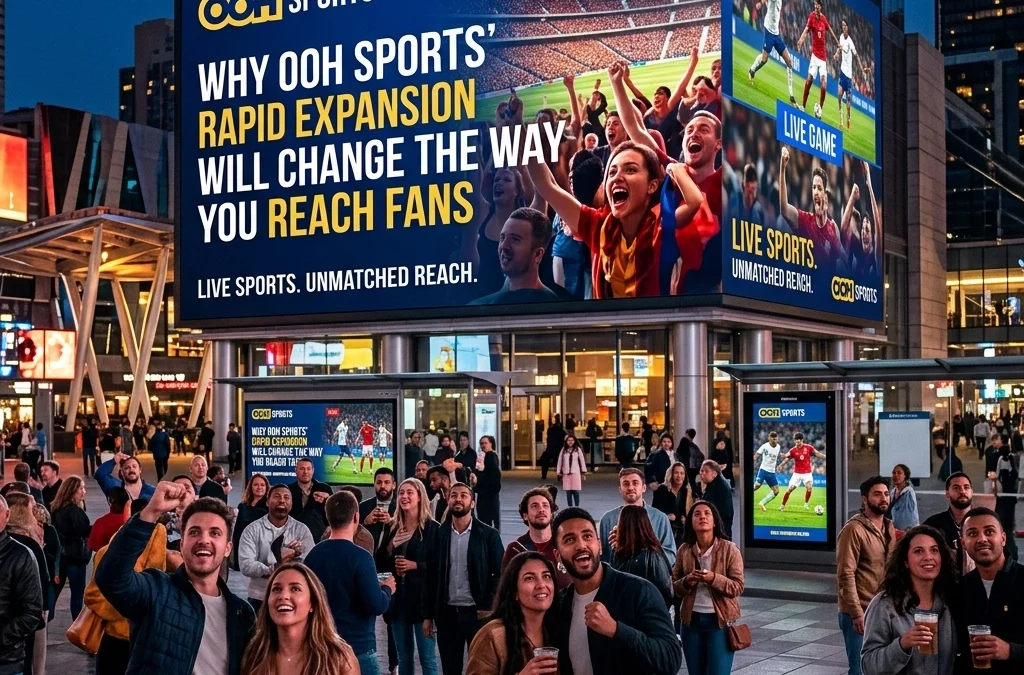
The landscape of sports media is undergoing a fundamental transformation. As traditional broadcast models face fragmentation and in-stadium advertising becomes increasingly exclusive, a new frontier has emerged. OOH Sports has reached a significant milestone in its network expansion, growing to over 25,000 digital screens. This rapid scaling is not merely a quantitative increase in inventory. It represents a strategic shift in how brands interact with the sports audience throughout the entire fan journey.
For media buyers and industry stakeholders, this expansion provides a scalable solution to a long-standing problem: how to maintain relevance with fans once the stadium lights go down or the television is turned off. By placing high-impact digital out-of-home (DOOH) assets in the places where fans live, work, and socialize, the network is redefining the boundaries of sports marketing.
The Strategic Shift: Beyond the Three-Hour Window
Historically, sports advertising was confined to a narrow window of time. Brands competed for expensive 30-second spots during a live broadcast or static signage inside a venue. This approach, while effective for mass awareness, often ignored the hours of anticipation before a game and the celebration or analysis that follows.
The expansion of the OOH Sports network changes this dynamic. By blanketing key areas such as approach roads, parking facilities, transit hubs, and concourses, the network creates a continuous loop of engagement. The "fan journey" is now a series of addressable touchpoints. Whether a fan is commuting to the arena, grabbing a drink at a sports bar, or visiting a retail location for team merchandise, the brand presence remains constant.
This evergreen strategy ensures that a campaign is not tethered to a single game day. Instead, it becomes part of the daily lifestyle of the sports enthusiast. This approach allows for messaging that aligns with the specific mindset of the fan at different times of the week, moving from awareness on non-game days to high-intent conversion prompts during peak emotional moments.

Objective and Strategy: Total Market Coverage
The core objective of the OOH Sports expansion is to provide total market coverage that mirrors the local economy’s connection to sports. When a major sporting event occurs, it drives significant economic activity in the surrounding area. Research indicates that 99% of fans who attend a game after seeing an OOH ad spend money locally on hotels, restaurants, and transportation.
By expanding its footprint into these secondary spending zones, OOH Sports allows advertisers to tap into the "sports economy." The strategy involves a three-pronged approach to placement:
- High-Dwell Environments: Placing screens in sports bars and fan zones where fans gather for long periods. This allows for repeated exposure and more detailed creative messaging.
- Transit and Commuter Hubs: Capturing the attention of fans as they move through the city. These high-traffic areas are ideal for bold, short-form messaging that drives immediate brand recall.
- Retail and Lifestyle Centers: Reaching fans during their everyday routines. This is where purchase decisions for beverages, snacks, and apparel are often made, providing a direct link to the point of sale.
For more information on the specific locations and assets available, media buyers can explore OOH Sports Sportrons to see how these screens are integrated into diverse environments.
Technology Partners and Programmatic Integration
A key driver of this rapid expansion is the integration of sophisticated programmatic technology. The network is built to be flexible, allowing for seamless buying through major Demand-Side Platforms (DSPs). This move toward programmatic DOOH (pDOOH) democratizes access to premium sports inventory.
In the past, high-level sports associations required multi-year, eight-figure commitments. OOH Sports has removed these barriers. Now, mid-market and challenger brands can execute campaigns with the same level of precision as global sponsors. Through partners like StackAdapt, advertisers can use data-driven targeting to reach specific demographics at the most opportune moments.
The technology allows for real-time triggers based on live game events. For example, a brand could trigger a "congratulatory" creative the moment a player breaks a record or a team clinches a playoff spot. This level of contextual relevance was previously impossible with traditional static billboards or even pre-scheduled digital rotations.

Quantifiable Results and Measurable Impact
The effectiveness of this expanded network is supported by robust data. Moving beyond simple impressions, OOH Sports focuses on performance metrics and consumer action. According to data from the OAAA and The Harris Poll, 90% of adults who see sports-related OOH ads take some form of action. Furthermore, 61% of these viewers engage with the brand on social media, often sharing creative that features star power or clever messaging.
The network has facilitated several high-performing campaigns that demonstrate the power of this medium:
- Sea-Doo: This campaign utilized targeted DOOH to reach outdoor enthusiasts and sports fans, resulting in a 144% increase in purchase consideration. Detailed findings can be found in the Sea-Doo case study.
- White Claw: By leveraging programmatic DOOH for a vodka launch, the brand saw a 74% lift in purchase consideration. The details are outlined in the White Claw campaign analysis.
- Mike’s Hard Iced Tea: This execution resulted in a 119% lift in positive brand image, proving that DOOH is as effective for brand sentiment as it is for direct sales. More information is available via the Mike's Hard case study.
These results highlight that the expansion is not just about reach, it is about driving meaningful business outcomes. By using device IDs and location-based attribution, OOH Sports can prove exactly how many fans saw an ad and subsequently visited a retail location or a website.
Implementation: How to Adjust the Playbook
With the expansion of the OOH Sports network, media planners must adjust their strategies to fully capitalize on the new inventory. The following tactics are recommended for maximizing ROI:
1. Design for Context
Different environments require different creative approaches. Screens in transit hubs should feature high-contrast, simple visuals that can be absorbed in seconds. Conversely, screens in sports bars can support longer-form content or utility-based creative, such as live scores or QR codes for immediate engagement.
2. Align with the Emotional Arc of the Game
The expanded network allows brands to sync their creative with the fans' emotional state. Pre-game messaging should focus on anticipation and preparation (e.g., tailgating supplies). Post-game messaging should shift to celebration or convenience (e.g., ride-sharing services or food delivery).
3. Utilize Geofencing and Retargeting
The 25,000+ screens provide a massive footprint for data collection. Brands can use the location data from these screens to retarget fans on their mobile devices. If a fan is exposed to a Sportron near the stadium, they can be served a follow-up ad on social media later that evening, creating a multi-touchpoint experience.
4. Focus on Always-On Visibility
Because the network reaches fans in everyday spaces like retail centers and gyms, it is a viable "always-on" channel. Brands can maintain a baseline of awareness throughout the season, ramping up spend only for major rivalry games or championship events.

A Foundational Pillar of Sports Marketing
The rapid expansion of the OOH Sports network elevates DOOH from an experimental "add-on" to a foundational pillar of any comprehensive sports media plan. It offers the massive reach of television with the granular targeting and accountability of digital advertising.
As the network continues to grow, the ability to reach fans in a way that is non-intrusive yet highly impactful becomes a competitive advantage. For brands looking to break through the noise of a crowded marketplace, the OOH Sports network provides the scale, technology, and strategic placement necessary to win.
To learn more about how to integrate these 25,000+ screens into your next campaign, visit the OOH Sports marketing page or contact the team directly via the contact page. The future of fan engagement is no longer confined to the arena, it is happening everywhere the fan goes.
