
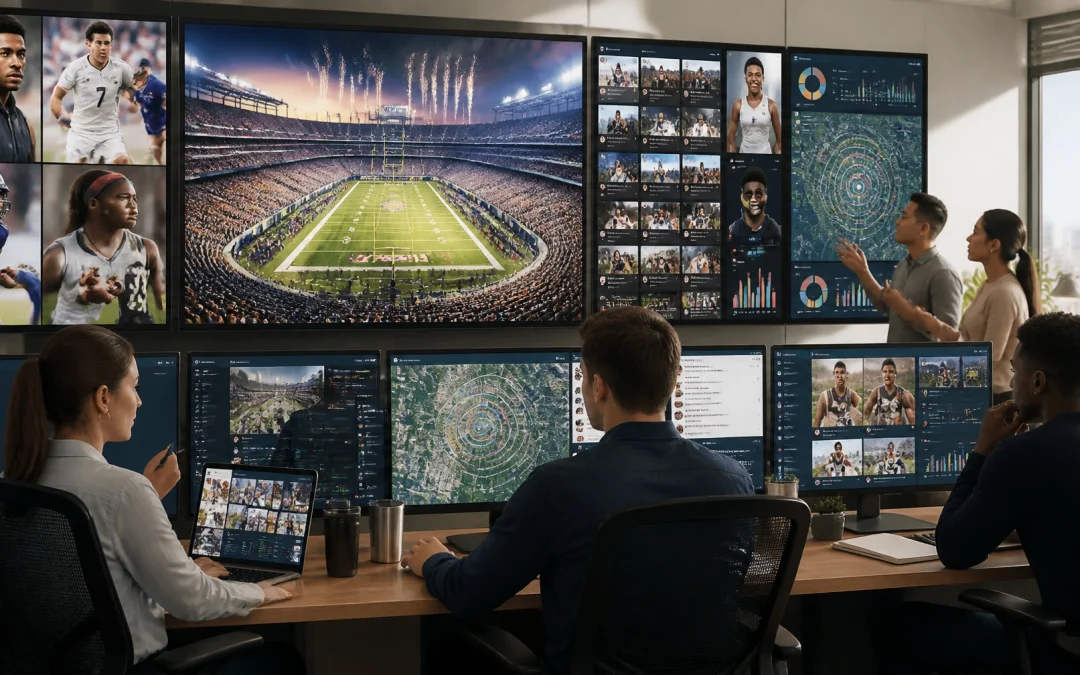
Super Bowl 2026 is going to be expensive, crowded, and insanely competitive for attention. Media buyers already know the obvious options, linear, CTV, social, retail media, and big splashy sponsorships. The less obvious option that can still feel real at scale is NIL, specifically, activating a large roster of student-athletes as authentic creators in a coordinated, measurable program.
OOH Sports supports sports-first media planning with a mix of digital out of home and a scaled NIL platform built to activate 20,000+ student-athlete voices. Below are 10 practical things media buyers should know before locking a Super Bowl 2026 plan.
Related OOH Sports pages:
- OOH Sports home: https://oohsports.com/
- Sporttron network overview: https://oohsports.com/sportrons/
- Case studies: https://oohsports.com/case-study/
- Marketing page: https://oohsports.com/marketing/
- Contact: https://oohsports.com/contact/
1) “NIL at scale” is not influencer marketing, it is a media system
NIL can look like influencer marketing from the outside. At 20,000 athletes, it has to operate more like a media channel with controls.
A scalable NIL system typically includes:
- Athlete onboarding and identity verification
- Standard deliverable templates (post types, timelines, usage rights)
- Content review and brand safety checks
- Pacing, frequency, and audience mix management
- Measurement that rolls up from post-level to campaign-level
For Super Bowl 2026 planning, this matters because the “one cool post” mindset does not translate to Big Game week expectations.
2) The core advantage is authenticity, but only if creative is built for athletes
Audiences can smell a script. NIL works best when the brand gives athletes structure without removing their voice.
Execution guidelines that keep it authentic and still on-brief:
- Provide 3 to 5 talking points, not a word-for-word script
- Build a content menu (pregame ritual, watch party, fit check, food, predictions)
- Require clear FTC disclosure language, but keep everything else flexible
- Approve for safety, not for “perfect brand tone”
This is where the “reach that feels real” part comes from, the message is consistent, but the delivery is personal.
3) Scale comes from tiers, not from treating 20,000 athletes the same
A common mistake is spreading budget evenly or randomly across a huge roster. Media buyers should tier athletes like a portfolio.
A practical tiering model:
- Anchor athletes: high reach, high creative reliability, heavier usage rights
- Regional amplifiers: strong local relevance (school, conference, city)
- Volume creators: many smaller voices that deliver breadth and cultural texture
That mix gives both:
- Enough scale to matter during Super Bowl week
- Enough variety that the campaign does not feel copy-paste

4) Super Bowl timing needs a flighting plan, not a single “game day drop”
NIL performs better when it is paced. For Super Bowl 2026, the clean approach is a 3-phase flight.
Recommended flighting:
- Pre-game (4 to 6 weeks out): awareness, teasers, product education, list building
- Game week (Mon to Sat): heavier frequency, offers, watch-party plans, retail availability
- Game day + 72 hours: real-time reactions, recap content, retargeting and conversion
This mimics how attention actually builds and then converts around the Super Bowl.
5) Paid amplification is the difference between “good content” and guaranteed delivery
Organic athlete posting is the authenticity layer. Paid amplification is the delivery layer.
Media buyers should plan for:
- Whitelisting or boosting athlete posts (where allowed)
- Controlled audience targeting on top of athlete content
- Frequency management across regions and demos
- Creative sequencing (teaser, proof, offer)
This is how NIL behaves like a predictable media buy without losing the athlete voice.
6) Creative operations are the real bottleneck, solve it like production
At 20,000 athletes, the biggest risk is operational, not strategic. The plan needs a workflow that can handle volume without breaking.
Operational pieces that prevent chaos:
- Standard briefs by content type (Reels, TikTok, Stories)
- Pre-approved visual do’s and don’ts (logos, uniforms, locations, competitor avoidance)
- Batch review windows and clear SLAs for approvals
- Version control for offers, landing pages, and disclaimers

7) NIL pairs unusually well with DOOH around sports venues
Super Bowl week is not just a TV moment. It is a physical movement moment. Watch parties, bars, airports, hotels, and sports districts are packed.
NIL can create social proof while DOOH drives repeated real-world exposure. For planners building a sports-first surround strategy, DOOH adds:
- High-frequency reach near venues and fan gathering spots
- Daypart and location control during peak movement windows
- A clean bridge from awareness to action when paired with mobile retargeting
OOH Sports’ broader approach to sports environments is outlined here: https://oohsports.com/marketing/ and the Sporttron network page is here: https://oohsports.com/sportrons/

8) Measurement has to go beyond likes, build a Big Game-grade scorecard
Super Bowl investment is judged on impact. NIL should be graded the same way, just with more granular data.
A practical NIL measurement stack:
- Delivery: impressions, reach, frequency (by platform, athlete tier, region)
- Engagement quality: video completion, shares, saves, comment sentiment
- Traffic: click-through, landing page engagement, QR or short-link scans
- Conversion: signups, purchases, app installs, promo code redemption
- Lift: brand lift study or panel-based study (ad recall, favorability, consideration)
For general Super Bowl benchmarking and creative effectiveness frameworks, iSpot’s Super Bowl hub is a useful reference point: https://www.ispot.tv/events/super-bowl-commercials
And for budget context, Digiday has reported on the alternatives a Super Bowl 2026 budget can buy across channels: https://digiday.com/marketing/heres-what-else-a-8m-30-second-super-bowl-budget-can-purchase-in-2026/
9) Brand safety is manageable, but only with clear guardrails
Student-athletes are real people with real feeds. That is the point. It also means brand safety must be handled with process, not hope.
Common guardrails used in scaled NIL programs:
- Eligibility checks and identity verification
- Content category exclusions (alcohol, gambling, adult content) as needed
- Keyword and competitor restrictions
- Mandatory FTC disclosures and platform policy compliance
- Escalation path for takedowns or edits
The goal is not to sanitize athletes into ads. The goal is to keep athletes authentic while keeping brands protected.
10) The best Super Bowl 2026 use case for NIL is “mass credibility,” not a single hero moment
Super Bowl ads are built for a hero moment. NIL is built for mass credibility.
NIL at scale works best when the objective is:
- To make the brand feel present everywhere during Super Bowl week
- To show real usage, real reactions, real routines
- To create a layered story, hundreds or thousands of posts, not one
That is exactly what a large roster can do. It turns one brand message into thousands of proofs.
Recommended Super Bowl 2026 NIL plan (simple starting point)
For media buyers who want a clean setup to take into a planning meeting, this is a practical outline:
- Athlete mix
- 20 to 50 anchor athletes for high reach and paid usage
- 500 to 2,000 regional amplifiers for geo relevance
- 5,000+ volume creators for breadth and repetition
- Deliverables
- Game week short-form video as the core unit
- Optional Stories for reminders and offers
- Distribution
- Organic plus paid amplification on the top-performing content
- Measurement
- Delivery + engagement rollups
- Click and conversion tracking
- Optional brand lift study for executive reporting
For examples of how OOH Sports frames measurement and results in sports environments, explore the case study page: https://oohsports.com/case-study/
Video: Super Bowl 2026, sports environments, and NIL at scale
The following video provides additional context on how sports marketing is being approached across environments, including NIL as a scalable way to leverage thousands of authentic voices.
Next step for media buyers
A scaled NIL plan becomes dramatically easier to evaluate when the inputs are clear.
Information that typically tightens the plan quickly:
- Category and compliance constraints (especially regulated categories)
- Primary KPI (reach, lift, traffic, sales)
- Priority geographies (national vs. specific DMAs)
- Whether DOOH is included around sports venues for added frequency
OOH Sports contact page for planning conversations: https://oohsports.com/contact/
