
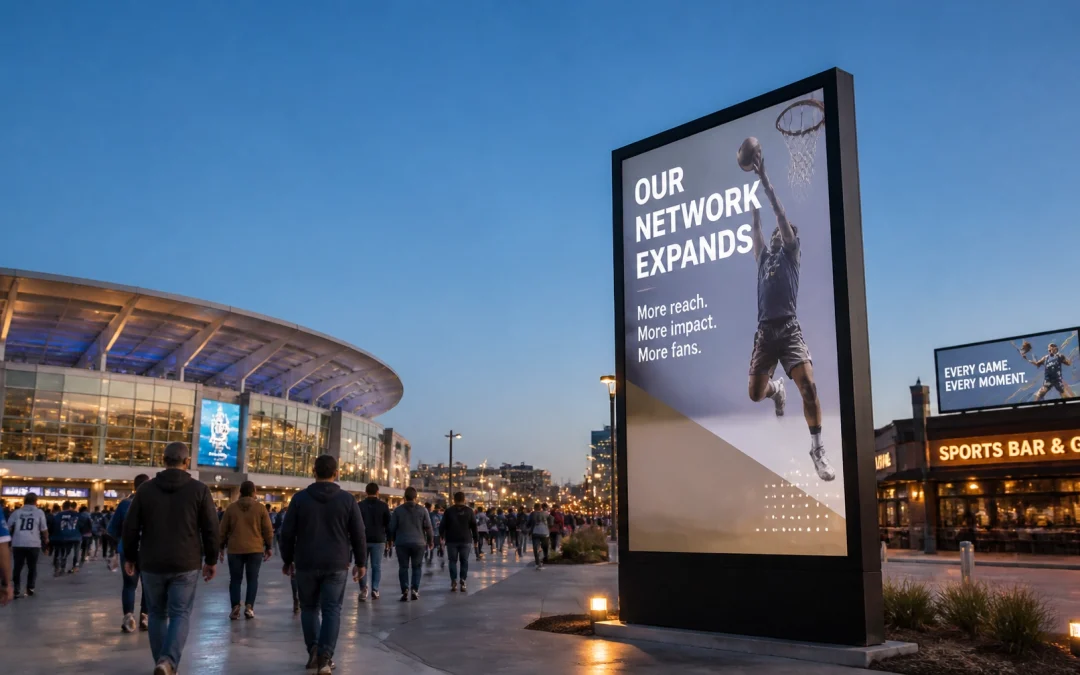
OOH Sports, part of the Sports Media Inc. family, announced a major expansion milestone across its digital out-of-home sports network, adding new venue coverage designed to improve how planners build sports media schedules, target game-day audiences, and measure outcomes across markets.
The expansion increases access to digital video advertising inventory across sports environments, with an emphasis on the perimeter around venues and the places fans actually visit before and after games. For media buyers, this shifts sports OOH from a one-off add-on into a repeatable planning layer that can be deployed with consistent market logic.
For an overview of OOH Sports and its approach to sports marketing, visit the company site: OOH Sports and About.
What’s New: Expanded Venue Coverage Across the OOH Sports Network
The OOH Sports network expansion adds more venue-centric inventory, making it easier to plan by market, sport, and fan movement patterns around game time.
What “new venue coverage” means in practical planning terms:
- More sports venues and surrounding districts included in the addressable footprint
- More digital video boards and screens available for sports-driven messaging, both inside and outside the venue environment
- More consistent options for market-by-market rollouts, rather than isolated one-off placements
- More opportunities to build frequency and sequencing, aligned to pre-game, in-game, and post-game windows
OOH Sports also works alongside in-stadium capabilities via its sister platform, Sportrons, which focuses on digital advertising solutions inside venues and can be layered into broader sports OOH plans.
Objective & Strategy: Build a More Plan-Friendly Sports DOOH Layer
The primary planning objective behind network expansion is straightforward, improve venue-based coverage so buyers can build scalable sports DOOH plans with predictable inventory access.
Planning problems the expansion is designed to solve:
- Fragmented venue-area inventory that is hard to buy consistently across markets
- Limited ability to build repeatable templates for different cities and teams
- Difficulty aligning OOH to sports tentpoles without losing local relevance
- Inconsistent options for season-long flights that require steady reach and frequency
Strategic approach enabled by expanded coverage:
- Start with venue clusters, then build outward into surrounding fan zones
- Use sports calendars to define flights, not just individual game dates
- Align creative to fan moments, not just generic branding windows
- Plan OOH as a complement to CTV, social, audio, and mobile, not as a silo
Why Venue Coverage Changes Sports Media Planning
Sports media planning often begins with what fans watch. Venue-centric DOOH planning starts with where fans go. That difference affects targeting, creative, and measurement.
1) Planning shifts from “event moments” to “fan movement”
Expanded coverage supports a practical audience model, fans move through predictable corridors:
- travel and arrival
- pre-game meetups and dining
- watch-party locations
- post-game celebration and late-night foot traffic
When inventory exists across more of that path, a campaign can be sequenced rather than repeated.
2) Market selection becomes more operational
With broader venue coverage, planning can shift toward repeatable market tiers:
- Tier 1, top sports markets with multi-venue density
- Tier 2, cities with strong team followings and predictable game-day hubs
- Travel-driven markets where hotels, entertainment districts, and transit volume matter
3) Creative becomes context-driven and easier to localize
Near-venue DOOH is effective when it behaves like the environment, not like a generic national ad. Expanded coverage supports local creative logic without rebuilding the plan each time.
Common creative formats that benefit from venue-area coverage:
- “Tonight’s game” reminders and tune-in prompts
- limited-time offers tied to game-day windows
- retail and QSR call-to-action messaging near high foot traffic zones
- dynamic messaging that shifts by daypart or event phase
Activation Approach: How Media Buyers Can Use the New Coverage
Expanded coverage is most useful when translated into a clear buying workflow. The following activation framework is designed for agency and brand teams that need predictable setup across multiple markets.

Step 1, Build a venue list and define the radius logic
- Identify priority venues by sport, season timing, and market goals
- Define a consistent radius approach for “near-venue” exposure
- Separate home markets from away-market reach depending on the campaign objective
Step 2, Segment placements by environment type
Where a screen sits matters as much as how many impressions it delivers.
Common venue-area environment segments:
- sports bars and dining corridors
- entertainment districts
- commuter routes and key intersections
- hospitality and hotel zones
- convenience retail clusters near fan traffic
Step 3, Sequence creative by game-day phase
- pre-game, build anticipation and direct fans to viewing or purchase decisions
- in-game, reinforce brand presence and support second-screen actions
- post-game, drive late-night conversions and next-day reminders
Step 4, Connect to omnichannel workflows
Expanded venue coverage makes DOOH easier to use as a bridging channel across a sports media mix:
- CTV and streaming for narrative and reach
- social for conversation and content distribution
- mobile for direct response
- DOOH for high-context reinforcement in the real world
Technology Partners and Programmatic Readiness
Modern sports DOOH planning depends on speed and control. Expanded coverage supports planning models that prioritize:
- flexible scheduling
- market-by-market scaling
- consistent creative QA
- measurable outcomes
A practical benchmark from the broader DOOH ecosystem is that month-long DOOH flights can compete strongly with single-event bursts on reach and CPM efficiency in certain analyses. For example, Broadsign cites industry research comparing a month-long DOOH campaign to a single Big Game TV spot, reporting 7.5× greater reach and 10× better CPM value in top markets under the study conditions. Source: Broadsign, OOH strategies to amplify your big game ad campaign.
The takeaway for sports planners is not “DOOH replaces TV.” The operational takeaway is that DOOH becomes more useful when coverage makes it scalable, so it can be flown longer, targeted tighter, and measured more consistently.
Measurement and Accountability: What Buyers Can Prove More Easily
Expanded network coverage matters only if outcomes can be tied to planning decisions. The strongest use cases connect exposure to clear next steps, whether that is store visits, app actions, tune-in, or brand lift.

Common measurement approaches used in sports DOOH programs:
- impression delivery and pacing by market and daypart
- geo-based performance comparisons between exposed and control areas
- brand lift studies where applicable
- QR code and short-link response measurement for direct actions
- footfall and visitation lift analysis for retail and QSR categories
Industry research also supports the role of OOH in driving action around sports. OAAA reporting based on Harris Poll research notes that a majority of U.S. adults recall seeing OOH ads for major sporting events, and that many take follow-on actions after exposure. Source: OAAA, OOH powers sports marketing playbook.
Results: What Expanded Venue Coverage Typically Improves
This announcement is a network milestone, not a single campaign recap, so outcomes are best framed as planning-level performance improvements that buyers can expect when coverage expands.
Expanded venue coverage typically improves:
- Reach consistency across markets, fewer gaps and fewer “dark zones”
- Frequency control, easier to maintain 5 to 7 meaningful exposures across a flight
- Creative relevance, more placements where “game-day” messaging makes sense
- Operational speed, faster market expansion without rebuilding specs each time
- Measurement quality, more comparable market-to-market reporting
For examples of how DOOH measurement is commonly reported in a campaign context, review the case study hub: OOH Sports Case Study.
Use Cases: Who Benefits Most From the Expansion
The new coverage is designed to support both national brand objectives and local conversion goals.
High-fit categories:
- Sports betting and sports apps: capture intent around game time and viewing locations
- Beer, spirits, and ready-to-drink: influence pre-game and watch-party purchasing patterns
- QSR and casual dining: drive arrivals during high-traffic meal windows near venues
- Retail and convenience: promote game-day bundles and limited-time offers
- Travel and hospitality: reach out-of-town fans where decisions are made
How to Plan Against the Expansion: A Simple Checklist for Buyers

Use this checklist as a starting point when building a venue-based DOOH plan:
- Define the sport season and the priority markets
- Choose the top venues and map surrounding fan zones
- Segment placements by environment type, not just impression volume
- Build a three-phase creative plan, pre-game, in-game, post-game
- Align DOOH timing with CTV, social, and mobile pushes
- Set KPIs by objective, awareness, consideration, visitation, or action
- Confirm measurement plan and reporting cadence before launch
Visualizing the Fan Footprint: Why “Near Venue” Matters
Expanded coverage increases the ability to plan for what many teams call the “stadium district” effect, the restaurants, bars, and entertainment corridors that fill up before and after games.

This is the window where many brand decisions happen quickly:
- Where to watch
- What to drink or eat
- Which app to open
- Which store to stop at on the way home
When the network expands around more venues, that decision window becomes easier to buy at scale.
Next Steps: Get Network Coverage and Planning Support
Media buyers and planners evaluating new venue coverage can review OOH Sports capabilities and request planning support through these pages:
- Network and company overview: OOH Sports
- Venue and in-stadium extensions via sister platform: Sportrons
- Contact for RFPs, coverage questions, and planning: Contact
Expanded venue coverage is ultimately a planning upgrade. It gives buyers more consistent access to the fan footprint around sports, and it makes sports DOOH easier to deploy as a measurable, repeatable layer within a modern omnichannel media plan.