
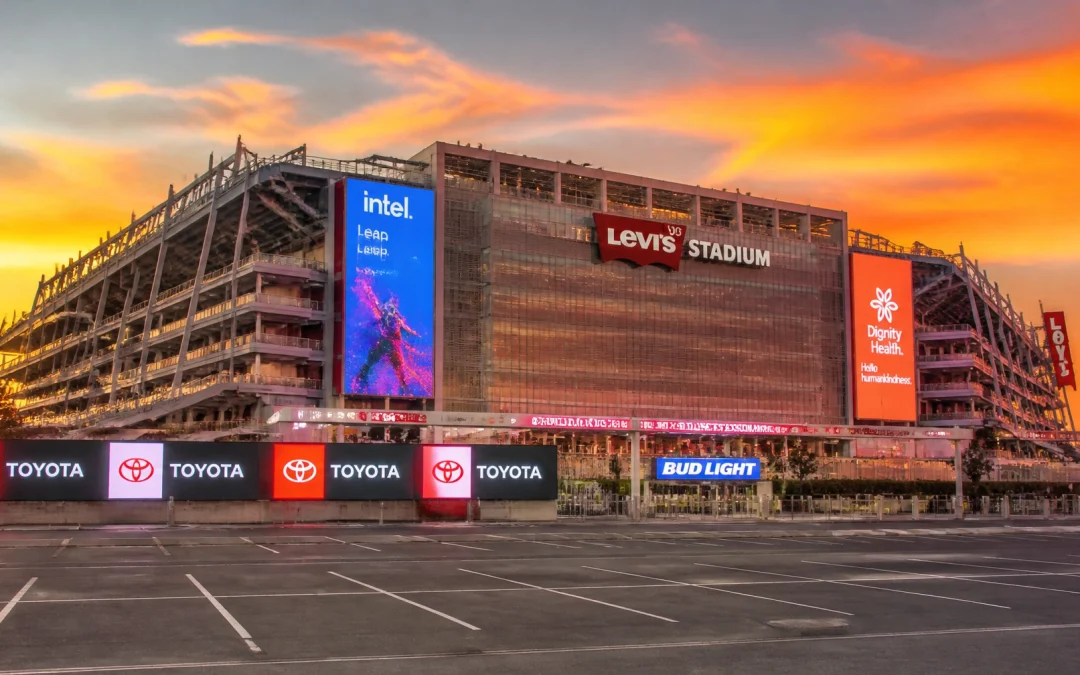
The Super Bowl remains the pinnacle of American sports marketing, and as the 2026 game approaches Levi’s Stadium in Santa Clara, the stakes have reached an all-time high. With thirty-second television spots reportedly commanding upwards of $8 million, brands are increasingly looking toward high-impact Digital Out of Home (DOOH) strategies to capture the attention of the millions of fans descending upon Silicon Valley. Dominating the Super Bowl landscape requires more than just a single screen. It demands a venue-wide presence that spans from the literal stadium floors to the towering roadside billboards lining the 101 freeway.
Strategy: The 40-Year Blueprint for Sports Marketing
The success of modern sports advertising is built on decades of evolution. OOH Sports, as part of the Sports Media Inc. family, brings 40 years of leadership to the arena. This extensive history has transformed sports marketing from simple static signage into a dynamic, multi-layered ecosystem. The 2026 strategy focuses on total immersion. By leveraging forty years of industry relationships and technical expertise, campaigns are no longer confined to the broadcast window. Instead, they become a week-long narrative that greets fans the moment they land at the airport and follows them until the final whistle.
Objective and Strategy: The 10-Mile Perimeter
The primary objective for any major brand during the Super Bowl is to own the physical environment surrounding the event. For 2026, the strategy centers on a "10-mile dominance" model. Research indicates that the vast majority of fan engagement occurs outside the stadium bowl, in the sports bars, transit hubs, and retail centers of Santa Clara and San Jose.
The 10-mile perimeter strategy involves:
- Saturating high-traffic highway arterials leading to Levi’s Stadium.
- Deploying digital screens in "everyday fan spaces" such as grocery stores and convenience hubs.
- Utilizing place-based networks in bars and restaurants where non-ticket holders gather to watch the festivities.
- Ensuring a persistent visual presence that reinforces brand recall during the critical lead-up days.

Technology Partners: Programmatic DOOH and Performance
The backbone of a successful 2026 Super Bowl campaign is the technology used to deploy it. By partnering with advanced Demand Side Platforms (DSPs), brands can execute programmatic DOOH buys with surgical precision. This technology allows for real-time adjustments based on weather, game scores, or local traffic patterns.
Programmatic integration ensures that:
- Creative can be swapped instantly to reflect game-day excitement.
- Budgets are allocated to the highest-performing screens in the Silicon Valley corridor.
- Inventory is secured through Programmatic Guaranteed deals to ensure premium placement during peak hours.
- Performance is measured through device ID exposure and brand lift studies.
This data-driven approach moves OOH advertising away from "guesswork" and into the realm of performance marketing, providing the same level of accountability as a digital social media campaign but on a much larger, more public scale.
Execution: From Stadium Floors to Roadside Billboards
Dominating the Super Bowl requires a "top-to-bottom" execution. This means the creative must be visible at every touchpoint of the fan journey.
Stadium Interior and Floor Graphics
Inside the venue, the strategy shifts toward experiential and tactile advertising. Digital screens in the concourses and entry gates provide high-frequency touchpoints. However, the use of floor graphics and column wraps offers a unique way to "etch" a brand into the environment. Floor displays in high-dwell areas like concessions and luxury suites ensure that the brand is part of the physical architecture of the game.
Concourse and Ribbon Boards
Bowl-facing DOOH, including LED ribbon boards and end-zone displays, allows brands to synchronize their messaging with the broadcast. This creates a powerful "omnichannel" effect where a fan sees the ad on their phone, on the concourse screens, and on the field-level perimeter boards simultaneously.
Roadside and Transit Billboards
The journey to the stadium is just as important as the game itself. Large-format digital billboards on the main routes leading to Santa Clara provide the initial "wow" factor. These boards are strategically timed to capture the heavy traffic flows of fans arriving from San Francisco and Oakland, ensuring the brand message is the first and last thing they see.

Measuring the Big Game Impact
A successful campaign is ultimately defined by its results. For Super Bowl 2026, the metrics move beyond simple impressions to focus on "brand lift" and "purchase intent."
Historical data from similar high-stakes sports campaigns shows significant outcomes:
- Purchase Consideration: Campaigns utilizing programmatic DOOH in a 10-mile radius have seen increases in purchase consideration by as much as 144% for specific product categories.
- Brand Image: Strategic placement around major sporting events has led to a 119% lift in positive brand image perceptions among exposed audiences.
- Reach and Efficiency: Compared to a single $8 million TV spot, a diversified DOOH campaign can offer up to 10 times better CPM value while reaching fans multiple times throughout the week.
By tracking device IDs exposed to the billboards and following their digital journey, marketers can prove a direct link between seeing a roadside billboard and visiting a website or making a purchase.
Logistics and Planning
Executing at this scale requires meticulous planning. The 2026 Super Bowl in Silicon Valley presents unique logistical challenges, including dense traffic and high demand for digital inventory. Early booking and the use of specialized sports media networks are essential to secure the best locations.
The process typically follows these steps:
- Asset Audit: Evaluating available inventory within the 10-mile "hot zone" around Levi's Stadium.
- Creative Development: Designing high-contrast, simple messaging that reads clearly on both large billboards and small transit screens.
- Trigger Implementation: Setting up programmatic triggers based on game-time events or local conditions.
- Post-Game Attribution: Collecting and analyzing exposure data to quantify the return on investment.

The Power of Video Integration
In the digital age, a billboard is rarely just a billboard. It is a portal to a larger brand story. Integrating video content is crucial for reinforcing the visual themes seen on the streets. Below is a look at the dynamic nature of modern sports media execution.
https://www.youtube.com/watch?v=l6J-0zileKE
Conclusion: Winning Beyond the Scoreboard
As Super Bowl 2026 draws closer, the brands that win will be those that understand the power of physical presence. By combining 40 years of advertising leadership with the latest in programmatic technology, OOH Sports provides the tools to dominate the entire fan experience. From the highway billboards that welcome fans to the Bay Area to the stadium floors where they stand, every inch of the environment is an opportunity to tell a story. In the race for attention, the most effective strategy is to be everywhere the fans are.
For more information on how to leverage the OOH Sports Network for your next campaign, or to see how we handled recent activations like the Nike NYC Marathon campaign, visit the official OOH Sports blog.