
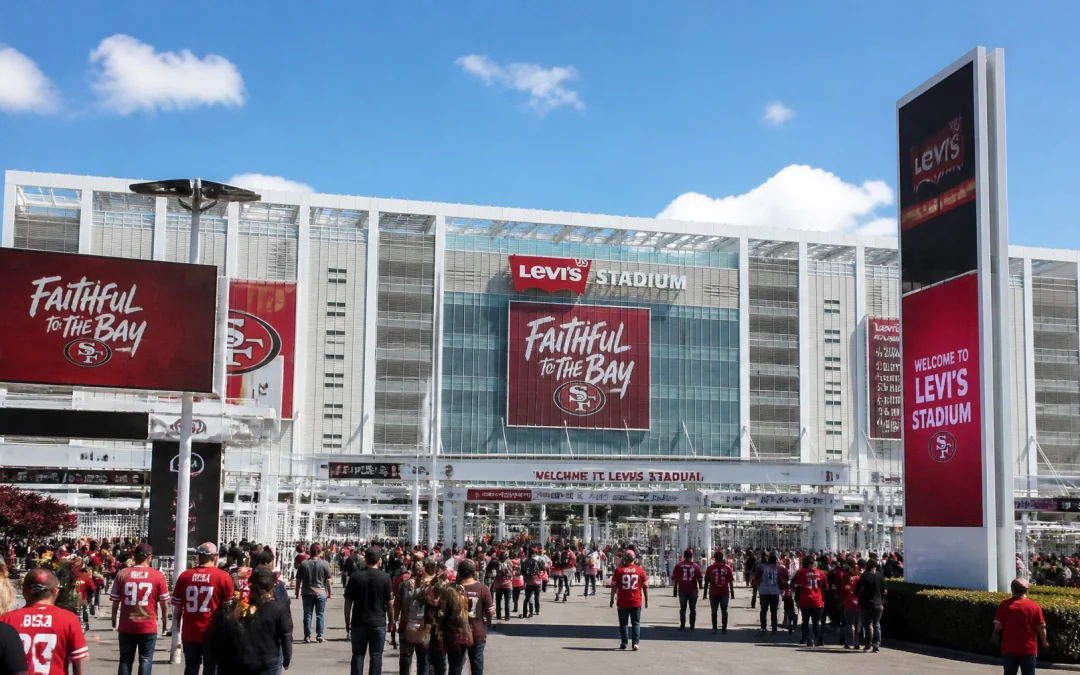
The Super Bowl remains the pinnacle of American advertising, a cultural moment where brand messages transcend mere commercial interruptions to become part of the event narrative. As the industry prepares for Super Bowl LX at Levi’s Stadium in Santa Clara, the stakes for brand managers have never been higher. With 40 years of advertising leadership in the sports media space, OOH Sports and the Sports Media Inc. family have refined the art of venue dominance.
Dominating the Super Bowl ecosystem requires more than a single high priced television spot. It demands a comprehensive, venue wide strategy that captures the attention of fans from the moment they enter the host city until they take their seats in the arena. This guide outlines the five essential steps to achieving total brand saturation during the biggest game of the year.
Step 1: Secure the 10-Mile Perimeter with Programmatic DOOH
The journey to the Super Bowl does not begin at the stadium gates. It begins in the transit corridors, hotel districts, and fan zones of the host city. A successful branding strategy must establish a presence within a 10-mile perimeter of the venue to intercept fans throughout their entire journey.
Using programmatic Digital Out-of-Home (DOOH) technology, brand managers can deploy flexible, data driven campaigns that reach audiences on digital billboards, transit kiosks, and urban panels. This approach ensures that a brand is the first thing a fan sees when they land at the airport and the last thing they see as they approach the stadium. By leveraging a network that covers every digital video advertising board in the category, a brand can create a sense of inescapability.
The efficiency of DOOH is a significant factor in its growing dominance. While a 30-second Super Bowl television spot can cost upwards of $7 million, a strategic OOH campaign provides sustained visibility for a fraction of the cost. This allows for a high frequency of impressions that reinforce the brand message over several days or weeks leading up to the game.

Step 2: Conquer the Stadium Interior from Floors to Billboards
Once fans enter Levi’s Stadium, the focus shifts to environment ownership. To truly dominate the venue, a brand must be visible across all touchpoints. This includes traditional placements like jumbotrons and ribbon boards, but it also extends to more innovative surfaces.
Concourse floor graphics are one of the most effective ways to command attention. These high impact visuals turn high traffic walkways into branded environments. When fans are navigating the stadium, their eyes are naturally directed toward the ground for wayfinding. Placing brand messages directly in their path ensures they cannot be missed.
In addition to floor graphics, brands should utilize the full spectrum of in-stadium assets.
- Ribbon Boards: These provide 360-degree visibility and are ideal for high energy, short duration messaging.
- Jumbotrons: Use these for cinematic, long-form creative that captures the crowd during breaks in play.
- Concession Platforms: Branding napkin dispensers, cup holders, and concession counters creates a tangible connection with fans during peak engagement moments.
- Wayfinding Signage: Integrating a brand into the stadium’s functional signs provides value to the fan while maintaining brand presence.
This multi-layered approach ensures that the brand message is etched into the hearts of fans as they experience the excitement of the game. Information on these specialized venue networks can be found through the OOH Sports Sportrons page.
Step 3: Leverage 40 Years of Sports Advertising Heritage
Experience is the most valuable asset when navigating the complexities of a Super Bowl campaign. For four decades, the leadership behind OOH Sports has been at the forefront of sports marketing, evolving from static billboards to the sophisticated digital networks of today. This heritage provides a deep understanding of fan behavior and venue logistics that newer players simply cannot match.
A 40-year track record means having established relationships with venue operators and a proven methodology for execution. It allows brand managers to navigate the strict regulations and high demand for space during the Super Bowl with confidence. Whether it is a national campaign or a hyper-local execution, the historical data and insights gathered over 40 years ensure that every dollar spent is optimized for maximum impact.
This level of expertise is particularly crucial when coordinating across multiple platforms. A campaign must be cohesive, moving seamlessly from the digital world to the physical arena. Understanding how to tell a story that resonates across these different environments is what separates a successful campaign from a forgettable one. More about the company’s history and mission can be found on the about page.

Step 4: Integrate Physical Media with Digital Interactivity
In the modern sports landscape, out-of-home advertising serves as a bridge to digital engagement. Every physical placement should be viewed as a gateway to a brand’s online ecosystem. Including clear calls to action, such as QR codes or social media hashtags, allows fans to move from passive observers to active participants.
For example, a floor graphic in the concourse can feature a QR code that leads fans to an exclusive Super Bowl promotion or a branded AR experience. This not only increases the time spent with the brand but also provides valuable first-party data. Fans are increasingly looking for ways to enhance their game-day experience through their mobile devices, and OOH advertising is the perfect vehicle to facilitate that connection.
Furthermore, the physical presence of a brand at the Super Bowl provides the perfect backdrop for social media content. When a brand dominates the visual landscape of the stadium, it becomes the setting for thousands of fan photos and videos shared across platforms like Instagram and TikTok. This "Social OOH" effect amplifies the reach of the campaign far beyond the physical limits of the venue.
Step 5: Measure Success with Quantifiable Data
The final step in dominating the Super Bowl is proving the effectiveness of the strategy through rigorous measurement. Gone are the days when OOH was considered a "top of funnel" awareness play with no clear attribution. Today, sophisticated measurement tools allow brand managers to track the direct impact of their venue coverage.
By using brand lift studies and exposure data, it is possible to quantify the increase in brand preference and purchase consideration. For instance, recent programmatic DOOH campaigns have seen significant results. White Claw’s campaign for its vodka launch saw a 74% lift in purchase consideration, a testament to the power of targeted digital out-of-home media. You can read the full details in the White Claw case study.
Other notable results include:
- Mike’s Hard Iced Tea: Achieved a 119% lift in positive brand image through a programmatic DOOH campaign.
- Sea-Doo: Increased purchase consideration by 144% using its first digital OOH campaign.
These metrics provide the clarity needed to evaluate the return on investment and inform future strategies. By comparing exposed versus unexposed audiences, brand managers can see exactly how their Super Bowl venue coverage moved the needle on key performance indicators.

Conclusion
Dominating the Super Bowl venue coverage is an ambitious goal that requires a blend of historical expertise and cutting-edge technology. By owning the environment both inside and outside the stadium, leveraging decades of advertising leadership, and integrating physical media with digital data, brands can achieve a level of visibility that is truly inescapable. As we look toward Super Bowl LX in 2026, the opportunity to etch a brand’s message into the history of the game has never been greater.
For a deeper look into the impact of these strategies, view the following presentation on the power of sports media:
https://www.youtube.com/watch?v=l6J-0zileKE
For more information on how to execute a winning strategy, explore the various case studies available at OOH Sports.