
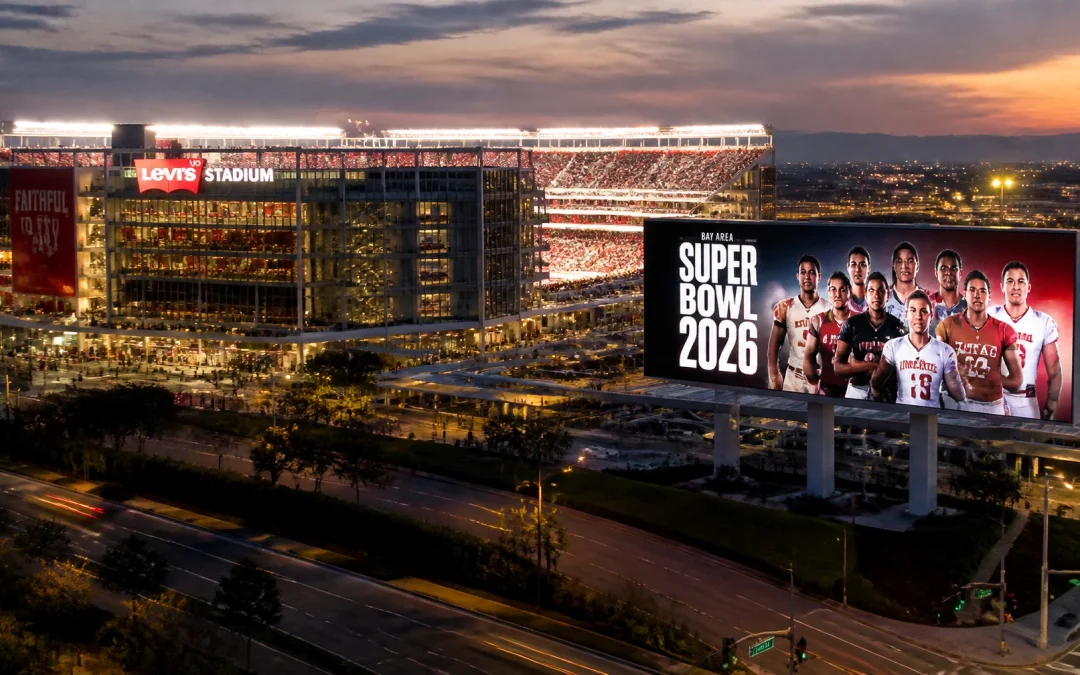
The arrival of Super Bowl 2026 at Levi’s Stadium in Santa Clara represents a significant milestone in the evolution of sports marketing. For media buyers and brand managers, this event is no longer just a single Sunday of television commercials. It has transformed into a multi-layered ecosystem where digital out of home (DOOH) advertising and Name, Image, and Likeness (NIL) partnerships converge to create a high-impact narrative.
As the industry moves toward February 2026, the traditional boundaries of athlete endorsements are fading. The rise of the student-athlete as a primary content creator has shifted the focus from massive national campaigns to hyper-local, authentic connections. OOH Sports, a division of the Sports Media Inc. family, is at the forefront of this revolution, providing the infrastructure to link brands with over 20,000 authentic student-athlete voices while simultaneously saturating the physical environment around the arena.
Objective & Strategy: The Power of Multi-Channel Authenticity
The primary objective for any Super Bowl campaign is to cut through the massive volume of noise generated by competing brands. Historically, this meant outspending the competition on broadcast slots. However, modern media planners are increasingly prioritizing "authenticity" as a measurable metric. The strategy for 2026 involves a two-pronged approach: leveraging the social capital of student-athletes through NIL platforms and reinforcing those messages via programmatic DOOH networks.
By utilizing the OOH Sports network, brands can establish a presence that follows the fan journey. This journey begins on social media feeds through NIL content and extends to the physical world via digital billboards, transit screens, and Sportrons located within the immediate vicinity of the sports venues. The goal is to create a seamless brand experience that feels less like an intrusion and more like a part of the cultural conversation surrounding the game.
The NIL Landscape: 20,000+ Student-Athlete Voices
The most significant shift in sports media over the last few years is the professionalization of the student-athlete. These individuals are no longer just players on a field; they are influential creators with deeply engaged, campus-centric audiences. For media buyers, the OOH Sports NIL platform offers access to a diverse network of over 20,000 student-athletes.
This scale allows for a level of micro-targeting that was previously impossible. A brand does not simply "buy a sports influencer." Instead, a planner can execute a campaign involving hundreds of athletes who resonate with specific demographics, regional interests, or lifestyle categories.
Why Student-Athletes Matter for Super Bowl 2026:
- High Engagement Rates: Student-athletes often see significantly higher engagement percentages compared to professional celebrities, as their followers consist of peers, alumni, and local fans.
- Narrative Continuity: These athletes can build a story in the weeks leading up to the Super Bowl, discussing party preparations, fashion, or travel, rather than providing a single, static post.
- Cost-Efficiency: Engaging a fleet of mid-tier and micro-athletes can often yield a higher total reach and resonance than a single, high-cost professional athlete contract.

Hyper-Local Targeting: The 10-Mile Perimeter
While NIL content drives digital engagement, the physical presence around the stadium remains the ultimate proof of brand authority. OOH Sports provides a specialized network that covers a 10-mile perimeter around major sports venues, including Levi’s Stadium. This geographic "moat" ensures that every fan, tourist, and media professional in the area for the Super Bowl is exposed to the brand's messaging multiple times.
The use of programmatic DOOH within this perimeter allows for real-time flexibility. Brands can adjust their creative based on the time of day, current weather conditions, or even the score of the game. This level of precision is discussed in detail in the guide on programmatic DOOH vs traditional stadium ads, where the data suggests that dynamic creative drives significantly higher recall.
Execution Tactics within the Perimeter:
- Strategic Placement: Identifying high-traffic transit routes, hotel clusters, and fan zones where digital screens are most visible.
- Contextual Creative: Using the athlete's NIL content on DOOH screens to bridge the gap between the phone screen and the street.
- Frequency Capping: Ensuring that the brand remains top-of-mind without over-saturating the audience, a balance managed through advanced programmatic platforms.

Technology Partners & The Sports Media Inc. Ecosystem
Executing a campaign of this magnitude requires a robust technological foundation. OOH Sports operates as a specialized storyteller within the Sports Media Inc. framework, which provides the back-end support for wide-scale digital distribution. This partnership allows media buyers to access every category of digital video advertising board, from large-format roadside bulletins to point-of-sale displays.
The integration of technology partners enables the use of device ID tracking to measure exposure. By identifying which mobile devices were present within the 10-mile perimeter during an ad play, planners can later retarget those same individuals with NIL-focused digital ads. This omnichannel approach creates a closed-loop system where the physical and digital worlds reinforce each other. For more on how these shifts are changing the industry, see the analysis of 7 DOOH industry shifts.
Results & Measurement: Data-Driven Success
Success in the Super Bowl window is measured by more than just impressions. Modern media buyers demand proof of brand lift and purchase consideration. Previous campaigns executed through this network have shown remarkable results. For instance, a campaign for Sea-Doo utilized digital OOH to increase purchase consideration by 144 percent.
For Super Bowl 2026, the integration of 20,000 student-athlete voices provides a new set of data points. Planners can track engagement, sentiment, and conversion rates across the NIL platform, then correlate that data with the foot traffic and exposure metrics from the DOOH perimeter.
Metrics to Monitor:
- Brand Preference Rating: Measuring how the association with authentic student-athletes improves the consumer's perception of the brand.
- Device ID Attribution: Tracking the journey from physical ad exposure to online search or purchase.
- Social Amplification: Monitoring the organic reach generated when fans share photos of DOOH billboards featuring their favorite college stars.

Conclusion: The New Playbook for 2026
The playbook for Super Bowl 2026 is being written today. It is a playbook that favors the bold, the local, and the authentic. By combining the massive reach of a 20,000+ student-athlete network with the undeniable presence of a 10-mile DOOH perimeter, brands can achieve a level of dominance that was previously reserved for official league sponsors.
OOH Sports remains committed to bringing brands to life in a way that is as dynamic as the sports themselves. For media buyers and planners, the opportunity lies in the intersection of these two powerful forces. The goal is not just to be seen. It is to be remembered as a part of the greatest show on turf.
To see the potential of this network in action, watch the overview below: