
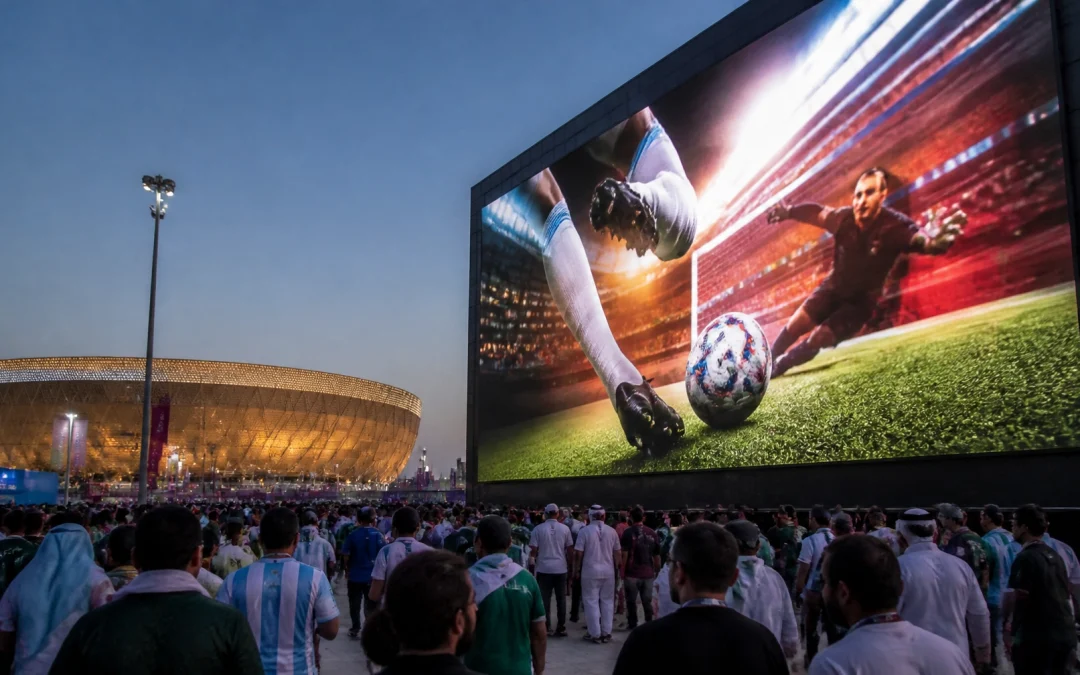
The landscape of sports marketing is undergoing a seismic shift. For decades, the pinnacle of brand visibility was a fixed sign inside a stadium or a logo stitched onto a jersey. However, the most recent global sporting events, particularly the World Cup, have demonstrated that traditional stadium sponsorships are no longer the only, or even the most effective, way to capture fan attention. As media budgets face increasing scrutiny, the rise of Digital Out of Home (DOOH) advertising has challenged the status quo.
While official stadium sponsorships often require multi-million dollar investments and long-term commitments, DOOH offers a more agile and data-driven alternative. The real battle for brand loyalty is no longer confined to the four walls of an arena. Instead, it is happening in the transit hubs, city centers, bars, and retail environments where fans actually live their lives. This evolution proves that while traditional sponsorships provide prestige, DOOH provides the measurable impact and tactical flexibility that modern CMOs and media planners demand.
The 10-Mile Strategy: Beyond the Stadium Gates
The core of this shift lies in the realization that the vast majority of fans never set foot inside the stadium. For every 80,000 people in a World Cup arena, there are millions more in the surrounding city and across the globe. By focusing on a 10-mile stadium strategy, brands can engage with the total fan ecosystem rather than just the ticket holders.
Digital advertising boards positioned within a 10-mile radius of sports venues create a perimeter of influence. This approach captures fans as they travel to the game, celebrate in fan zones, or shop for gear in local retail outlets. It transforms an entire metropolitan area into a distributed media stadium. This strategy allows brands to achieve high-frequency exposure at a fraction of the cost of official rights, effectively "ambushing" the event with high-impact visuals and contextual relevance.
Objective & Strategy: Targeting the 99 Percent
The primary objective of a modern sports DOOH campaign is to maximize reach and conversion among the "99 percent": the fans who are emotionally invested in the game but are experiencing it outside the venue. The strategy relies on three main pillars:
- Omnipresence in the Fan Journey: Placing ads in airports, transit stations, and city spectaculars to greet fans as they arrive and move through a host city.
- Contextual Relevance: Utilizing real-time data to update creative content based on match scores, player performance, or local weather conditions.
- Mobile Synergy: Using DOOH as a "priming" tool to increase the effectiveness of mobile and digital retargeting efforts.
Research indicates that nearly 6 in 10 fans recall seeing OOH advertising during major sports events. More importantly, over 90 percent of those fans take a follow-up action, such as searching for the brand or visiting a store. This level of engagement is rarely achieved through static stadium signage alone, which often fades into the background of a broadcast.

Technology Partners: The Programmatic Edge
The transition from traditional to digital is driven by sophisticated technology partners and programmatic platforms. Unlike fixed signs that are printed and installed weeks in advance, DOOH networks allow for instantaneous updates. This level of network scale is the new gold standard for sports branding.
Programmatic DOOH enables media buyers to purchase screen time based on specific triggers. For example, a beverage brand can trigger ads to appear on screens in city bars exactly when a goal is scored or during halftime. This ensures that the message is delivered at the peak of fan emotion. Furthermore, technology partners provide detailed attribution data, allowing brands to track footfall increases and brand lift with precision. These industry insights help planners understand how their investment translates into real-world behavior.
Execution: Integrating Live Data
Effective execution in the DOOH space requires more than just high-resolution visuals. It requires a deep integration of live game data. By integrating live game data with a DOOH strategy, advertisers can remain part of the conversation as it happens.
Tactics used during the World Cup include:
- Scoreboard Updates: Displaying live scores alongside brand messaging to provide utility to fans.
- Dynamic Creative Optimization (DCO): Automatically switching creative assets based on which team is winning or which player is trending.
- Hyper-Local Targeting: Adjusting ads to the specific language or culture of the fans congregating in a particular neighborhood or fan zone.
This level of agility allows brands to pivot their messaging instantly, a feat that is impossible with traditional in-stadium billboards.

Results: The Numbers Behind the MVP
The performance data from recent tournaments paints a clear picture. While official sponsors pay massive fees for exclusive rights, "ambush" brands using DOOH often achieve higher purchase intent. A recent analysis of a global tournament showed that certain non-sponsor athletic brands posted 2.6 times higher purchase intent than official partners by focusing purely on conversion-oriented OOH.
The measurable impact of DOOH includes:
- Actionable Recall: 96 percent of fans who see World Cup-related OOH ads take a digital or physical action afterward.
- Store Visit Uplift: Campaigns using location-aware DOOH have demonstrated a 9 percent increase in store visits among exposed audiences.
- Brand Preference: 55 percent of soccer fans report a higher likelihood of purchasing from brands that appear as part of their match-day experience.
These results suggest that DOOH is not just a secondary channel but a primary driver of ROI in sports marketing. It bridges the gap between high-level brand awareness and ground-level sales activation.

Comparative Analysis: Traditional vs. DOOH
When comparing traditional stadium sponsorships to DOOH, the differences in flexibility and measurement are stark. Traditional sponsorships are excellent for long-term status and credibility. They provide the "big stage" feel that many global brands desire. However, they are also static, expensive, and difficult to measure in the short term.
DOOH, on the other hand, is built for the modern era of performance marketing. It offers:
- Lower Entry Barriers: Brands do not need to be official FIFA or NFL partners to dominate the conversation around the event.
- Unmatched Flexibility: Campaigns can be started, stopped, or optimized in real-time based on performance.
- High-Traffic Reach: By targeting transit hubs and retail centers, DOOH reaches fans at multiple touchpoints throughout their day.
This does not mean that stadium sponsorships are entirely obsolete, but rather that their role is changing. For a sponsorship to be truly effective, it must now be amplified by a robust DOOH strategy that follows the fan out of the arena and into the streets.

Conclusion: The Future of the Sports Buy
The World Cup has served as a proof of concept for the power of the digital perimeter. As the sports industry moves forward, the traditional model of "logo on a wall" will continue to lose ground to the "message in the moment" model provided by DOOH. Media buyers and CMOs are increasingly prioritizing networks that offer scale, precision, and real-time engagement.
By leveraging the OOH Sports Network and its expansive reach, brands can ensure they are not just spectators but active participants in the most passionate moments of the fan experience. The real MVP of the next decade of sports marketing will not be a sign inside the stadium, it will be the digital board that connects with a fan at exactly the right time, in exactly the right place.