
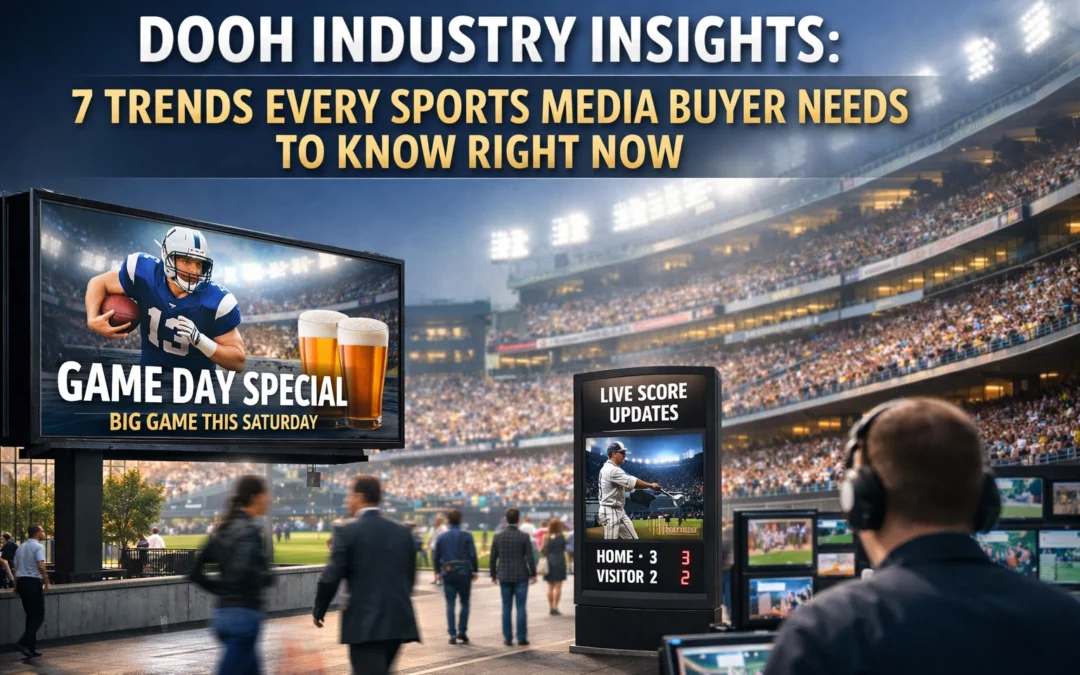
The digital out-of-home landscape for sports advertising continues to evolve at a rapid pace. Media buyers who want to maximize campaign performance need to stay ahead of emerging trends and proven strategies that drive measurable results. The following insights represent critical shifts in how successful campaigns leverage DOOH to connect with sports audiences.
1. Strategic Placement Around Fan Gathering Moments
The most effective DOOH campaigns target locations where fans naturally congregate throughout the entire event lifecycle. Research indicates that nearly six in ten fans recall seeing out-of-home advertising around major sporting events, and more than 90 percent take a follow-up action after exposure.
These high-recall placements extend beyond stadium perimeters. Sports bars, fan zones, transit hubs near venues, and entertainment districts all represent prime real estate for capturing attention during peak engagement windows. The strategic value multiplies when considering social amplification: 42% of consumers discuss sporting events with friends or family after seeing OOH ads, creating organic word-of-mouth marketing that extends campaign reach beyond initial impressions.

Media buyers should map fan journey touchpoints from pre-event excitement through post-game celebrations. Screens positioned at these natural gathering points deliver higher engagement rates and more meaningful brand interactions than generic placements.
2. Early Inventory Booking Paired with Flexible Activation
Premium screen inventory around major sporting events becomes scarce quickly. Media buyers who secure high-demand placements well in advance gain competitive advantages, but early booking doesn't mean sacrificing flexibility.
Programmatic DOOH enables a hybrid approach. Lock in coveted screen locations ahead of time, then use programmatic capabilities to activate and optimize closer to kickoff or during key game moments. This dual strategy balances the need for guaranteed premium placements while maintaining agility for real-time adjustments based on weather, game developments, or unexpected viral moments.
The shift toward programmatic buying platforms has made this combination possible. Media buyers can reserve inventory months ahead while retaining the ability to update creative, adjust frequency, or shift budget allocation as events unfold.
3. Real-Time, Context-Aware Creative Delivery
Once events are underway, dynamic creative optimization becomes the difference between relevant messaging and missed opportunities. Screens can update creative at halftime, after major plays, or as crowds move between venues, ensuring messages remain aligned with the unfolding action.

Context-aware delivery responds to multiple variables:
- Live scores and game-changing moments
- Weather conditions affecting outdoor viewing parties
- Crowd density and foot traffic patterns
- Time-of-day shifts in audience demographics
- Unexpected upsets or viral plays generating social buzz
This responsiveness requires integration between DOOH platforms and real-time data feeds. Media buyers who build this capability into campaign infrastructure can capitalize on fleeting moments of heightened attention that static campaigns miss entirely.
4. Three-Phase Temporal Campaign Strategy
Sophisticated sports DOOH campaigns structure messaging across three distinct phases, each requiring different creative approaches and placement priorities.
Pre-Match Phase: Building anticipation through screens in business districts, commuter corridors, and shopping centers where potential attendees make purchasing decisions. Creative focuses on event awareness, ticket sales, and brand positioning ahead of competition.
Live Event Phase: Capturing engaged crowds at stadiums, fan zones, sports bars, and surrounding entertainment districts. Messaging shifts to product promotions, real-time offers, and calls-to-action that drive immediate response from highly engaged audiences.
Post-Match Phase: Maintaining momentum through screens in city centers and transit hubs during the days following major events. Creative leverages event highlights, user-generated content, and sustained brand presence while fan enthusiasm remains elevated.
Each phase serves distinct objectives and reaches audiences at different points in their engagement journey. Media buyers who treat sporting events as multi-day opportunities rather than single-event activations achieve greater overall impact and improved attribution across the entire funnel.
5. Interactive Elements That Drive Measurable Engagement
Passive billboard impressions are giving way to interactive experiences that transform DOOH from one-way communication into active exchanges with audiences. QR codes, mobile prompts, live polls, and social media integrations convert physical screens into digital engagement platforms.

Interactive DOOH delivers multiple advantages:
- Deeper engagement beyond viewability metrics
- First-party data collection for retargeting
- Measurable conversion pathways from screen to action
- Real-time feedback on creative effectiveness
- Social amplification through shareable experiences
Sports audiences, already highly engaged and often holding mobile devices, respond particularly well to interactive prompts. Media buyers who incorporate these elements create measurable conversion events that demonstrate clear ROI beyond traditional awareness metrics.
6. Omnichannel Integration for Coordinated Fan Journeys
Sports audiences fragment across linear broadcast, streaming platforms, social media, and in-person experiences. DOOH campaigns that operate in isolation miss opportunities for coordinated messaging across these touchpoints.
Effective omnichannel strategies synchronize DOOH creative with:
- Television and streaming ad buys
- Social media campaigns and influencer content
- Mobile app notifications and push messaging
- Email marketing to ticket holders and prospects
- Retargeting campaigns based on DOOH exposure
This integration requires coordination across planning, creative development, and measurement. Media buyers should establish DOOH as a core component of broader marketing ecosystems rather than treating it as a standalone channel. Device ID matching and location-based attribution enable precise measurement of how DOOH exposures influence behavior across other channels.

7. Fan Spending as an ROI Metric
Traditional advertising metrics often struggle to demonstrate clear business impact, but sports DOOH offers a compelling correlation. Research shows that 99 percent of fans who attend a game after seeing OOH advertising spend money locally, providing tangible evidence of campaign effectiveness beyond brand awareness.
This spending behavior extends across multiple categories:
- Food and beverage purchases at venues and nearby establishments
- Merchandise and team apparel
- Transportation and parking
- Hospitality and entertainment
- Future ticket purchases
Media buyers can leverage this data to build business cases that connect DOOH investment to actual revenue generation. When combined with attribution modeling and foot traffic measurement, these spending patterns demonstrate return on ad spend in concrete financial terms rather than relying solely on reach and frequency metrics.
Adapting Strategy to Market Realities
The DOOH landscape for sports advertising rewards media buyers who combine strategic foresight with tactical flexibility. Early planning secures premium inventory, while programmatic capabilities enable real-time optimization. Static creative gives way to dynamic, context-aware messaging that responds to unfolding events. Isolated campaigns evolve into coordinated omnichannel experiences.

Media buyers who master these seven trends position campaigns for maximum impact in an increasingly competitive and sophisticated marketplace. The convergence of digital technology, programmatic buying, and measurable attribution has transformed sports DOOH from a supplementary awareness channel into a performance-driven platform capable of delivering measurable business outcomes.
Success requires moving beyond traditional planning approaches. Lock in inventory early, but activate flexibly. Plan creative across the full event timeline, not just game day. Build interactivity into screens to create engagement beyond impressions. Coordinate DOOH within broader marketing ecosystems. Measure impact through actual behavior and spending, not just reach.
The sports media buyers who embrace these trends will capture disproportionate value as DOOH continues its rapid growth trajectory. Those who treat digital screens as static billboards risk falling behind competitors who leverage the full capabilities of modern DOOH platforms.