
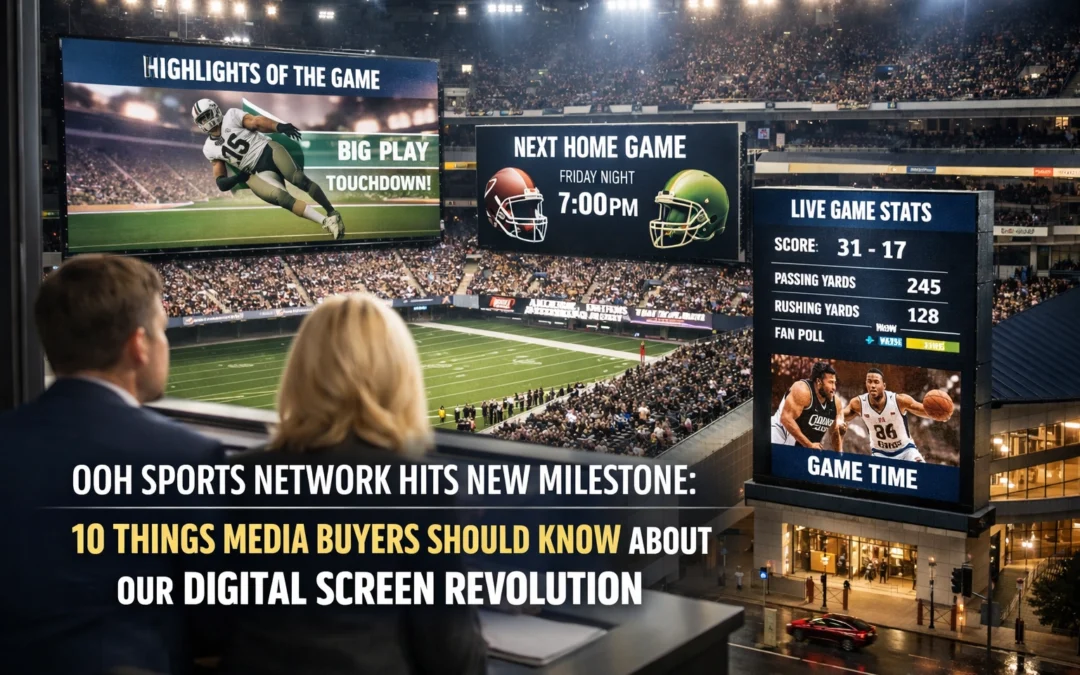
The sports advertising landscape has undergone a fundamental transformation. As traditional stadium sponsorships face rising costs and fragmented audience attention, a new approach has emerged that combines the scale of outdoor advertising with the precision of digital targeting.
OOH Sports has reached a significant expansion milestone, operating thousands of digital screens positioned strategically within proximity of major sports venues across North America. This network represents a shift in how brands connect with sports audiences, moving beyond static placements to dynamic, data-driven campaigns that activate precisely when and where fans are most engaged.
For media buyers evaluating sports marketing channels, the evolution of digital out-of-home (DOOH) around sports venues warrants serious consideration. The following insights outline what makes this channel distinct and how it fits into modern omnichannel strategies.
1. Scale and Strategic Positioning Create Multiple Fan Touchpoints
The network extends well beyond venue perimeters. Thousands of digital screens now line the corridors fans travel before, during, and after games, including transit routes, retail districts, hospitality zones, and parking areas surrounding stadiums and arenas.
This positioning strategy creates repeated exposure throughout the fan journey rather than relying on a single touchpoint. A fan traveling to a game encounters messaging on the highway approach, at nearby restaurants during pre-game gatherings, and again during the post-game commute. This repetition drives message retention and action in ways single-location placements cannot achieve.

2. Real-Time Creative Optimization Matches Campaign Messaging to Game Flow
Digital infrastructure enables advertisers to update creative in real time, aligning messaging with live game developments and audience sentiment. Brands can celebrate home team victories moments after final buzzers, update sports betting odds as games unfold, or shift messaging based on weather conditions affecting outdoor venues.
This dynamic capability ensures campaigns remain relevant to the unique energy surrounding each event. Rather than running static creative for weeks at a time, advertisers adapt messaging to match the specific context of each game day, increasing resonance and engagement.
3. Geofencing Technology Delivers Precision Timing
Campaign activation relies on geolocation technology that triggers ads based on actual traffic patterns and fan movement rather than fixed schedules. This precision ensures maximum impression delivery during peak attendance periods.
The technology tracks real-time traffic flow to and from venues, automatically adjusting impression delivery to match actual fan density. When unexpected delays occur or games run long, the system adapts accordingly, maintaining campaign efficiency without manual intervention.
4. Audience Engagement Metrics Exceed Traditional OOH Benchmarks
Research indicates that 99 percent of fans who attend games after exposure to OOH advertising spend money at local businesses, creating direct economic impact for brands targeting sports audiences. Additionally, 42 percent of consumers discuss sporting events with friends and family after seeing related outdoor ads, effectively multiplying reach through organic word-of-mouth amplification.
These engagement rates reflect the heightened emotional state of sports fans during game days. The combination of anticipation, excitement, and social gathering creates a receptive mindset that traditional commuter-focused OOH cannot replicate.

5. Measurable Attribution Rivals Digital Channel Performance
Sports DOOH campaigns now offer measurement capabilities that directly compete with digital advertising standards. The platform enables device ID tracking, foot traffic analysis, and brand lift studies that provide concrete evidence of campaign impact.
Attribution methodologies include:
- Exposure-based device ID capture for mobile retargeting
- Geo-behavioral analysis comparing exposed vs. control groups
- Point-of-sale data correlation in nearby retail locations
- Brand lift measurement through pre- and post-campaign surveys
Campaign performance data demonstrates significant lifts in key metrics. Documented case studies show purchase consideration increases of 74 percent and brand image improvements exceeding 100 percent for brands leveraging the sports DOOH channel effectively.
6. Fragmented Sports Viewing Habits Make Venue-Proximity Targeting Essential
As sports consumption fragments across linear television, streaming platforms, and mobile devices, reaching fans through their viewing habits alone has become increasingly complex and expensive. DOOH targeting based on physical proximity to venues captures audiences regardless of how they consume game broadcasts.
This approach fills a critical gap in sports marketing strategies. Whether fans watch games in-venue, at nearby sports bars, or at home after attending pre-game gatherings, they pass through the advertising corridors surrounding stadiums. This physical concentration provides a targeting method that transcends the complications of multi-platform media buying.
7. Omnichannel Integration Extends Campaign Reach Beyond Physical Screens
Modern sports DOOH campaigns function as anchor points in broader omnichannel strategies. Device IDs captured during screen exposure enable sequential messaging across mobile, social media, and connected TV platforms.
This integration creates a coordinated consumer journey. A fan exposed to DOOH creative while driving to a game later receives complementary mobile ads, follows up with social media engagement, and encounters related connected TV spots when streaming content at home. The DOOH exposure initiates the relationship, with other channels reinforcing and extending the message.

8. Hyper-Local Targeting Serves Regional Brands and National Campaigns Equally
The network proves particularly effective for local businesses seeking to reach concentrated fan audiences. Restaurants, retailers, and service providers near venues leverage the predictable traffic patterns surrounding games to drive immediate foot traffic and transactions.
National brands also benefit from the ability to customize messaging by market. A multi-market campaign can feature location-specific creative, promotional offers tied to local team performance, or market-by-market product launches aligned with regional sports calendars.
9. Market Growth Signals Channel Maturation and Advertiser Confidence
Industry projections indicate digital out-of-home will account for 45.2 percent of total OOH advertising spend by 2028, up from 22.0 percent in 2016. Sports environments represent a significant driver of this growth, with venue-proximity inventory experiencing particularly strong demand.
This expansion reflects advertiser confidence in the channel's performance and scalability. Major brands across categories including beverage alcohol, sports betting, automotive, and consumer packaged goods have shifted material budgets to sports DOOH based on documented performance advantages over alternative channels.
10. Programmatic Buying Infrastructure Simplifies Campaign Execution
The network operates within major programmatic platforms, enabling media buyers to plan, execute, and optimize campaigns using familiar tools and workflows. Integration with demand-side platforms allows for:
- Automated bidding and inventory optimization
- Real-time performance monitoring and adjustment
- Cross-channel budget allocation and pacing
- Unified reporting across DOOH and digital channels
This programmatic infrastructure removes traditional friction points associated with outdoor media buying. Campaigns launch within days rather than weeks, creative updates deploy instantly, and performance data flows in real time rather than through post-campaign reports.

Strategic Implications for Media Planning
The maturation of sports-focused DOOH represents more than incremental channel expansion. It addresses fundamental challenges facing sports marketers: fragmented audiences, attribution difficulties, and the need for contextually relevant messaging that respects the heightened emotional state of fans during games.
For media buyers not yet incorporating sports DOOH into their strategies, the channel has evolved from experimental to essential. The combination of scale, targeting precision, measurable performance, and programmatic accessibility positions venue-proximity DOOH as a core component of effective sports marketing campaigns.
As digital screen density continues increasing around major sports venues and attribution methodologies become more sophisticated, early adoption provides competitive advantages in securing premium inventory and developing optimization expertise. The brands achieving the strongest results are those treating sports DOOH not as a supplement to traditional channels but as a foundational element of integrated sports marketing strategies.
The digital screen revolution around sports venues has fundamentally altered how brands connect with one of advertising's most valuable and engaged audiences. For media buyers seeking performance, measurability, and relevance in sports marketing, this evolution warrants immediate strategic consideration.