
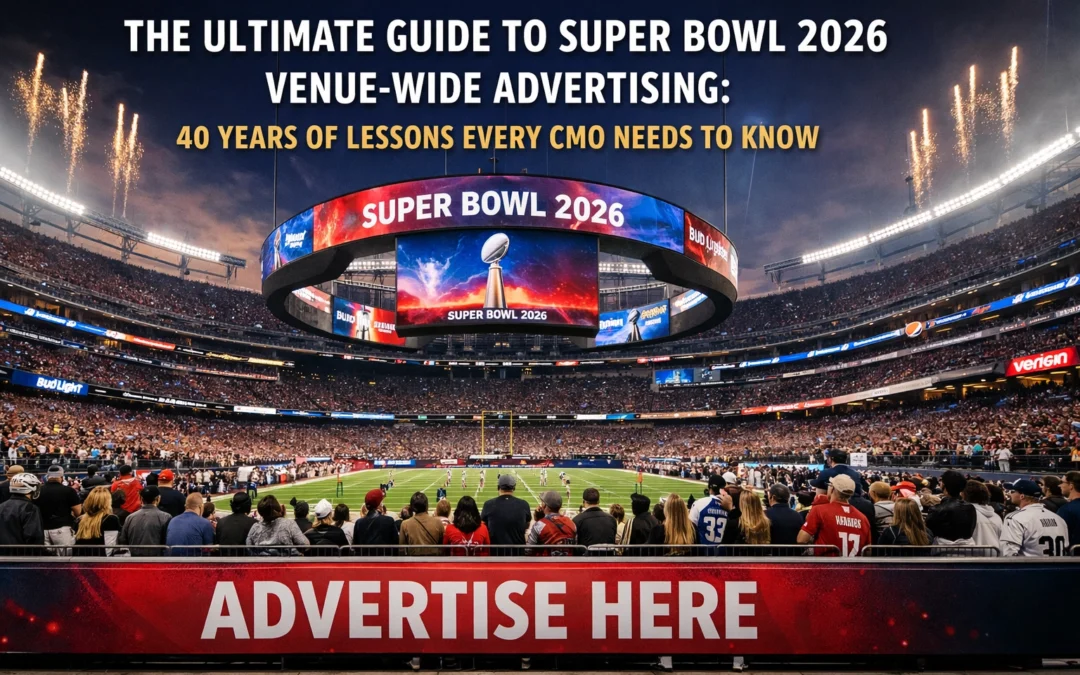
Super Bowl 2026 is coming. And if you're only thinking about TV spots, you're missing the bigger picture.
For 40 years, the smartest brands have known a secret: the venue is where the magic happens. From floor decals to massive billboards, venue-wide advertising puts your brand in front of fans when they're most engaged, most excited, and most likely to remember what they see.
Let's break down everything CMOs need to know about venue-wide advertising at the Super Bowl, including what four decades of data tells us actually works.
The Evolution of Venue-Wide Advertising: 40 Years of Getting Smarter
Back in the mid-1980s, Super Bowl venue advertising was simple. Some banners. Maybe a logo on the field. That was about it.
Fast forward to today, and venue-wide advertising has become a sophisticated science. Brands now cover every inch of the stadium experience, from the moment fans pull into the parking lot to when they leave.

The progression has been remarkable:
1985-1995: The Banner Era
Static signage and field-level banners dominated. Brands paid for visibility, but measurement was basically nonexistent.
1995-2005: The Digital Awakening
LED boards arrived. Suddenly, brands could rotate messages and show video content. Engagement jumped immediately.
2005-2015: The Integration Phase
Brands started thinking holistically. Concourse activations, branded lounges, and coordinated messaging across multiple touchpoints became the norm.
2015-Present: The Data-Driven Revolution
Programmatic capabilities, real-time adjustments, and attribution modeling changed everything. Brands can now prove ROI on venue advertising like never before.
Venue-Wide Coverage: Every Surface Tells Your Story
Modern Super Bowl venue advertising isn't about picking one spot. It's about creating an immersive brand experience that follows fans throughout their entire journey.
Floor Graphics and Field-Level Presence
Floor decals in high-traffic areas get seen thousands of times per hour. Tunnel wraps reach players and coaches. Field-level signage appears in broadcast shots, multiplying your investment.
Digital Billboards and LED Networks
The modern stadium is basically a network of screens. Rotating digital content keeps messages fresh and allows for real-time updates based on game situations.

Concourse Domination
This is where fans spend time between quarters. Branded charging stations, interactive displays, and experiential activations create memorable moments that TV ads simply cannot deliver.
Exterior and Approach Advertising
The experience starts before fans enter the building. Exterior wraps, parking lot signage, and approach billboards set the tone and capture everyone, not just ticket holders.
Premium Spaces and Hospitality Areas
Suites and club levels host decision-makers and high-value audiences. Tasteful branding in these spaces reaches exactly the people CMOs want to influence.
The 7 Lessons 40 Years Have Taught Us
After four decades of Super Bowl venue advertising, some patterns have become crystal clear.
Lesson 1: Repetition Drives Recall
Seeing a brand message once is forgettable. Seeing it ten times throughout the venue creates lasting impact. The data consistently shows that multi-touchpoint exposure increases brand recall by 60-80% compared to single-placement strategies.
Lesson 2: Context Is Everything
A beer brand near concessions performs differently than near the main entrance. Location strategy matters as much as creative quality.
Lesson 3: Integration Multiplies Impact
Brands that coordinate venue advertising with TV spots, social campaigns, and experiential activations see compounding returns. The whole truly is greater than the sum of its parts.

Lesson 4: Measurement Must Be Built In
The days of "spray and pray" are over. Successful venue campaigns now include foot traffic analysis, social listening, brand lift studies, and attribution modeling from day one.
Lesson 5: Fan Experience Comes First
The most effective venue advertising enhances rather than disrupts the fan experience. Brands that add value, whether through entertainment, information, or utility, win long-term loyalty.
Lesson 6: Flexibility Beats Perfection
The ability to adjust messages in real-time based on game flow or social media trends has proven more valuable than perfectly planned static campaigns.
Lesson 7: The Venue Audience Is Different
People at the venue are more engaged, more affluent, and more likely to influence others than TV-only viewers. The demographics justify premium investment.
What Makes Super Bowl 2026 Different
Super Bowl 2026 brings new opportunities that didn't exist even five years ago.
Programmatic DOOH technology now allows brands to buy and optimize venue placements with the same precision as digital advertising. Real-time bidding, audience targeting, and performance tracking have finally come to stadium advertising.
The integration of mobile technology means venue ads can now drive immediate action. QR codes, NFC tags, and app-based experiences turn passive viewing into active engagement.
Sustainability has become a selling point. Brands using digital displays instead of printed materials score points with environmentally conscious consumers. This matters more every year.
What CMOs Should Do Right Now
Planning for Super Bowl 2026 venue advertising requires starting early and thinking strategically.
Secure Inventory Now
The best placements sell out months in advance. Premium locations with broadcast visibility or high foot traffic disappear first.
Think Beyond Awareness
Set clear objectives. Are you driving trial? Building brand preference? Launching a new product? Different goals require different venue strategies.
Plan for Measurement
Work with partners who can track everything from foot traffic patterns to social media engagement to post-event brand lift. Data proves value and informs future investment.
Coordinate Across Channels
Venue advertising delivers maximum ROI when it's part of an integrated campaign. Align messaging, timing, and calls-to-action across all touchpoints.
Test and Learn
If this is your first Super Bowl venue play, start with a diversified approach. Test different locations and formats, then scale what works for future events.

The Bottom Line
Forty years of Super Bowl venue advertising have proven one thing conclusively: brands that show up in the stadium see measurably better results than those that rely on TV alone.
The venue is where fans are most engaged. It's where emotional connections form. It's where your brand becomes part of the experience rather than an interruption.
Super Bowl 2026 represents the most sophisticated venue advertising opportunity in history. The technology is better. The measurement is clearer. The creative possibilities are endless.
For CMOs willing to invest in venue-wide coverage, from floor graphics to digital billboards and everything in between, the lessons from 40 years are clear: this is where the smart money goes.
The game happens once. The impressions last forever.
Ready to make Super Bowl 2026 your biggest venue advertising win yet? The playbook is written. Now it's time to execute.