
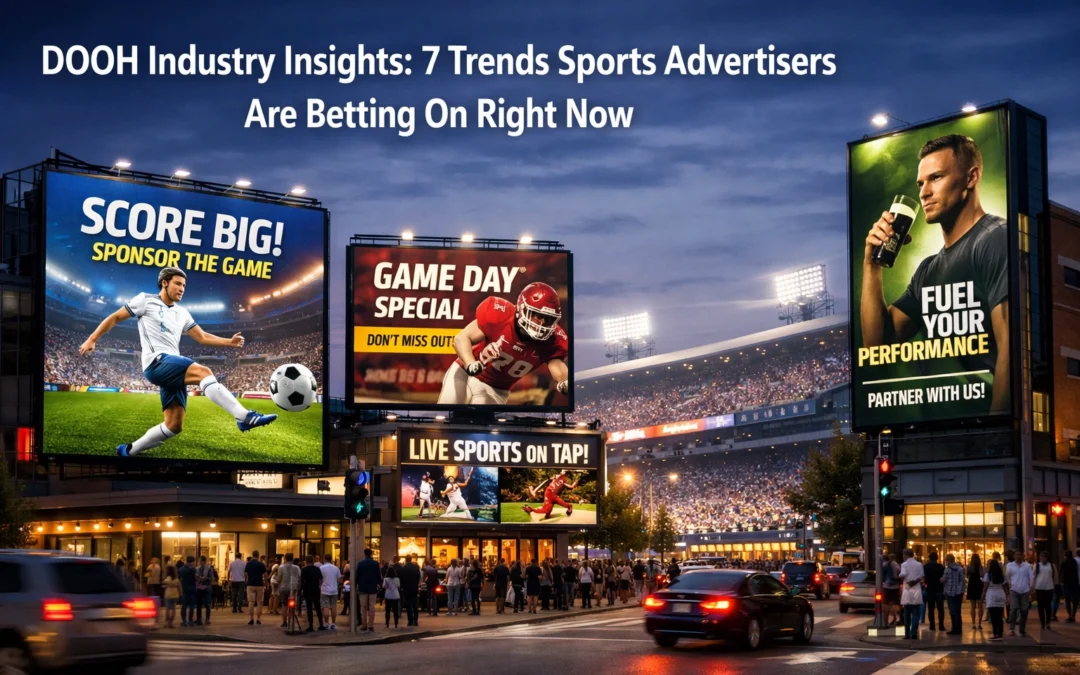
The sports advertising landscape is shifting faster than a breakaway goal. Digital out-of-home (DOOH) has evolved from billboards near stadiums to a sophisticated, data-driven powerhouse that rivals digital channels in targeting precision and measurability. As major sporting events continue to draw massive audiences across multiple touchpoints, advertisers are adapting their strategies to meet fans where they are, when they're most engaged.
The numbers tell a compelling story. Nearly 60% of US adults recall OOH ads for major sporting events, and an impressive 90% take action afterward, whether that means tuning in, sharing content online, or engaging locally. This level of recall and activation has pushed sports advertisers to rethink how they approach DOOH campaigns.
Here are seven trends reshaping how brands connect with sports audiences through digital out-of-home advertising.
1. Programmatic DOOH Becomes the Foundation
Gone are the days of manual insertion orders and static campaign planning. Programmatic DOOH has transitioned from experimental tactic to industry standard, fundamentally changing how brands secure and activate inventory.
The programmatic approach offers a dual advantage. Advertisers can lock in high-demand screens well ahead of major events, ensuring placement near stadiums, fan zones, and key transportation routes. Simultaneously, they maintain the flexibility to adjust campaigns dynamically as events unfold, responding to game outcomes, weather shifts, or unexpected viral moments.

This capability proves particularly valuable during tournament-style competitions where audience movement patterns change daily and brand opportunities emerge in real time. Rather than committing to fixed creative months in advance, brands can secure premium locations while reserving the right to optimize messaging based on live conditions.
The shift to programmatic infrastructure also enables more sophisticated buying strategies, including audience-based targeting, dayparting around game schedules, and competitive separation from rival brands.
2. Dynamic Creative Optimization Mirrors the Fan Experience
Static messaging no longer cuts it when fans experience sports in real time. Dynamic Creative Optimization (DCO) has emerged as the technology that transforms DOOH from passive displays into responsive, moment-driven communications.
DCO-powered campaigns adapt instantly based on:
- Live game outcomes and scoring plays
- Weather conditions affecting outdoor viewing
- Foot traffic patterns around venues
- Time-sensitive moments like halftime or post-game
This responsiveness creates relevance that generic advertising cannot match. When a team scores, brands can celebrate with fans immediately. When rain threatens an outdoor event, messaging shifts to indoor venues or weather-appropriate products. The technology essentially allows DOOH to participate in the same conversation fans are having in real time.
The result is advertising that feels less like interruption and more like enhancement of the sports experience itself. Rather than fighting for attention, brands become part of the narrative unfolding around the event.
3. Smart Billboards Leverage AI for Hyperlocal Precision
The next generation of DOOH infrastructure combines GPS, sensors, and artificial intelligence to deliver contextually relevant messages at a hyperlocal level. These smart billboards analyze real-time conditions to determine optimal content for each moment and location.
The performance gains are measurable. Hyperlocal smart billboard campaigns boost action rates by 6% and increase purchase intent 1.3 times over generic advertisements. Perhaps most significantly, 55% of audiences report feeling these campaigns are personally relevant, a critical factor in driving engagement.

Smart billboards excel in sports contexts because they can factor in multiple variables simultaneously. A display near a stadium might consider the current game score, weather conditions, traffic patterns, and demographic data to serve the most relevant message. The same screen could show different creative to fans arriving for a game versus those departing afterward, or adjust messaging based on whether the home team won or lost.
This level of sophistication moves DOOH beyond traditional outdoor advertising into territory previously occupied only by digital channels with extensive user data.
4. Convergent Media Strategy Erases Channel Boundaries
The artificial separation between linear TV, streaming, social media, and DOOH is disappearing. Sports advertisers now recognize that fans experience events across multiple screens simultaneously, and successful campaigns mirror this behavior through convergent media strategies.
The data supports this integrated approach. Streaming-exclusive sports content delivers 66% stronger ad effectiveness compared to broadcast averages. Super Bowl advertisements performed 243% more effectively on streaming platforms than traditional television, signaling a fundamental shift in how audiences consume sports content.
Forward-thinking brands no longer plan DOOH campaigns in isolation. Instead, they coordinate big-screen live moments with immediate social amplification, capturing both the in-the-moment energy around venues and the extended conversation happening online. DOOH serves as the physical anchor point, while digital channels extend reach and enable two-way engagement.
This convergence also acknowledges that sports fans increasingly consume content in non-traditional ways. Highlights shared on social platforms, streaming games on mobile devices, and following live updates while out-of-home all create opportunities for coordinated messaging across channels. Brands that treat these touchpoints as part of a unified experience rather than separate campaigns see stronger performance across all channels.
5. Mixed Reality Creates Shareable Cultural Moments
As inventory at major sporting events becomes increasingly crowded and expensive, brands are turning to Mixed Reality executions, often called FOOH (Fake Out-of-Home), to create outsized impact without requiring physical placement at every premium location.
These immersive experiences transform sports moments into clip-friendly, naturally shareable content designed for social amplification. Sports and Recreation consistently emerges as a top-performing category for these executions, alongside Automotive, particularly when campaigns achieve cultural relevance that accelerates performance sharply.
The appeal is straightforward. A cleverly executed Mixed Reality moment can generate millions of impressions through organic sharing, extending the value of DOOH investment far beyond the physical screen. Rather than paying premium rates for every high-traffic location, brands can create spectacular moments at select sites and let social media multiply the reach.

This trend also reflects changing audience expectations. Fans increasingly value experiences that are worth documenting and sharing. Mixed Reality executions give them something remarkable to capture and distribute through their own networks, turning audience members into active participants in campaign distribution.
6. Geofencing Activates High-Intent Zones
Location has always mattered in out-of-home advertising, but geofencing technology has transformed how advertisers identify and activate high-intent zones around sporting events.
Rather than relying solely on static screen placement, brands now use geofencing and device data to trigger campaigns based on audience location and behavior patterns. High-intent zones include:
- Airports during arrival and departure waves
- Stadium perimeters before and after games
- Fan zones and viewing parties
- Transit hubs connecting venues to hotels and restaurants
- Entertainment districts near sporting venues
These locations signal where fan engagement peaks and where audiences are most receptive to brand messaging. Data shows that contextual relevance dramatically improves campaign effectiveness, making proper zone selection critical to ROI.
Geofencing also enables sequential messaging strategies. A brand might serve one message to fans approaching a venue, a different message at halftime, and follow-up messaging to those leaving the event. This sequential approach builds narrative throughout the fan journey rather than relying on a single impression.
The technology further allows advertisers to build retargeting audiences based on DOOH exposure, connecting out-of-home impressions to subsequent digital engagement and closing the loop on cross-channel attribution.
7. Attribution Links Screens to Business Outcomes
Perhaps the most significant evolution in DOOH involves measurement. The channel has moved beyond impressions and reach to demonstrate direct connections between exposure and business results.
Modern DOOH campaigns track multiple outcome metrics:
- Point-of-sale transactions and sales lift
- Physical footfall to stores and venues
- Mobile app downloads and engagement
- Brand lift across awareness, consideration, and preference
- Location data showing visit patterns after exposure
This attribution capability proves ROI through concrete outcomes rather than estimated impressions. Brands can now demonstrate that ads near stadium exits, transit lines, or fan festival entrances directly impact store visits, product purchases, and brand perception.
The measurement infrastructure combines mobile location data, device IDs, brand lift studies, and sales data to create a comprehensive view of campaign impact. This level of accountability puts DOOH on equal footing with digital channels that have long offered detailed performance metrics.
For sports advertisers specifically, attribution closes the gap between awareness and action. Rather than assuming fans exposed to DOOH will eventually convert, brands can track the customer journey from screen exposure through consideration to final purchase or engagement.
Moving Forward
The DOOH landscape for sports advertising has matured rapidly, combining the scale and impact of traditional outdoor with the targeting precision and measurability of digital channels. These seven trends represent fundamental shifts in how brands approach out-of-home rather than temporary tactics.
As sporting events continue drawing massive audiences across multiple markets and touchpoints, advertisers who embrace programmatic infrastructure, real-time responsiveness, smart targeting, and rigorous measurement will capture the greatest share of attention and action. The question is no longer whether DOOH delivers results, but rather how sophisticated brands will become in leveraging its full potential.
The convergence of these trends creates unprecedented opportunities for sports advertisers to reach fans when and where they're most engaged, with messages that respond to real-time context and deliver measurable business outcomes. The brands investing in these capabilities now are positioning themselves to dominate sports marketing for years to come.