
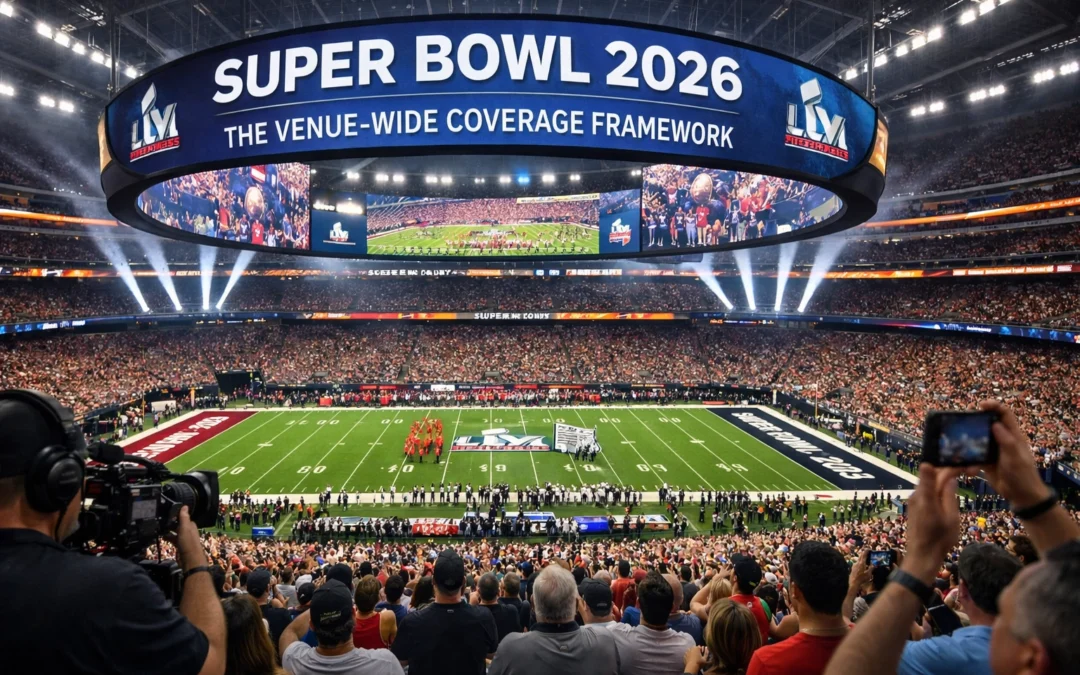
Super Bowl LX isn't just another game. It's the biggest advertising stage on the planet, and for the first time, brands have access to a complete venue-wide coverage system that reaches fans from the moment they step on stadium grounds to the second they leave.
After 40 years in sports advertising, we've seen every evolution in the game. But what's happening at Super Bowl 2026 is different. The technology, the scale, the sheer reach across every surface is unprecedented.
The Complete Coverage Approach
Think about how fans experience a Super Bowl. They're not just sitting in seats watching a game. They're walking through parking lots, standing in concession lines, checking their phones, looking at massive LED boards, and interacting with every surface around them.
That's exactly what venue-wide coverage targets. Every touchpoint. Every moment. Every surface.
The framework covers:
- Ground-level displays on stadium floors and walkways
- Perimeter LED boards surrounding the field
- Concourse advertising throughout interior spaces
- Digital displays at concession stands and restrooms
- Exterior billboards visible from miles away
- Parking lot signage capturing arriving fans

This isn't about picking one channel. It's about owning the entire fan journey through coordinated placement across multiple formats simultaneously.
Why Venue-Wide Coverage Matters More Than Ever
Super Bowl 2026 at Levi's Stadium brings together the largest concentration of high-value consumers in sports. Over 70,000 fans attend in person, but the venue infrastructure now connects those fans to millions watching remotely through shared visual experiences.
The stadium features 32,000 square feet of 4K LED signage, the largest outdoor glass-to-glass 4K displays in the NFL. Every camera captures in 4K, every system processes in 4K, and every display outputs in 4K. That means your brand message appears in crystal-clear resolution whether fans see it live or on broadcast replays.
But here's what most brands miss: the real power comes from layering these placements. When fans see your brand on the parking lot billboard, then again on the concourse display, then on the field perimeter, and finally on their phone through geo-targeted mobile ads, you're not just advertising. You're creating an unavoidable brand presence.
Research backs this up. Stadium perimeter advertising generates stronger emotional connections than social media campaigns because fans associate the brand directly with the live experience they're having.
The Technology Behind Seamless Coverage
https://www.youtube.com/watch?v=l6J-0zileKE
The infrastructure supporting Super Bowl 2026 represents a massive technological leap. A unified network handles everything through a single IP-based architecture connecting 12,000 network ports, 400 miles of fiber-optic cable, and over 2,000 IPTV screens throughout the 1.85-million-square-foot venue.
Nearly 1,500 Wi-Fi 7 access points operate on 6 GHz spectrum, ensuring every fan stays connected. Verizon, AT&T, and T-Mobile executed almost 200 individual projects layering multiple spectrum bands throughout the venue and surrounding areas.

What does this mean for advertisers? Your digital content can sync across every screen in real time. You can trigger specific creative based on game moments, coordinate messages across indoor and outdoor displays, and ensure your brand appears at exactly the right moments throughout the event.
The production system processes 432 replay channels simultaneously. That's 432 opportunities for your perimeter signage to appear on broadcast feeds reaching homes worldwide. Every replay angle potentially captures your placement, multiplying your reach exponentially beyond the stadium itself.
Strategic Placement Opportunities
Venue-wide coverage isn't about random placement. It's strategic choreography across multiple zones, each serving different purposes in the fan journey.
Arrival Zone Coverage
Fans start engaging miles before entering the stadium. Exterior billboards on approach routes, parking lot signage, and entrance displays create the first brand touchpoints. These placements capture fans when they're most excited and receptive.
Interior Experience Coverage
Once inside, fans move through concourses where digital displays line every pathway. Concession areas, merchandise stands, and restroom corridors all feature advertising opportunities. These moments catch fans during natural breaks in attention, when they're actively looking around.
Field-Level Visibility
Perimeter LED boards deliver the most valuable inventory. These placements appear in broadcast feeds, replay sequences, and every wide shot of the field. With 145 cameras covering the game (81 for live action, 64 for pregame), your brand has countless opportunities to reach global audiences.

Ground-Level Integration
Floor graphics and ground-level displays target fans looking down while walking. These placements face zero competition for attention, offering unique visibility that traditional elevated signage can't match.
The 40-Year Advantage
Four decades in sports advertising teaches you things that technology alone can't deliver. You learn which placements drive actual results. Which combinations amplify each other. Which timing maximizes impact.
The venue-wide framework leverages this experience by coordinating placements that historically perform best together. It's not about buying every available surface. It's about selecting the right mix that creates compound effects.
Brands working with experienced partners gain access to preferred inventory locations, strategic timing recommendations, and creative optimization based on thousands of previous campaigns. Traditional stadium sponsorships offer certain advantages, but venue-wide coverage frameworks combine the best of multiple approaches into coordinated campaigns that deliver measurable ROI.
Measuring Multi-Surface Impact
The challenge with venue-wide coverage has always been measurement. How do you prove that coordinated placement across multiple surfaces drives better results than single-channel campaigns?
Modern attribution technology now tracks this precisely. Device IDs captured through venue Wi-Fi networks can be matched to subsequent purchase behavior. Brand lift studies compare exposed audiences against control groups. Foot traffic analysis measures real-world visitation changes after campaigns.

Case studies demonstrate the impact. Brands deploying coordinated DOOH campaigns across multiple venues and formats consistently achieve triple-digit lifts in key metrics. White Claw's programmatic DOOH campaign drove a 74% lift in purchase consideration. Mike's Hard Iced Tea saw a 119% lift in positive brand image. Sea-Doo increased purchase consideration by 144%.
These aren't small incremental gains. They're transformative results that justify premium Super Bowl investment.
Planning Your Super Bowl 2026 Coverage
Venue-wide coverage requires advance planning. The best placements get reserved months ahead. Creative needs coordination across multiple formats. Technology integration takes time.
Brands serious about maximizing Super Bowl 2026 impact should start planning now. Identify your key objectives, define your target audience segments, and map out which venue zones align with your goals.
Consider how your message changes across different contexts. Parking lot signage might emphasize brand awareness while concourse displays drive specific calls to action. Field perimeter placements reinforce brand association with the premium Super Bowl experience.
The framework works because it mirrors how fans actually experience the event. They don't just watch the game. They immerse themselves in the entire environment for hours. Venue-wide coverage ensures your brand becomes part of that immersive experience, creating memories that last long after the final whistle.
Super Bowl LX represents the evolution of sports advertising into truly integrated, multi-surface campaigns that capture attention at every moment. After 40 years in this business, we can say with confidence: this is the most powerful advertising opportunity in sports history.