
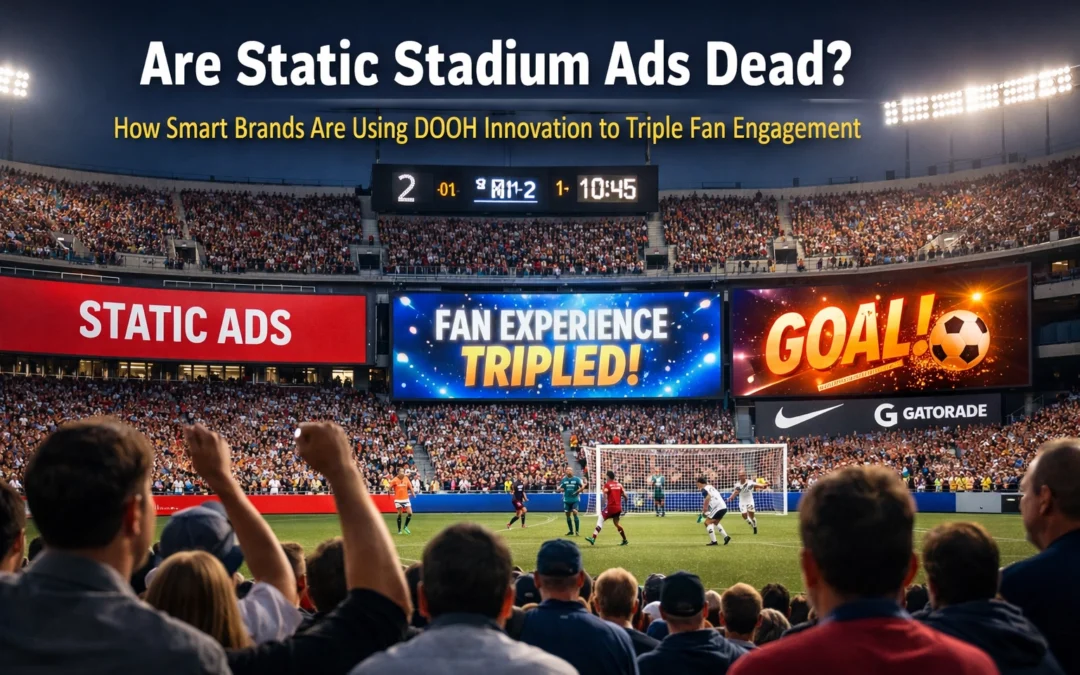
Static stadium advertisements are rapidly losing relevance in modern sports venues. As technology transforms the fan experience, traditional billboards and painted signage are giving way to dynamic digital formats that deliver real-time personalization and quantifiable engagement metrics.
The shift represents more than a simple technology upgrade. Digital out-of-home (DOOH) advertising in sports environments now enables brands to respond to game situations, weather conditions, and audience demographics in real time, creating advertising experiences that static placements could never achieve.
The Decline of Static Stadium Advertising
Traditional static ads in sports venues operate on a simple premise: place a logo or message where fans will see it, then hope for the best. This approach fails to account for changing game contexts, varying audience segments, or the ability to measure actual impact beyond estimated impressions.
Static placements lock brands into messaging decisions made weeks or months before game day. A predetermined advertisement cannot adapt when unexpected weather shifts fan behavior, when game momentum creates emotional peaks, or when specific audience segments require tailored messaging. This inflexibility leaves significant engagement opportunities unexploited.
The measurement limitations of static advertising compound these challenges. Brands investing substantial budgets in stadium placements historically relied on attendance figures and estimated viewership to justify expenditures, without concrete data on attention, engagement, or conversion impact.

Dynamic Content That Responds to Real-Time Conditions
Modern DOOH systems in sports venues replace rigid static content with adaptive messaging that responds to multiple variables simultaneously. A beverage brand can promote cold drinks during timeouts on hot afternoons, then shift to food pairings as evening temperatures drop. A restaurant chain can advertise lunch specials during daytime events and happy hour offerings as evening games conclude.
This adaptability extends beyond simple time-based rotations. Advanced DOOH platforms incorporate:
- Game situation triggers that adjust messaging based on scoring plays, timeouts, or momentum shifts
- Weather integration that responds to temperature, precipitation, or humidity conditions
- Audience demographic data that tailors content to specific attendee profiles
- Broadcast integration that optimizes content for television camera angles and broadcast timing
AI-driven content management systems handle the complexity of managing these variables, automatically selecting optimal creative executions from brand-approved libraries based on current conditions. Motion-tracking technology adjusts brightness and color balance to ensure visibility across different lighting scenarios and camera positions.
Multiple Touchpoints Create Comprehensive Brand Experiences
Smart venues deploy digital screens across the entire fan journey, creating what industry professionals describe as surround-sound advertising experiences. Rather than relying on a single perimeter board placement, brands can reinforce messaging at strategic moments throughout venue navigation.
Key touchpoints include:
- Parking lot LED billboards that begin brand exposure before venue entry
- Entrance pathway digital displays that reach fans during high-attention moments
- Concourse screens positioned at decision points near concessions and restrooms
- Concession area displays that influence purchase decisions at point-of-sale
- In-seat mobile integrations that extend engagement to personal devices
- Exit pathway signage that reinforces messaging as fans depart
Each touchpoint serves a distinct purpose in the engagement funnel. Entrance displays build awareness and establish brand presence. Concourse placements drive consideration during natural pause points in the fan experience. Concession area screens influence immediate purchase behavior. Mobile integrations enable direct response and ongoing engagement beyond the venue.

Interactive Elements That Deepen Fan Participation
Beyond dynamic content delivery, modern DOOH systems incorporate interactive features that transform passive viewing into active participation. These elements create measurable engagement that static advertising cannot replicate.
QR-based offers appearing during strategic game moments enable instant redemption and trackable conversion. When a brand displays a time-limited discount code during a timeout, fans can scan and redeem immediately, creating attribution that links venue exposure directly to transaction behavior.
Second-screen experiences unlock additional value for engaged fans. A perimeter board might prompt fans to access exclusive content, live statistics, or behind-the-scenes footage through their mobile devices, extending engagement duration and collecting opt-in data for future targeting.
Augmented reality integrations connect physical venue advertising to immersive digital experiences. Brands can layer virtual elements onto broadcast feeds or mobile applications, creating engagement opportunities that blend physical presence with digital interaction.
Dynamic Creative Optimization (DCO) represents a particularly powerful innovation for sports advertising. Rather than displaying static brand imagery, DCO-enabled ads incorporate live scores, recent plays, or current statistics directly into creative executions. Research indicates this approach can improve return on ad spend by 20-30% compared to static creative, as real-time relevance captures attention more effectively than generic messaging.
Measurement Capabilities That Prove ROI
The most significant advantage DOOH holds over static advertising lies in comprehensive measurement and attribution capabilities. Smart venue systems track multiple engagement metrics that enable data-driven optimization and clear ROI demonstration.
Advanced sensor networks and analytics platforms monitor:
- Impression counts with attention verification rather than simple exposure estimates
- Dwell time measurements that indicate actual viewing duration
- Audience sentiment analysis through facial recognition and behavioral monitoring
- Traffic pattern data that reveals optimal placement locations and timing
- Conversion attribution through mobile device tracking and purchase correlation
This measurement infrastructure transforms venue advertising from a brand-building expense with questionable accountability into a performance marketing channel with digital-level precision. Brands can identify which creative executions drive strongest response, which venue locations deliver optimal engagement, and which audience segments demonstrate highest conversion propensity.
The ability to prove ROI with concrete data drives increased investment in venue advertising. Media buyers and brand managers can justify budget allocation with performance metrics comparable to digital campaigns, removing the uncertainty that historically limited venue advertising expenditure.

Strategic Implications for Brand Managers
The transition from static to DOOH advertising requires strategic reconsideration of venue marketing approaches. Brands must shift from set-it-and-forget-it placements to dynamic campaign management that leverages real-time optimization capabilities.
Successful DOOH strategies begin with creative libraries rather than single executions. Brands need multiple approved variations that address different contexts, audiences, and objectives. A comprehensive creative library might include 15-20 distinct executions optimized for various game situations, weather conditions, and audience segments.
Data integration becomes critical. Brands must connect venue advertising systems to broader marketing data platforms, enabling audience insights from other channels to inform venue targeting and allowing venue engagement data to enhance broader campaign optimization.
Testing and learning cycles replace annual planning rhythms. DOOH platforms enable rapid experimentation with different messages, timing strategies, and creative approaches. Brands that embrace continuous testing identify high-performing approaches quickly and scale successful tactics across venue networks.
Attribution modeling connects venue exposure to downstream business outcomes. By tracking device IDs exposed to venue advertising and correlating with subsequent online behavior or retail purchases, brands can demonstrate concrete impact on business metrics rather than relying on estimated reach.
Implementation Considerations
Brands exploring DOOH innovation should evaluate several key factors when planning venue advertising strategies. Technical compatibility between venue systems and brand data platforms ensures seamless campaign execution and measurement. Creative production capabilities must support rapid iteration and variation development. Analytics infrastructure needs capacity to ingest, process, and act on real-time venue data.
Partnership selection matters significantly. Venues vary widely in their DOOH sophistication, from basic digital screen installations to fully integrated smart venue systems. Brands should prioritize venues offering comprehensive measurement, real-time optimization capabilities, and proven engagement track records.
The investment in DOOH typically exceeds static placement costs, but performance improvements justify the premium. Brands reporting 2-3x engagement increases and 20-30% ROAS improvements find that superior performance more than compensates for higher unit costs.
The Future of Venue Advertising
Static stadium advertising is not technically dead, but it increasingly represents a legacy approach disconnected from modern marketing expectations. As venues continue upgrading to digital infrastructure and brands demand measurable performance, the migration from static to DOOH will accelerate.
Smart brands are already capitalizing on this transition, using DOOH innovation to create fan experiences that static advertising could never deliver while generating concrete performance data that justifies continued investment. The question facing media buyers and brand managers is not whether to adopt DOOH, but how quickly they can transition budgets to capitalize on capabilities that triple fan engagement and deliver digital-level accountability.