
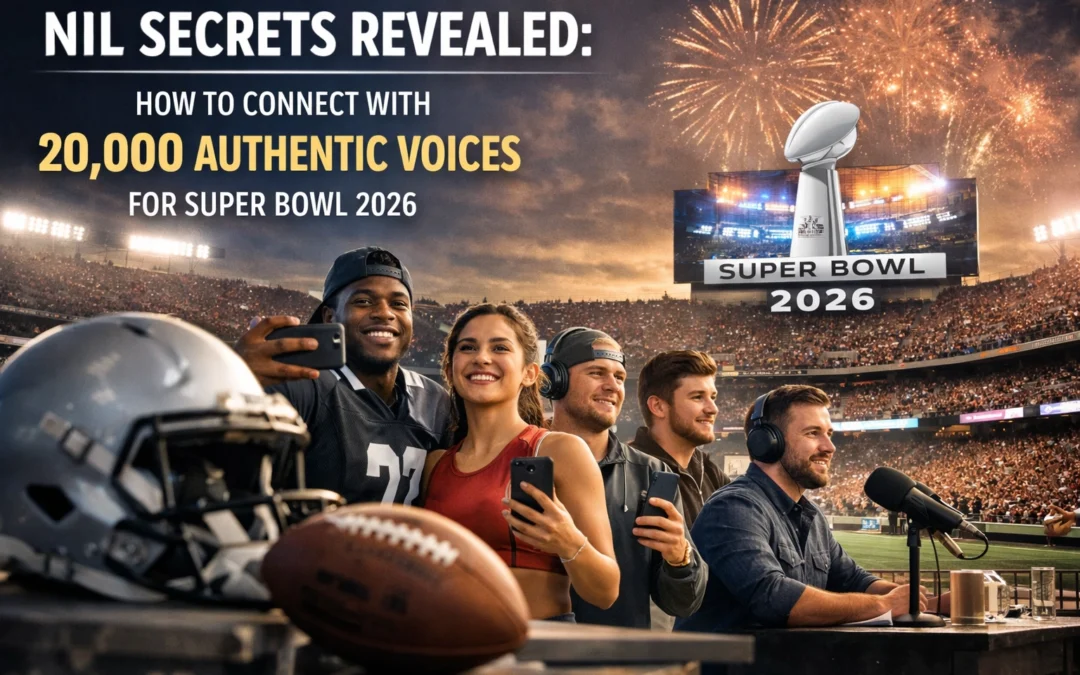
The landscape of sports marketing is undergoing a fundamental shift as the industry moves toward Super Bowl 2026. Traditional celebrity endorsements are no longer the sole drivers of consumer engagement. Instead, the focus has pivoted toward authenticity and local influence. This transition is powered by the rise of Name, Image, and Likeness (NIL) opportunities, which allow brands to partner with student-athletes who possess deep, trusted connections with their audiences.
For media buyers aiming to maximize impact during the biggest sporting event of the year, the secret lies in a network of over 20,000 authentic student-athlete voices. These athletes represent a diverse range of sports, geographies, and demographics, offering a level of peer-to-peer influence that traditional media often struggles to replicate.
The Power of 20,000 Authentic Voices
The core of a successful NIL strategy for Super Bowl 2026 involves tapping into the massive ecosystem of college athletes. These individuals are not just players on a field, they are content creators with direct access to highly engaged alumni networks, campus communities, and passionate fan bases. By leveraging a platform that connects brands with 20,000 of these voices, media buyers can achieve a scale that was previously impossible in the influencer marketing space.
These athletes operate across every major university and secondary market in the United States. This broad reach allows for a multi-layered approach to brand messaging. While a single Super Bowl commercial reaches a broad national audience, 20,000 NIL partners can saturate specific markets with personalized, relatable content.
Strategy: The Tiered Athlete Participation Structure
To manage a campaign of this magnitude effectively, a tiered participation structure is necessary. This approach ensures that the budget is allocated across different levels of influence to maximize both reach and engagement.
- Top-Tier Athletes (100,000+ Followers): These athletes serve as the anchor for the campaign. They provide high-production value content and high-level visibility. Their role is to establish brand authority and broad awareness.
- Mid-Tier Athletes (10,000 to 100,000 Followers): This group provides the necessary volume and reach. They often have higher engagement rates than top-tier celebrities because their followers feel a more personal connection to their journey.
- Micro-Athletes (Under 10,000 Followers): These athletes are the secret weapon for hyper-local activation. They deliver authentic peer-to-peer recommendations within their specific campus or local community.

Objective and Strategy: Integrating NIL with Digital Out-of-Home (DOOH)
A standalone social media campaign often lacks the physical presence needed to dominate the Super Bowl conversation. The most effective strategies for 2026 involve a synergy between NIL voices and Digital Out-of-Home (DOOH) advertising. For instance, OOH Sports has expanded to 25,000 digital screens across America, providing the perfect canvas to amplify NIL content.
When a student-athlete posts a video on TikTok or Instagram, that same content can be repurposed and displayed on digital screens in high-traffic areas, stadiums, and transit hubs. This cross-channel approach ensures that the brand message follows the consumer from their phone to the physical world.
https://www.youtube.com/watch?v=l6J-0zileKE
Demographic and Geographic Precision
One of the most significant advantages of the NIL platform is the ability to target audiences with extreme precision. Media buyers can select athletes based on specific criteria to ensure the message resonates with the intended demographic.
- Geographic Targeting: Brands can activate athletes at universities in specific markets to drive regional awareness. If a brand wants to target the host city of the Super Bowl or specific regions with high product demand, they can deploy 50 to 100 athletes in those exact locations simultaneously.
- Demographic Precision: Matching brand messaging with athlete profiles is crucial. Female athletes often reach different audience segments than football players. Similarly, athletes in Olympic sports or esports can connect with fitness enthusiasts or gaming communities, respectively.
This level of targeting ensures that the advertising spend is not wasted on irrelevant audiences. Instead, it builds a web of influence that feels organic and localized.

Technology Partners and Execution
Executing a campaign with 20,000 athletes requires robust technology and streamlined processes. Media buyers should look for platforms that handle the logistics of recruitment, contract execution, and content approval.
Planning for Super Bowl 2026 should ideally begin 90 to 120 days before the game. This timeline allows for the recruitment of the right talent and the creation of high-quality content that aligns with the brand's goals. Campaigns should launch two to three weeks before the event to build momentum, peaking during Super Bowl week, and continuing post-game to maintain engagement.

Creative Flexibility and Brand Safety
A common mistake in influencer marketing is forcing athletes to follow a rigid script. The strength of NIL lies in the athlete's unique voice. Successful campaigns provide clear brand messaging parameters while allowing the athletes creative freedom. When a student-athlete expresses a brand message in their own words, the content feels more like a recommendation from a friend than a traditional advertisement.
This authenticity is what drives results. For example, programmatic DOOH campaigns have shown significant lifts in purchase consideration, such as the 144 percent increase seen in Sea-Doo's first digital OOH campaign. By combining the reach of 25,000 digital screens with the authentic voices of 20,000 athletes, brands can achieve similar, if not greater, impact.
Results: Measuring the Impact of NIL
Measuring the success of an NIL campaign involves tracking both digital engagement and real-world actions. Media buyers should utilize unique URLs, promo codes, and QR codes assigned to individual athletes. This data allows brands to identify which athletes and what types of content are driving the strongest response.
Key metrics to track include:
- Website visits and app downloads.
- Direct purchase activity via promo codes.
- Brand lift and purchase consideration.
- Social media engagement rates (likes, shares, comments).
Data from previous campaigns indicates that NIL initiatives often deliver a lower cost per acquisition compared to traditional influencer marketing. This is particularly true when reaching younger demographics who are increasingly resistant to conventional media formats. For more insights on ROI, media buyers can explore how programmatic DOOH delivers better ROI for sports marketing.

The Future of Super Bowl Advertising
As the industry prepares for 2026, the integration of NIL and OOH Sports technology will define the most successful campaigns. The ability to connect with 20,000 authentic voices provides a level of scale and intimacy that was once thought to be mutually exclusive.
By leveraging the power of student-athletes, brands can move beyond the "one-size-fits-all" approach of the past. Instead, they can create a diverse, localized, and highly effective marketing machine that captures the hearts and wallets of fans across the country. The secret to Super Bowl success is no longer just about the commercial break, it is about the thousands of authentic conversations happening before, during, and after the game.
For those looking to stay ahead of the curve, the combination of student-athlete influence and the massive reach of digital screen networks represents the next frontier in advertising. Exploring these NIL secrets now will ensure that media buyers are ready to dominate the conversation in 2026.