
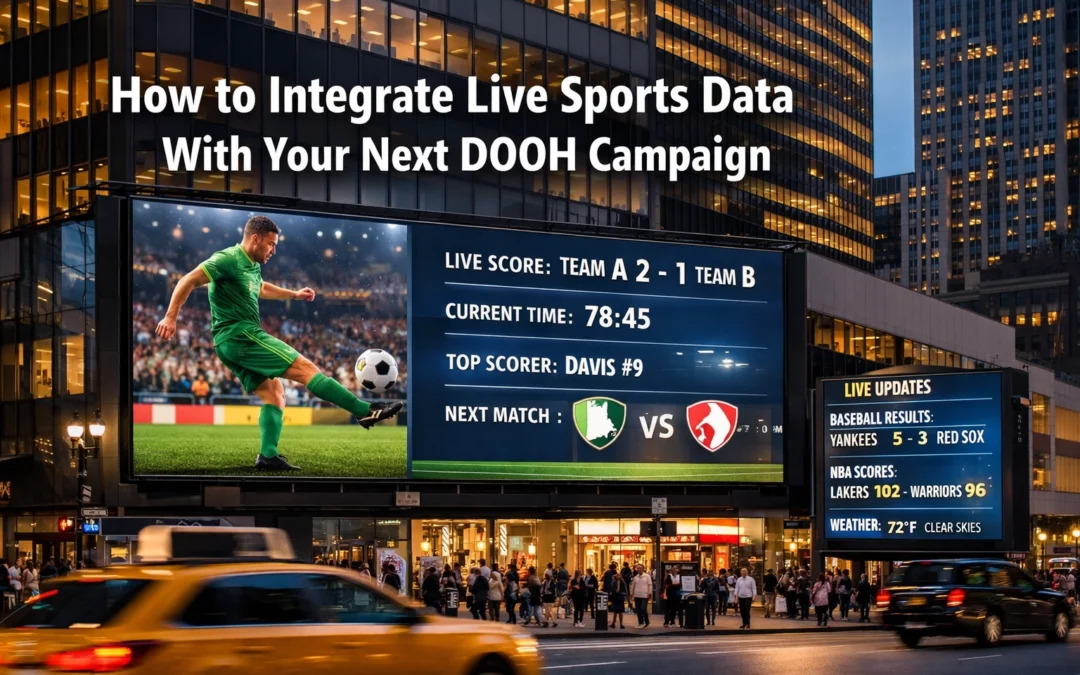

The landscape of Digital Out-of-Home (DOOH) advertising is undergoing a significant transformation, driven by the integration of real-time data and programmatic execution. For sports marketers, this evolution offers a unique opportunity to connect with fans at the height of emotional engagement. Integrating live sports data into a DOOH campaign moves a brand beyond static messaging and into the realm of utility and real-time relevance. By leveraging live scores, player statistics, and game events, advertisers can ensure their content is always contextual, capturing the attention of a highly distracted but passionate audience.
The following guide outlines the strategic framework, technological requirements, and execution tactics necessary to successfully integrate live sports data into a DOOH campaign.
The Strategy of Real-Time Engagement
Successful sports advertising relies on timing. The primary objective of integrating live data is to align brand messaging with the lived experience of the fan. Whether a game is in the pre-game hype phase, the heat of a blowout, or a nail-biting final minute, the tone of the advertising must match the moment.
A data-driven strategy allows for three primary levels of engagement:
- Utility: Providing the audience with valuable information, such as live scores or countdowns to kick-off.
- Reactivity: Triggering specific creative content based on game events, such as a home run or a touchdown.
- Localization: Tailoring content to specific geographic regions to support local teams, fostering a sense of community.
By focusing on these three areas, a brand can transition from being an interloper in the fan experience to a valuable participant. This strategic alignment is a core component of modern sports marketing, as detailed in the exploration of 7 real-time strategies to capture market share.
Core Technology Infrastructure
Executing a data-integrated campaign requires a robust technological foundation. Traditional manual uploads are insufficient for the speed of live sports. The process relies on Programmatic DOOH (pDOOH) and Application Programming Interfaces (APIs).
Programmatic DOOH (pDOOH)
pDOOH is the automation of the buying and delivery of digital billboards and screens. It allows advertisers to set specific parameters for when and where an ad should play. Unlike traditional buying, pDOOH enables real-time adjustments to campaign frequency and messaging based on external data triggers. This flexibility is essential for sports, where a game outcome can change the relevance of an ad in seconds.
Data APIs and Feeds
The engine of a live data campaign is the API. An API serves as a bridge between a sports data provider and the DOOH content management system. These feeds provide a constant stream of information including:
- Live scores and period/quarter updates.
- Individual player statistics (e.g., points, rebounds, passing yards).
- Game-state information (e.g., "bases loaded," "red zone," "power play").
- Betting odds and line movements.
Integrating these feeds ensures that the information displayed on the screen is accurate to the second, maintaining the credibility of the brand.

Dynamic Content Execution and Templating
Once the data feed is established, the creative must be designed to accommodate it. This is achieved through Dynamic Creative Optimization (DCO). Instead of a single video file, the creative is built as a template with "dynamic fields." These fields are placeholders that the system fills with live data at the moment of playback.
Structure and Layout Options
There are several ways to structure the visual integration of sports data:
- Full-Screen Data Interstitials: The entire screen is dedicated to a sports update, with the brand logo prominently displayed as the sponsor of the update.
- Sidebar or L-Wrap Placement: The primary brand creative occupies the majority of the screen, while a sidebar or bottom ticker displays live scores or upcoming game times.
- Dynamic Backgrounds: The background of the creative changes color or imagery based on which team is leading or which event has just occurred.
Templates must be designed with flexibility in mind. Character counts for player names vary, and team logos must be sized correctly to ensure the visual integrity of the ad across different screen formats.
Strategic Use of Programmatic Triggers
The true power of integrating live data lies in programmatic triggers. These are "if/then" logic statements that dictate when a specific ad should be served. Triggers allow for hyper-relevant messaging without manual intervention.
Event-Based Triggers
A brand can set a trigger to increase ad frequency or change the creative when a specific event occurs. For example:
- A "Win" Trigger: If the local team wins, the system immediately switches to celebratory creative.
- A "Clutch" Trigger: If a game is tied in the final two minutes, the ad frequency increases to capture the attention of fans who are intensely focused on every screen in the vicinity.
- A "Milestone" Trigger: If a player breaks a record, a brand can be the first to congratulate them on-screen.
Contextual and Environmental Triggers
Beyond the game itself, external factors can influence the campaign. Weather triggers are particularly effective for sports apparel or beverage brands. For example, if the temperature at a stadium falls below a certain threshold, the system can trigger ads for hot coffee or winter gear. This level of sophistication is discussed further in guides regarding how to launch real-time betting campaigns.

Vertical-Specific Applications
Different industries can leverage live sports data in various ways to drive specific business outcomes.
Sports Betting and Gaming
For sportsbooks, live data is a utility. Displaying real-time odds on screens in sports bars or near stadiums can drive immediate app downloads and bet placements. By syncing the DOOH creative with the live betting line, the brand remains relevant to the current state of the game.
Consumer Packaged Goods (CPG)
Beverage and snack brands can use sports data to create "ritualistic" advertising. A brand might trigger a "Happy Hour" ad every time a specific team scores a goal. This associates the brand with the positive emotions of the game. Research into White Claw’s programmatic campaigns has shown that these targeted, programmatic approaches can lead to a 74 percent lift in purchase consideration.
Apparel and Retail
Retailers can use live data to drive foot traffic. If a local team makes the playoffs, DOOH screens near retail locations can display live countdowns to the next game alongside images of the latest team jerseys available in-store.
Measurement and Attribution
The effectiveness of a live-data DOOH campaign is measured through a combination of traditional OOH metrics and advanced digital attribution.
Brand Lift and Sentiment
Surveys can be used to measure the impact of real-time data on brand perception. Studies have shown that brands providing useful live information are often perceived more favorably. For instance, AB InBev’s use of programmatic DOOH resulted in a 119 percent lift in positive brand image.
Device ID Tracking and Foot Traffic
By using anonymized device ID data, advertisers can track how many people who were exposed to a specific DOOH screen later visited a retail location or opened a specific app. This data can be correlated with game events. For example, a brand can analyze if ad exposure during a high-scoring game led to a higher conversion rate than exposure during a defensive struggle.

Best Practices for Implementation
To maximize the ROI of a data-integrated campaign, several best practices should be followed:
- Prioritize Latency: Ensure that the data provider and the pDOOH platform have a low-latency connection. Displays that show outdated scores can harm brand credibility.
- Keep it Simple: The best DOOH creative is easily digestible. Do not overcrowd the screen with too many statistics. Focus on the most impactful data point.
- Localize the Content: Use geographic targeting to ensure the right fans are seeing the right data. A screen in Chicago should focus on Chicago teams unless a national event is taking place.
- Test the Logic: Before the campaign goes live, run "dry runs" with historical data to ensure the triggers and templates are functioning as expected.
- Correlate with Omnichannel Efforts: Ensure the messaging on the DOOH screens aligns with social media and mobile ad campaigns running simultaneously.
Conclusion
Integrating live sports data with DOOH represents the future of sports marketing. It moves the medium away from being a "passive" background element and turns it into an active, engaging, and useful part of the fan's environment. By combining programmatic infrastructure with creative agility, brands can capture the attention of sports fans in a way that static advertising simply cannot match. As the industry moves toward a 50 billion dollar market cap by 2030, the ability to harness real-time data will be the primary differentiator for successful advertisers.