
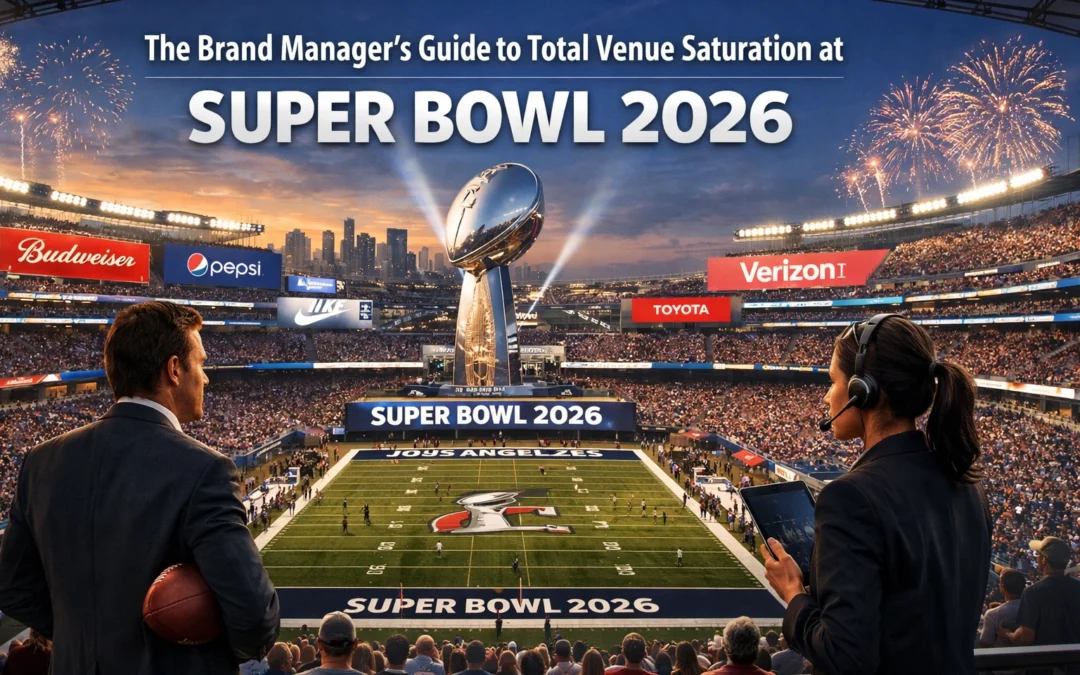

The Super Bowl represents the pinnacle of American sports culture and a massive opportunity for brand visibility. In 2026, the stakes for brand managers are higher than ever. It is no longer enough to simply secure a thirty-second television spot. To truly capture the attention of over one hundred million viewers and hundreds of thousands of attendees, a strategy of total venue saturation is required. This guide explores how OOH Sports leverages forty years of industry leadership to dominate the physical and digital landscape of the big game.
The Strategy of Total Venue Saturation
Total venue saturation is the process of surrounding the consumer at every possible touchpoint within and around the event perimeter. This strategy moves beyond traditional billboards. It encompasses a multi-layered approach that includes digital screens, floor graphics, stadium wraps, and transit advertising. The objective is to create a seamless brand narrative that follows the fan from their arrival at the airport to their seat in the stadium.
A successful campaign at Super Bowl 2026 relies on a three-phase structure. The first phase, Pre-Game Hype, runs from mid-January through early February. During this time, the focus is on building awareness and establishing retargeting audiences through high-traffic transit hubs. The second phase, Game Day Execution, prioritizes high-impact placements near the primary venue. Finally, the Post-Game Momentum phase captures sustained engagement after the final whistle.

Forty Years of Advertising Leadership
The expertise required to execute a campaign of this magnitude does not happen overnight. OOH Sports, led by CEO Dan Kost, brings four decades of experience to the table. This history provides a deep understanding of how sports fans interact with their environment. Over the years, the company has evolved from managing static signage to overseeing a network of over 25,000 digital screens across America.
This longevity in the market has allowed for the development of exclusive partnerships and prime real estate acquisitions. When a brand manager works with a legacy leader, they gain access to decades of data on fan movement patterns and engagement metrics. This historical perspective is vital for navigating the complexities of a modern Super Bowl environment.
Venue-Wide Coverage: From Floors to Billboards
One of the most effective ways to achieve saturation is through diversity in touchpoints. Traditional stadium sponsorships are evolving. Modern brands are now looking at how 25,000 digital screens are changing sports marketing.
Saturation includes everything from the ground up:
- Floor Graphics: Utilizing high-traffic walkways and concourses to place branding directly in the line of sight of walking fans.
- Digital Billboards: Leveraging massive screens for high-impact, dynamic content that can change based on the score or game events.
- Transit Hubs: Capturing fans at airports, train stations, and bus stops as they travel to the host city.
- Stadium Perimeters: Using digital out-of-home (DOOH) assets to target fans as they wait in line or enter the venue.
By spreading the message across these various formats, a brand avoids being "white noise" and instead becomes an integral part of the event experience.

Technology and Real-Time Integration
In 2026, the integration of physical and digital assets is non-negotiable. Programmatic DOOH allows brand managers to pivot their messaging in real-time. If a specific player has a breakout moment, creative assets can be updated within minutes to capitalize on the viral conversation. This level of agility ensures that the brand remains relevant throughout the four-hour broadcast.
The following video demonstrates the visual impact and the scale of modern out-of-home sports advertising. It showcases the dynamic nature of these placements and how they dominate the visual landscape.
https://www.youtube.com/watch?v=l6J-0zileKE
Furthermore, the use of QR codes and NFC touchpoints transforms passive viewing into active participation. Fans can scan a billboard to enter a contest, download an app, or receive a limited-edition digital collectible. This interaction provides brands with valuable first-party data and a direct line of communication with the consumer.
Measurable Results and ROI
The success of a venue saturation campaign is measured through hard data and brand lift studies. Modern DOOH technology allows for precise tracking of device IDs exposed to specific screens. This data can then be used to measure purchase consideration and intent.
For instance, past campaigns have shown significant success in moving the needle for major brands. A programmatic DOOH campaign for White Claw resulted in a 74 percent lift in purchase consideration for their vodka launch. Similarly, AB InBev saw a 119 percent lift in positive brand image through targeted DOOH efforts. These figures prove that when a brand dominates the physical space of a major sporting event, the impact on consumer behavior is substantial.

Strategic Planning for 2026 and Beyond
As the industry looks toward the future, the valuation of the DOOH market continues to climb. Experts predict that sports advertising will hit 50 billion dollars by 2030. For brand managers, this means that the competition for space will only become more intense.
To stay ahead, advertisers must focus on:
- Audience Segmentation: Using location data to target specific fan demographics.
- Creative Versatility: Developing assets that work across vertical, horizontal, and unconventional screen sizes.
- Omnichannel Consistency: Ensuring that the OOH message aligns perfectly with social media and television creative.
- Early Planning: Securing premium inventory well in advance of the Super Bowl window.
The Logistics of Execution
Executing total venue saturation requires a meticulous logistical plan. This involves coordinating with local city authorities, stadium management, and technical teams to ensure every screen and wrap is installed correctly and functioning perfectly. OOH Sports manages these complexities, allowing brand managers to focus on the overarching creative strategy.
The process includes site surveys to identify the best "eyeball" locations, testing digital feeds for latency, and ensuring that physical wraps are weather-resistant and meet stadium safety standards. Every detail, from the brightness of a LED screen at noon to the slip-resistance of a floor graphic, is accounted for in the execution phase.

Conclusion: Dominating the Big Game
The Super Bowl is the ultimate stage for brand storytelling. By employing a strategy of total venue saturation, brand managers can ensure their message is not just seen, but experienced. With forty years of leadership and a network of 25,000 digital screens, OOH Sports provides the infrastructure and expertise needed to achieve this level of dominance.
In the high-stakes environment of 2026, the brands that win will be the ones that occupy every inch of the fan journey, from the floor to the sky-high billboards. Success is found where preparation meets the largest audience in the world. For those looking to dive deeper into the technical side of these campaigns, the ultimate guide to sports DOOH trends offers further insights into the future of the industry.