
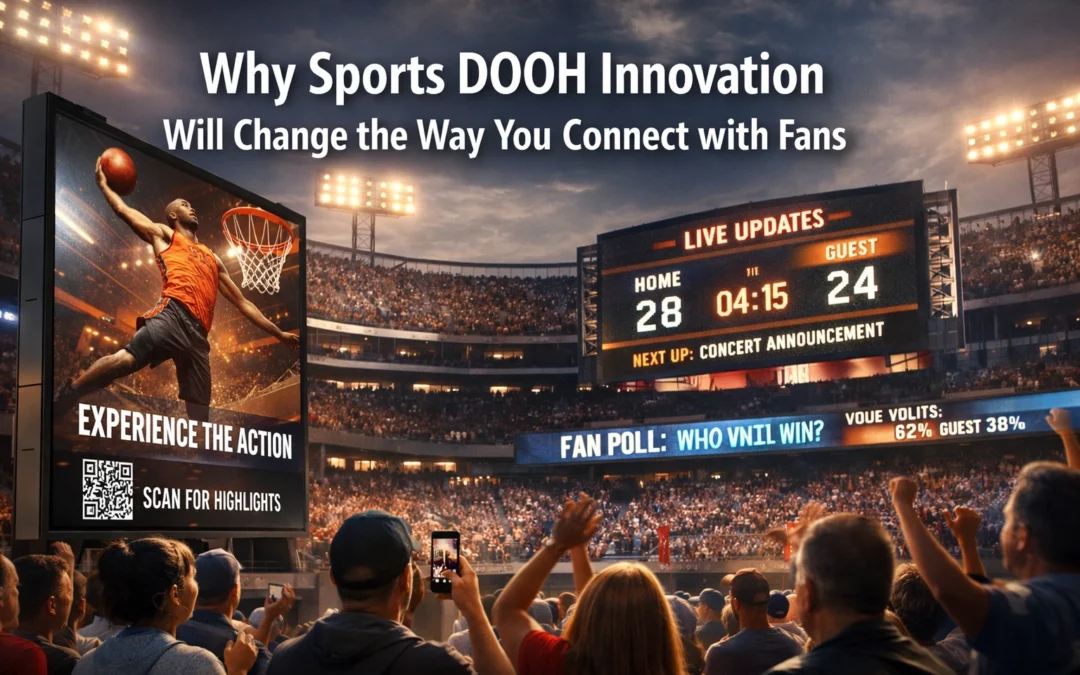
The landscape of sports marketing is undergoing a significant transformation. As traditional cable television viewership shifts toward fragmented streaming services, brands face the challenge of finding consistent ways to reach large, engaged audiences. Digital Out of Home (DOOH) advertising has emerged as a primary solution to this problem, particularly within the sports vertical. By leveraging real-time data, programmatic buying, and high-traffic physical locations, sports DOOH allows brands to connect with fans in ways that feel natural and impactful.
Modern fans do not just watch a game, they live it. This journey begins at home, continues through the commute, thrives inside the stadium, and extends to the post-game celebration. OOH Sports provides the infrastructure to follow this journey, ensuring that brand messaging remains relevant at every touchpoint.
Strategy: The Power of Contextual Relevance
The core strategy behind successful sports DOOH lies in contextual relevance. Unlike a static billboard that displays the same image for weeks, digital screens can adapt to the current state of a sporting event. When a brand aligns its creative with the emotional highs and lows of a game, it creates a much stronger connection with the viewer.
Innovation in this space is driven by Dynamic Creative Optimization (DCO). This technology allows advertisers to set specific triggers based on live game data. For example, if a local team scores a winning goal, the digital screens in that city can immediately update to show a celebratory message alongside the brand’s product. This level of responsiveness ensures that the advertising is never seen as an interruption, but rather as a part of the fan experience.

Objective and Execution: Reaching Fans Where They Live
The primary objective for media buyers and brand managers is to capture attention in an environment where consumers are already looking. Sports fans are famously attentive, and they often gather in public spaces to experience the thrill of the game. OOH Sports facilitates this connection through a vast network of screens located in high-visibility areas.
The execution involves placing screens in sports bars, fitness centers, transit hubs, and retail environments where fans are most likely to spend time. By utilizing a network of over 25,000 digital screens, brands can achieve a massive scale that rivals traditional television reach while maintaining the hyper-local targeting capabilities of digital marketing.
Detailed logistics play a role here. Campaigns are not just blasted to every screen. Instead, they are targeted based on specific fan demographics and regional interests. A brand promoting hockey gear will see much higher engagement in northern markets, while a beachwear brand might focus its sports-adjacent DOOH on coastal regions during major volleyball tournaments.
Technology Partners and Programmatic DOOH
The shift toward programmatic DOOH (pDOOH) has made it easier for media buyers to integrate out-of-home advertising into their existing omnichannel strategies. By using Demand-Side Platforms (DSPs), brands can buy OOH inventory with the same ease and precision as they buy mobile or display ads.
Technological integration allows for:
- Geofencing: Identifying when target audiences are near a screen to trigger specific messaging.
- Audience Segmentation: Using anonymized mobile data to ensure ads are displayed when the highest concentration of sports fans is present.
- Retargeting: Following up a DOOH impression with a mobile ad to drive a specific conversion or purchase action.
Platforms like the StackAdapt DSP have been instrumental in driving this adoption, providing the tools necessary for brands to measure the impact of their spend in real time.

Measurable Results and Case Study Insights
Success in DOOH is no longer a matter of guesswork. Modern measurement techniques allow brands to quantify the impact of their campaigns with high precision. By looking at campaign mechanics and outcomes, several brands have demonstrated the effectiveness of this medium.
White Claw: Driving Purchase Consideration
White Claw utilized a programmatic DOOH campaign to launch a new vodka product. The strategy focused on reaching consumers in key urban markets during high-traffic social periods. By aligning their creative with the lifestyle and energy of the target audience, the brand saw a 74% lift in purchase consideration. This result highlights how DOOH can move the needle on consumer intent by appearing at the right time in the physical world. For more details on this execution, the White Claw case study provides an in-depth look at the data.
Mike’s Hard Iced Tea: Enhancing Brand Image
In another example, Mike’s Hard Iced Tea focused on improving brand perception among a competitive demographic. By using the OOH Sports network to deliver vibrant, high-energy creative, the campaign achieved a 119% lift in positive brand image. The ability to dominate a physical space with large-format digital visuals creates a sense of brand authority that is difficult to replicate on a small mobile screen. The full breakdown can be found in the Mike's Hard case study.
Sea-Doo: Reaching New Audiences
Sea-Doo's first foray into DOOH proved that high-ticket recreational products could also benefit from the medium. The campaign targeted outdoor enthusiasts and sports fans, resulting in a 144% increase in purchase consideration. This success demonstrates that DOOH is not just for quick-service restaurants or beverages, but also for brands that require deeper consideration from the consumer. More information is available in the Sea-Doo case study.

Capturing the "Unreachable" Audience
One of the most significant advantages of DOOH innovation is its ability to reach audiences that have become unreachable through traditional digital means. Ad-blockers, premium streaming subscriptions, and the decline of linear TV have made it harder for brand managers to guarantee their ads are being seen.
DOOH exists in the real world, where it cannot be skipped, blocked, or ignored. For a brand manager, this offers a level of brand safety and viewability that is increasingly rare. When a fan is walking into a stadium or sitting in a sports bar, their attention is focused on the environment. By placing a brand in that field of vision, OOH Sports ensures that the message is delivered to a receptive audience.
The Future of Sports DOOH Engagement
As we look toward the growth of the industry, the integration of interactive elements will likely become more prevalent. QR codes, live polls, and mobile prompts are already being used to turn a passive viewing experience into an active exchange. This interaction allows brands to collect first-party data, which is essential for long-term marketing strategies.
Research indicates that over 90% of fans take some form of follow-up action after seeing an OOH ad at a major sporting event. This could include searching for the brand online, visiting a website, or making a direct purchase. The "priming effect" of DOOH also makes other digital channels more effective. When a consumer sees an ad on a large digital panel, they are significantly more likely to engage with a similar ad on their smartphone later that day.
The scale of this opportunity is massive. Industry projections suggest that sports DOOH advertising will see significant growth as more brands recognize the value of connecting with fans in real time.

Strategic Implementation for Media Buyers
For those looking to implement these strategies, the process is straightforward but requires a focus on data and creative alignment.
- Define the Fan Profile: Understand which sports and regions align best with the brand’s goals.
- Select High-Impact Locations: Use the OOH Sports network to identify screens in areas where fans congregate.
- Leverage Real-Time Triggers: Work with technology partners to ensure creative updates based on live game outcomes.
- Measure and Optimize: Use attribution modeling to track how DOOH impressions lead to physical foot traffic or online conversions.
By focusing on these mechanics, brand managers can ensure their campaigns are not just visible, but effective. The innovation in sports DOOH is not just about the screens themselves, but about how those screens are used to tell a story that resonates with the passion of the fan base.
As the physical and digital worlds continue to merge, the brands that succeed will be those that find a way to be present in the moments that matter most to their customers. Through OOH Sports, that presence is more achievable and measurable than ever before.