
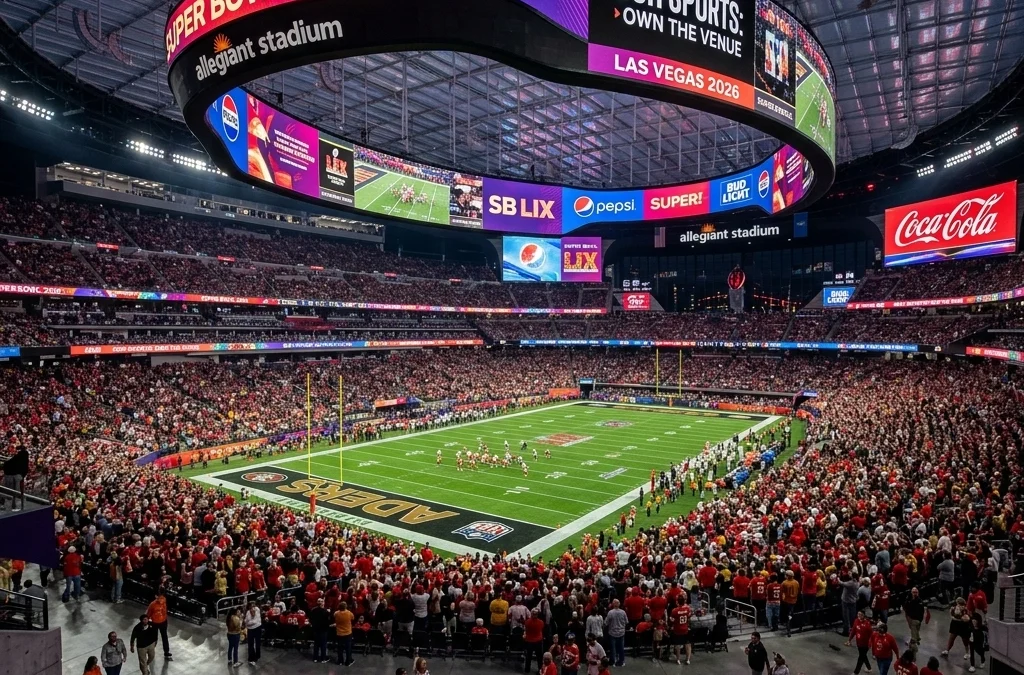
Super Bowl LX is not just a football game. It is the pinnacle of American culture, a massive economic engine, and the ultimate playground for brand visibility. On February 8, 2026, the world will turn its eyes toward Levi’s Stadium in Santa Clara, California. For brands looking to make an impact, the stakes have never been higher. With an estimated $500 million economic boost hitting the Bay Area, the competition for attention is just as fierce as the action on the gridiron.
OOH Sports brings 40 years of advertising leadership to this event. Under the guidance of CEO Dan Kost, the focus remains on delivering venue-wide coverage that leaves no corner of the stadium untouched. From the moment a fan steps off the VTA light rail until they reach their seat in the upper deck, there are countless opportunities for a brand to become part of the Super Bowl experience.
The Stage: Levi’s Stadium and the Silicon Valley Spotlight
Levi’s Stadium is uniquely positioned for a high-tech Super Bowl. Located at 4900 Marie P. DeBartolo Way, it sits in the heart of Silicon Valley. This venue is one of the most technologically advanced stadiums in the world, featuring LEED Gold certification, a green roof with solar panels, and thousands of Wi-Fi access points.
For advertisers, the stadium capacity of 68,500 (expandable to 75,000 for the Super Bowl) represents a massive, captive audience. Unlike traditional television viewers who might skip commercials or browse their phones during breaks, fans inside the stadium are constantly interacting with their surroundings. The intimate design of the stands brings spectators close to the field, but it also brings them closer to the advertising assets integrated into the stadium’s architecture.
https://www.youtube.com/watch?v=l6J-0zileKE
40 Years of Winning Plays in Advertising
Experience matters when dealing with an event of this magnitude. OOH Sports has spent four decades refining the art of out-of-home advertising. This history provides a deep understanding of how fans move, where they linger, and what types of visuals actually drive engagement.
A successful campaign at Super Bowl LX requires more than just buying a billboard on Highway 101. It requires a holistic strategy that covers every touchpoint. Brands can learn more about this approach by visiting the OOH Sports About page, which outlines the long history of innovation in the sports marketing space.

Owning the Venue: From Floors to Billboards
To truly "own" the venue, a brand must look beyond the obvious. While large-scale digital displays are impressive, the most effective campaigns utilize a layered approach. This includes everything from floor graphics to massive wall wraps and traditional billboards.
Ground-Level Impact: Floor Graphics
Floor graphics are one of the most underrated assets in venue advertising. As fans navigate the concourses, their eyes naturally drift downward to watch their step or find their way to a specific gate. Strategic placement of high-durability floor decals can turn every hallway into a branded experience.
These graphics work particularly well for directional cues or "path to purchase" messaging that leads fans toward specific concessions or merchandise stands. By dominating the ground space, a brand creates a sense of immersion that feels inescapable in a crowded environment.
Wall Wraps and Stadium Skinning
The sheer vertical scale of Levi’s Stadium offers massive canvases for brand storytelling. Wall wraps can transform plain concrete into a vibrant narrative. Whether it is highlighting a product’s features or celebrating the spirit of the game, these large-format prints dominate the visual field.

Digital Out-of-Home and Sportrons
Levi’s Stadium is equipped with massive high-definition video boards and thousands of smaller screens located throughout the concourses and luxury suites. Through Sportrons, OOH Sports enables brands to sync their messaging across these digital assets.
Programmatic digital out-of-home (DOOH) allows for real-time adjustments and targeting that was impossible a decade ago. Brands can look at past successes, such as how White Claw saw a 74 percent lift in purchase consideration by using data-driven DOOH strategies. Similarly, Mike’s Hard Iced Tea achieved a 119 percent lift in brand image using similar tactics.
Strategic Placement and Fan Movement
Understanding the logistics of the Bay Area is crucial for any advertiser. Levi’s Stadium is easily accessible via Highway 101, Caltrain, and the VTA light rail. This means the advertising journey begins long before the fan reaches the gate.
Advertisers should consider the following zones:
- Transit Hubs: Targeting San Francisco International and San Jose International airports.
- Commuter Routes: Billboards along the 101 and 880 corridors.
- The "Last Mile": Signage around the stadium perimeter and parking lots.
- The Inner Sanctum: Concourse wraps, restroom advertising, and floor graphics.
By mapping out these zones, a brand can ensure they are the first thing a fan sees when they arrive and the last thing they see as they leave. More details on these strategies can be found on the marketing page.
The Power of Programmatic in 2026
By 2026, programmatic advertising has become the standard for major sporting events. It allows brands to be nimble. If the weather changes or a specific team takes a massive lead, creative assets can be swapped instantly to remain relevant to the mood of the crowd.

Using specialized platforms and device ID tracking, OOH Sports can measure exactly how many fans were exposed to an ad and whether they took action afterward. This level of attribution is a game-changer for justifying the spend on a Super Bowl campaign. For example, Sea-Doo increased purchase consideration by 144 percent through a targeted DOOH campaign, proving that even "niche" lifestyle brands can win big in the OOH space.
Why 2026 is Different
Super Bowl LX is more than a game, it is a statement about the future of live events. With Levi’s Stadium’s focus on sustainability and technology, brands that align themselves with these values will resonate more deeply with the modern consumer.
The economic impact of $500 million indicates a high-spending, high-intent audience. These are not just fans, they are influencers and decision-makers who have traveled from across the globe to be in Santa Clara. Capturing their attention requires a partner who understands the nuance of venue-wide coverage.
For those interested in seeing how these strategies play out in the real world, the OOH Sports case study section provides detailed breakdowns of previous high-impact campaigns.
Execution and Logistics
Executing a venue-wide takeover for the Super Bowl is a logistical marathon. It involves coordinating with stadium management, local government, and technical teams to ensure every graphic is installed perfectly and every digital screen is synced.
The process includes:
- Site Surveys: Analyzing the physical space to identify high-traffic "dead zones" that can be revitalized with advertising.
- Creative Optimization: Ensuring that designs are legible from a distance and impactful at a glance.
- Technical Integration: Linking digital assets to programmatic platforms for real-time delivery.
- Measurement: Setting up the methodology for brand lift studies and attribution tracking.
For brands ready to start this process, reaching out via the contact page is the first step toward securing a presence at Super Bowl 2026.
Final Thoughts on Super Bowl LX
The opportunity to dominate the landscape of Super Bowl LX only comes once. With 40 years of expertise and a focus on venue-wide dominance, OOH Sports is the partner of choice for brands that want to own the floors, the walls, and the skyline of Santa Clara.
As the industry moves toward more integrated and data-driven solutions, the fundamentals of great advertising remain the same: being in the right place, at the right time, with a message that cannot be ignored. Whether it is through a massive billboard or a clever floor graphic, the goal is to make the brand a part of the Super Bowl legend.
For more insights into the world of sports advertising, visit the OOH Sports blog or review the terms of service and privacy policy for more information on how data and campaigns are managed.