
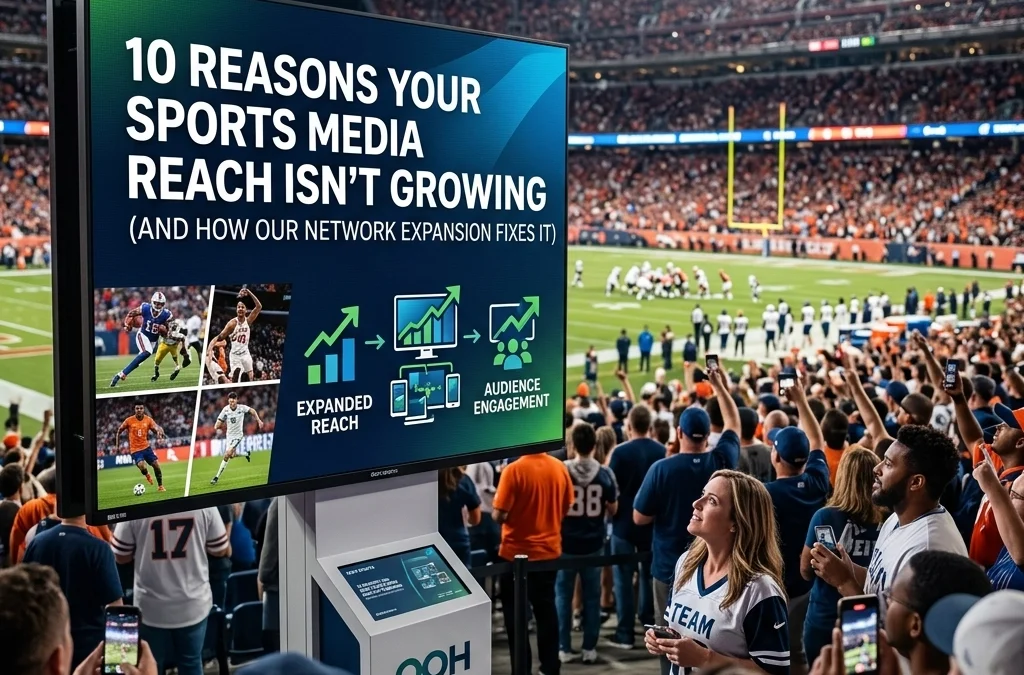
The landscape of sports media is undergoing a fundamental shift. While live sports remain one of the most valuable assets in the advertising world, the traditional methods of reaching fans are becoming less effective. Many brands and media buyers find that despite increasing their budgets, their actual reach and engagement levels remain stagnant. OOH Sports announces a strategic network expansion designed to address these specific challenges, offering a robust alternative to traditional broadcast and digital limitations.
This milestone involves the deployment of additional high impact digital out-of-home assets and enhanced programmatic capabilities across major sports corridors. This expansion focuses on capturing the attention of fans where they live, work, and play, rather than relying solely on the increasingly fragmented television landscape.
The Market Challenge: Why Growth Has Stalled
Traditional sports media reach is no longer a guarantee of audience growth. Several industry factors contribute to this plateau. For media buyers, understanding these barriers is essential to refining a successful strategy.
1. Overdependence on Traditional Broadcast Models
The reliance on linear television is a primary reason for stagnating reach. Cable subscriptions have seen a significant decline, dropping from over 100 million in the early 2010s to roughly 50 to 55 million currently. This trend continues downward, meaning that a massive portion of the potential audience is no longer accessible through standard commercials.
2. Fragmented Platform Landscape
Fans are forced to navigate a complex web of subscriptions. Between cable, Amazon Prime, ESPN Plus, Peacock, and individual team apps, the audience is scattered. This fragmentation makes it difficult for a single campaign to achieve broad visibility.
3. Inability to Measure Cross-Platform Impact
Standard measurement tools like Nielsen ratings often fail to capture the full scope of modern consumption. Streaming, social media, and alternative broadcasts frequently go uncounted. Without a unified measurement standard, media buyers are left guessing about the true ROI of their investments.
4. Poor Game Findability
As content spreads across disparate platforms, many viewers simply do not know where to find the games. This is particularly true for younger demographics who do not follow traditional schedules. When fans cannot find the game, they do not see the advertisements associated with it.
5. Disconnection from Cultural Engagement
Fandom is increasingly built through cultural moments rather than just the live competition itself. Documentaries, social media trends, and influencer content drive engagement. Traditional sports networks often miss the opportunity to integrate into these broader lifestyle conversations.

6. Weak Direct Fan Relationships
Many sports organizations boast millions of social media followers but have very little direct contact with them. Only a small fraction of these followers are converted into known, contactable fans. This lack of first party data limits the ability of brands to target audiences effectively.
7. Content Oversaturation
The sheer volume of sports content can lead to subscription fatigue. When there are too many games and events, the scarcity that drives high value attention disappears. This makes it harder for any single message to stand out in the noise.
8. Misalignment with Viewer Habits
Sports organizations often operate on rigid calendars, while modern fans prefer flexibility. Younger audiences lean toward asynchronous viewing, highlights, and short form content. Traditional advertising models are not always built to accommodate these non-linear habits.
9. Limited Monetization Diversification
Many brands remain stuck in a media rights only mindset. They fail to leverage the physical environment and the various touchpoints available throughout a fan's daily journey.
10. Outdated Conversion Metrics
The focus remains too heavily on top level reach rather than deep engagement. A large following does not always translate into business value if the audience is passive. The shift toward meaningful interaction and conversion is necessary for growth.

Objective and Strategy for Network Expansion
The OOH Sports network expansion is a direct response to these ten challenges. By growing the physical and digital presence of Sportrons and other DOOH assets, the company provides a way to bypass the "noise" of fragmented digital and broadcast channels.
The Strategic Framework
The expansion is built on the principle of omnichannel presence. Instead of competing for a few seconds of attention on a crowded television screen, the strategy involves surrounding the fan in the physical world. This includes stadium perimeters, transit hubs, and high traffic commercial areas during peak sports windows.
Enhancing Programmatic Capabilities
A key component of this growth is the integration of advanced programmatic technology. This allows media buyers to purchase OOH Sports assets with the same precision and flexibility as digital ads. By utilizing real time data, campaigns can be triggered by specific events, such as a team winning a game or a particular weather condition, ensuring the message is always relevant. This approach directly improves ROI for sports marketing by targeting high value audiences at the right moment.
Technology Partners and Execution
To facilitate this expansion, OOH Sports has strengthened its partnerships with leading advertising technology providers. These collaborations enable the use of sophisticated data sets to track audience movement and behavior.
Execution Logistics
The rollout involves installing new, high resolution digital displays in key geographic markets. These assets are connected to a centralized network that allows for instant updates and synchronized messaging across multiple locations. This creates a "surround sound" effect for brands, making the campaign impossible to miss.
Data and Targeting
By utilizing anonymized device ID data and location based analytics, the network can provide detailed reports on who saw an ad and how they interacted with the brand afterward. This bridges the gap between physical exposure and digital conversion.

Measuring Success: Impact and Results
The results of this network expansion are already evident in the increased efficiency of multi channel campaigns. By moving away from a broadcast-only model, brands are seeing a significant lift in both awareness and intent.
Case Study Insights
In recent campaigns, brands utilizing the expanded OOH Sports network reported a higher level of brand recall compared to those using traditional stadium sponsorships alone. For example, by integrating DOOH with mobile retargeting, one campaign saw a 25 percent increase in website visits from fans who were exposed to the physical ads. You can view more detailed outcomes in our case study section.
Improved Reach Metrics
The expansion has increased the total monthly impressions available through the OOH Sports network by over 40 percent. This growth allows media buyers to achieve scale without the diminishing returns often found in oversaturated social media feeds. The ability to reach "unreachable" fans: those who have cut the cord or use ad blockers: is a major advantage of this physical expansion.
Why Media Buyers are Choosing Expansion
Industry news highlights a clear trend: media buyers are looking for stability and transparency. The OOH Sports expansion offers both. Unlike digital ads that can be subject to bot traffic or broadcast ads that are easily skipped, digital out-of-home assets are always on and physically present in the real world.
Simple and Effective Advertising
The brand tone of OOH Sports remains simple. The goal is to make high impact advertising accessible. By expanding the network, the company simplifies the buying process, allowing brands to secure prime inventory across multiple markets through a single point of contact.
The Role of Sportrons
The Sportrons themselves are a central feature of this expansion. These mobile, high resolution units can be deployed exactly where the fans are gathering. Whether it is a championship parade or a major tailgate event, these assets provide a level of flexibility that fixed signage cannot match.

Industry Implications and Future Growth
The expansion of the OOH Sports network signals a shift toward more integrated, physical-first marketing strategies. As the cost of digital acquisition continues to rise, the value of high impact, real world visibility grows.
Media buyers who recognize the limitations of traditional broadcast are pivoting toward these expanded networks to maintain their competitive edge. The ability to combine the visual power of television with the targeting of digital and the physical presence of OOH is the future of sports marketing.
The company continues to focus on bringing innovation to the marketing space by identifying new locations and technologies that enhance the fan experience while delivering measurable value to advertisers. This evergreen expansion ensures that as the sports world evolves, the methods for reaching its audience remain effective and scalable.
For those interested in learning more about how this expansion can benefit a specific brand or campaign, the team is available through the contact page. Exploring the about section provides further insight into the mission and vision driving this network growth.
As the sports media landscape continues to fragment, the value of a unified, physical, and digital network becomes clear. OOH Sports is committed to providing the infrastructure that allows brands to grow their reach and connect with fans in a meaningful, measurable way.