
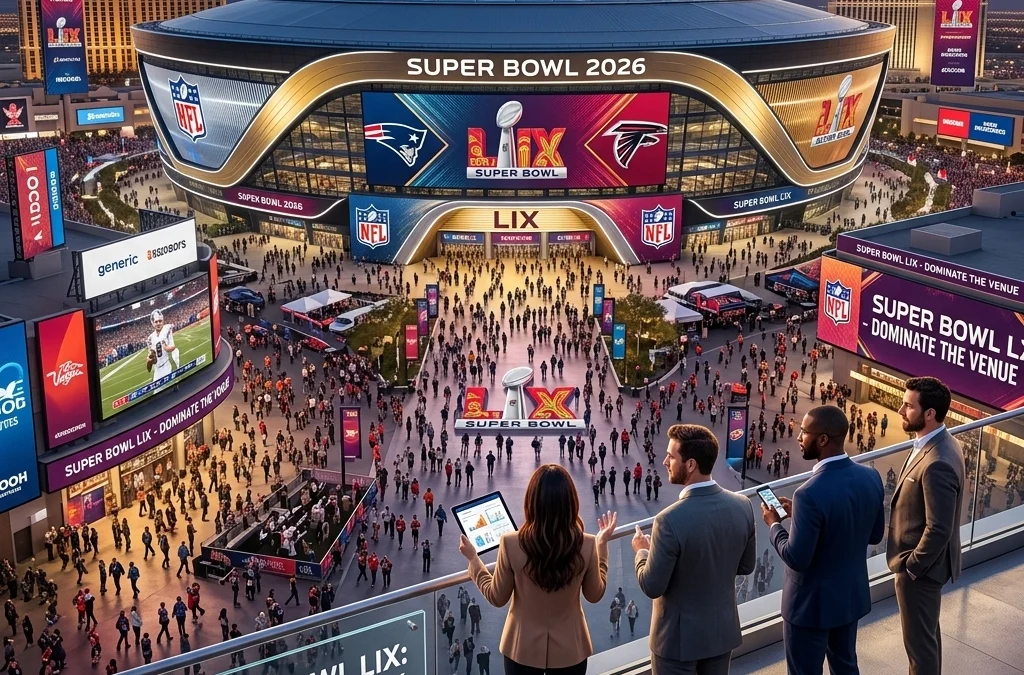
Super Bowl LX, held in February 2026, marked a significant turning point in the world of sports advertising. While television commercials reached a record breaking price of $8 million for a single 30 second slot, the real victory happened within the walls of Levi’s Stadium. For media buyers, the 2026 season proved that total venue dominance is no longer a luxury. It is a strategic necessity.
OOH Sports has spent 40 years leading the industry in stadium and arena advertising. Since 1986, the organization has evolved from static posters to fully integrated, digital environments. This guide examines the mechanics behind venue wide coverage and why this approach delivers a superior return on investment compared to traditional broadcast methods.
The Strategy of Environmental Domination
Total venue dominance is defined as the saturated presence of a brand across every physical and digital touchpoint within a sports complex. Instead of a single fleeting moment on a television screen, the brand becomes a permanent part of the fan experience for the duration of the event.
The strategy focuses on high traffic zones and extended dwell times. When fans arrive at the stadium, they spend an average of four hours inside the venue. This timeframe provides a massive window for repeated brand exposure. By utilizing everything from the floors to the massive digital billboards, media buyers can create a cumulative effect that drives brand recall far higher than a single commercial ever could.

Objective and Strategy: The 40 Year Legacy
For four decades, OOH Sports has refined the art of stadium marketing. The journey began in 1986, a time when stadium ads were limited to simple fences and scoreboards. Today, the landscape is entirely different. The objective is now to create a seamless brand journey.
This journey begins at the parking lot entrance and ends only when the fan leaves the building. Over the past 40 years, the company has developed proprietary methods for installing large scale graphics and managing digital networks that ensure 100 percent uptime during high pressure events like the Super Bowl. For more information on these specific systems, media buyers often look at Sportrons to understand the technical infrastructure required for such massive undertakings.
Floor to Ceiling Execution
The logistics of Super Bowl 2026 required a multi layered approach to physical advertising. The execution was broken down into four primary zones.
1. Ground Level Foundations
The first touchpoint for fans entering Levi’s Stadium involves ground level graphics. Floor decals and vinyl wraps on main entry stairs provide immediate impact. These placements are highly effective because fans must look down as they navigate stairs and escalators. During Super Bowl 2026, these floor graphics saw thousands of impressions per hour during the peak entry window.
2. Concourse Integration
The concourse is where the longest dwell times occur. Fans spend significant time waiting for food, beverages, and merchandise. Media buyers utilize digital screens and pillar wraps in these areas to maintain brand presence during non-gameplay moments. This strategy ensures the message is seen even when fans are away from their seats.

3. Perimeter and Field of Play
This zone offers the dual benefit of reaching the in person crowd and the global broadcast audience. Perimeter LED displays allow for real time message rotation. During Super Bowl 2026, these boards were used to react to game events, such as touchdowns or turnovers, making the brand feel integrated into the action.
4. Surrounding Territory
The reach extends beyond the stadium walls. Highway billboards, transit advertising, and digital displays in the surrounding entertainment districts create a week long activation. This builds anticipation leading up to the game and reinforces the message during the post game exit.
Technology and Programmatic DOOH
The integration of technology has changed how media buyers purchase space. Programmatic Digital Out-of-Home (DOOH) allows for data driven placements and real time optimizations. This technology ensures that the right message reaches the right audience at the specific time it is most relevant.
The following video demonstrates the power of modern stadium technology and its impact on the fan experience:
https://www.youtube.com/watch?v=l6J-0zileKE
By using programmatic platforms, brands can adjust their creative based on the score of the game or the time of day. This agility is a key component of what many high level media buyers consider the secret to successful stadium campaigns.
Measuring Success and ROI
The shift toward venue dominance is backed by data. When comparing an $8 million TV spot to an $8 million venue wide takeover, the metrics favor the latter.
Reach and Frequency
A TV spot offers a one time reach. Venue dominance offers a high frequency of exposure over a four hour period. Data from Super Bowl 2026 showed that fans were exposed to venue dominant brands an average of 15 to 20 times during the event. This high frequency is critical for moving a consumer from brand awareness to brand preference.
Attribution and Device IDs
Modern stadium advertising allows for precise measurement through geofencing and device ID tracking. Media buyers can track how many fans saw a digital board and later visited a retail location or a website. This level of attribution was previously impossible with traditional OOH methods. Research into programmatic DOOH vs traditional stadium ads highlights that the ROI for venue wide dominance is often 30 to 40 percent higher due to these tracking capabilities.

Detailed Logistics and Execution Processes
Executing a campaign of this magnitude involves months of planning. For Super Bowl 2026, the process followed a strict timeline:
- Geographic Mapping: Identifying every high traffic zone within Levi’s Stadium.
- Creative Adaptation: Developing content that works across various formats, from vertical pillar wraps to horizontal LED ribbons.
- Installation: A team of specialists performed the physical installation of floor graphics and vinyl wraps in the weeks leading up to the event.
- Network Syncing: Digital assets were uploaded to the OOH Sports central hub to ensure synchronized playback across all screens.
- Monitoring: During the game, technical teams monitored all displays in real time to ensure maximum visibility.
This rigorous process is part of what sets a professional campaign apart from standard advertising attempts. The goal is a flawless presentation that matches the prestige of the event.
Results from the 2026 Campaign
The data gathered following Super Bowl 2026 confirmed the effectiveness of total venue dominance. Brands that utilized the full floor to billboard strategy reported a 25 percent higher brand recall than those that only utilized traditional perimeter boards. Furthermore, foot traffic to partner retail locations in the Santa Clara area increased by 18 percent for brands that utilized geofenced mobile retargeting alongside their physical displays.
Detailed performance analysis can be found in the OOH Sports case study section, which breaks down the specific impact on consumer behavior.

The New Standard for Media Buying
As the 2026 season concludes, the industry looks toward the future of sports marketing. The lesson from Super Bowl LX is clear. Attention is the most valuable commodity, and the most effective way to capture it is to own the environment.
With 40 years of experience, OOH Sports continues to pioneer these methods. The transition from static signage to a fully immersive brand experience represents the most significant shift in advertising history since the introduction of the television itself. Media buyers who prioritize venue dominance are not just buying space. They are buying an uninterrupted connection with a passionate audience.
For those looking to plan for future seasons or explore the evolution of these strategies, the OOH Sports blog provides ongoing insights into the changing landscape of sports advertising. The standard has been set, and the future of the industry belongs to those who dominate the venue.