
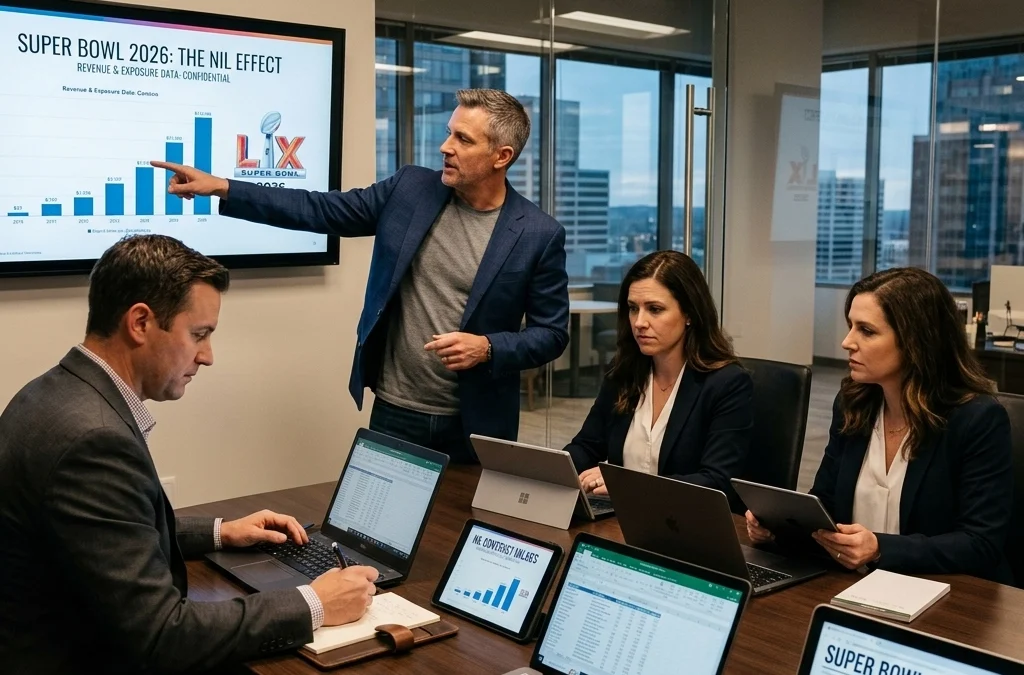
The landscape of sports advertising shifted permanently during the 2026 Super Bowl cycle. While traditional media buyers spent months justifying $7 million price tags for 30 second television spots, a quieter and more effective revolution was happening on the second screen. The secret that high-level agencies often hide from their clients is simple. The era of the singular, high-gloss broadcast ad is being overshadowed by the collective power of Name, Image, and Likeness (NIL) networks.
As the industry analyzes the data from Super Bowl LX, the results show a clear trend. The most successful brands did not just buy airtime. They bought influence through a massive web of student-athlete voices. By leveraging platforms like OOH Sports, these brands bypassed the gatekeepers of traditional media to speak directly to fans in a way that felt authentic and personal.
The Efficiency Gap: Why Traditional TV is Losing Ground
For decades, the Super Bowl was the undisputed king of brand awareness. However, the 2026 metrics reveal an uncomfortable truth for traditional agencies. While a television commercial reaches millions, it often lacks the direct attribution and sustained engagement that modern CMOs demand.
High-level media buyers often steer clients toward television because of the prestige and the large commissions associated with massive ad spends. What they do not want you to know is that the ROI on these spots is becoming increasingly difficult to prove when compared to hyper-targeted NIL campaigns.
During Super Bowl LX, over 70 percent of viewers were actively using a second screen, such as a smartphone or tablet, during the game. This shift in attention means that while the expensive commercial is playing on the big screen, the actual engagement is happening on social feeds. Brands that utilized the OOH Sports NIL platform were able to capture this attention at a fraction of the cost of a broadcast spot.

Scaling Authenticity with 20,000 Student-Athlete Voices
The real power of the 2026 marketing season came from the scale of athlete partnerships. In the past, a brand might sign one or two superstar athletes. This strategy is risky and expensive. If that athlete underperforms or lacks a personal connection with a specific demographic, the investment is wasted.
OOH Sports changed the game by offering access to over 20,000 authentic student-athlete voices. This network allows brands to execute a "saturation" strategy rather than a "star" strategy.
- Micro-Influencer Impact: Student-athletes have higher engagement rates than professional celebrities because their followers are often peers, family, and local community members.
- Regional Dominance: Brands can target specific college towns or regions where interest in the Super Bowl or specific draft prospects is highest.
- Trust Factor: A recommendation from a trusted student-athlete feels like a tip from a friend, not a corporate mandate.
This collective voice creates a "narrative equity" that a single celebrity spokesperson cannot replicate. It allows a brand to be present in thousands of individual conversations simultaneously.
The Secret Three-Phase Strategy of 2026
The most successful media buyers in 2026 did not just focus on the four hours of the game. They used a three-phase model that prioritized the NIL platform to build momentum.
Phase 1: The Pre-Game Build
Starting as early as November, brands began building relationships with athletes. This phase was about creating a story. Instead of a sudden appearance on game day, athletes shared their journey, their training, and their excitement for the upcoming season. This created a foundation of trust.
Phase 2: Game Day Activation
On the day of the Super Bowl, the OOH Sports network went into high gear. While the $7 million ads played once, 20,000 athletes provided real-time reactions, behind-the-scenes content, and interactive polls. This kept the brand at the top of social feeds for the entire duration of the event.
Phase 3: Post-Game Saturation
The week following the Super Bowl is often where traditional ads go to die. However, NIL campaigns thrived during this period. Athletes discussed the results, shared their favorite moments, and continued to drive traffic to brand sites like https://oohsports.com/marketing.

Watch: The Evolution of NIL in Professional Sports
To understand the magnitude of this shift, it is important to see how NIL is affecting the entire ecosystem, from college campuses to the NFL draft.
https://www.youtube.com/watch?v=l6J-0zileKE
Better Metrics and Direct Attribution
One of the biggest secrets in the industry is how "fuzzy" traditional Super Bowl metrics can be. Brand lift studies and estimated reach are often used to justify the spend, but they rarely provide a clear line to sales.
NIL campaigns through OOH Sports provide a level of data transparency that makes traditional media buyers nervous. Every athlete post can be tracked with specific links, promo codes, and device ID exposures.
- Real-Time Tracking: Brands can see exactly which athletes are driving the most traffic in real-time.
- Sentiment Analysis: AI tools can measure how fans are responding to the content, allowing brands to pivot their messaging mid-game if necessary.
- Conversion Data: By using platforms like those detailed on the OOH Sports Case Study page, marketers can see the direct correlation between an athlete's post and a completed purchase.
This data-driven approach removes the guesswork from sports marketing. It allows for a level of accountability that traditional broadcast advertising simply cannot match.
The Draft Evaluation Angle
An interesting development in 2026 is how NFL teams are now using NIL deals as a scouting tool. The way a student-athlete manages their personal brand and their partnerships is seen as a preview of their professional maturity.
Media buyers who understand this trend are no longer just looking for "influencers." They are looking for the next generation of professional leaders. By partnering with these athletes early through the OOH Sports platform, brands are not just buying an ad, they are investing in the future stars of the league. This long-term strategy provides a level of brand loyalty that is far more valuable than a one-off Super Bowl spot.

Why Simplicity Wins in 2026
The 2026 Super Bowl proved that audiences are tired of over-produced, high-concept commercials that try too hard to be "viral." The content that actually moved the needle was simple, casual, and authentic.
Student-athletes filming a quick video on their phone in their dorm room often outperformed multimillion dollar productions. This is because the audience values the "person" over the "production."
OOH Sports facilitates this by keeping the process simple for both the brand and the athlete. By removing the layers of bureaucracy and high-level agency gatekeeping, the platform allows for faster execution and more genuine connections. For more information on how this process works, the About page provides a clear breakdown of the strategy.
Breaking the Cycle of Overpriced Media
The secret is finally out. High-level media buyers don't want you to know that you can achieve better results by diversifying your budget away from massive broadcast buys and toward a network of 20,000 student-athletes.
The success of the 2026 NIL strategies has set a new benchmark for the industry. Brands are no longer satisfied with "awareness." They want engagement, they want data, and most importantly, they want authenticity.
As we look toward the 2027 season, the shift toward NIL and decentralized influence will only accelerate. The platform at OOH Sports is at the center of this movement, providing the tools and the network to ensure that your message is heard by the right people at the right time.
For brands looking to stay ahead of the curve, the message is clear. Stop following the old playbook and start building your own network of voices. The future of sports advertising isn't on a giant screen in a stadium. It is in the palm of every fan's hand, delivered by an athlete they trust.
If you are ready to explore how a network of 20,000 student-athletes can transform your next campaign, visit the OOH Sports contact page to start the conversation. The secrets of the high-level media buyers are no longer hidden, and the advantage is now yours.