
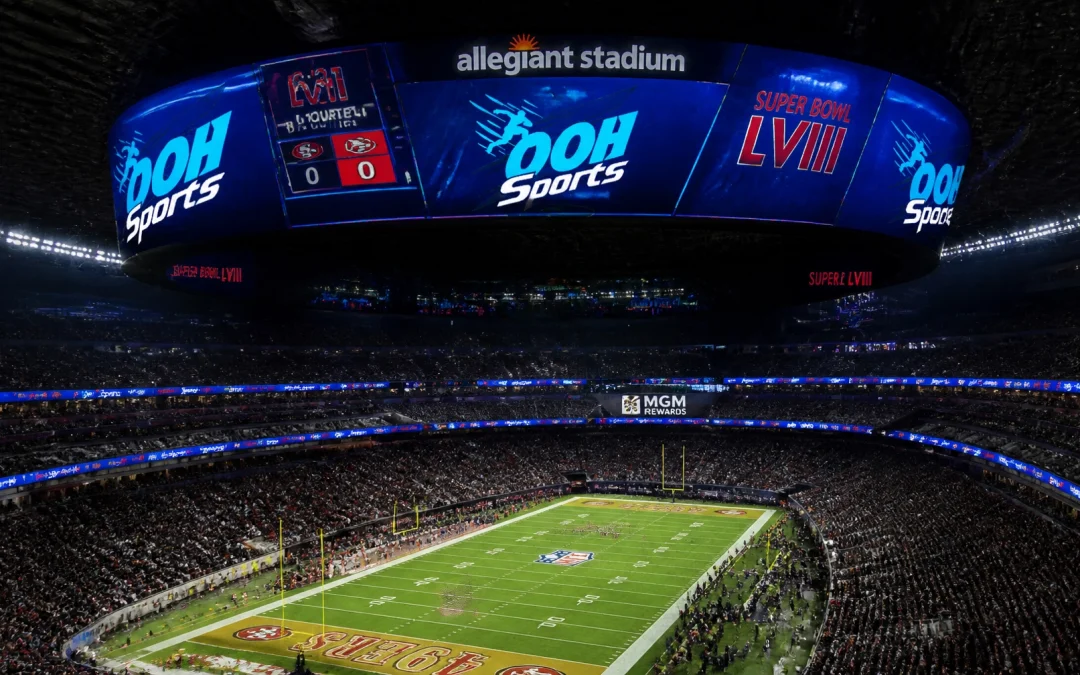
The Super Bowl represents the pinnacle of sports marketing, offering a global stage where brands compete as fiercely as the athletes on the field. As the industry looks toward the 2026 season, the complexity of capturing fan attention has shifted from single-point television commercials to comprehensive, venue-wide saturation. Success in this environment requires more than a presence; it demands a strategic takeover of the physical and digital space surrounding the event.
With 40 years of advertising leadership, OOH Sports and the Sports Media Inc. family have refined the science of stadium and perimeter marketing. This guide explores the tactics required to dominate every inch of the Super Bowl environment, from the floor graphics beneath a fan's feet to the digital billboards towering over the city skyline.
Strategic Objective: Total Brand Immersion
The primary objective of a venue-wide campaign is to create a seamless brand narrative that follows the fan journey. Rather than relying on a single high-cost placement, top-tier advertisers utilize a layered approach. This ensures that the brand remains top-of-mind from the moment a fan arrives at the airport until the final whistle blows.
A successful strategy is built on three pillars:
- Saturation: Ensuring high frequency across multiple touchpoints.
- Contextual Relevance: Delivering messages that resonate with the specific game-day atmosphere.
- Omnichannel Integration: Linking physical out-of-home (OOH) assets with digital retargeting and mobile engagement.
By focusing on these pillars, brands can achieve a "halo effect," where the perceived scale of the brand matches the magnitude of the Super Bowl itself.
The Inner Ring: Stadium Saturation
The stadium interior is a concentrated environment of high-emotion and high-dwell time. Achieving dominance here involves utilizing every available digital and static surface.
Digital Perimeter and LED Boards
Modern stadiums are equipped with sophisticated LED ribbon boards and jumbotrons that allow for "moment marketing." This involves triggering specific creative content during key game events such as touchdowns, turnovers, or halftime. These digital surfaces provide the flexibility to rotate messaging and maintain visual interest throughout the four-hour event.
Concourse and Dwell Time Media
While the action happens on the field, significant fan movement occurs in the concourses. Digital screens located near concession stands and restrooms offer a unique opportunity to capture attention when fans are less distracted by the game. These screens are ideal for longer-form narratives or calls-to-action, such as QR codes that lead to exclusive content or mobile promotions.

Floor Graphics and Static Placements
Often overlooked, floor graphics and branded stair-risers provide a tactile sense of brand presence. These placements are high-impact because they occupy the fan's immediate physical space, reinforcing the brand's association with the venue's infrastructure.
For more information on the specific technology used to power these displays, visit the Sportrons page.
Insights from 40 Years of Sports Media Leadership
The following video highlights the evolution of stadium advertising and the scale required to make a lasting impact in the modern sports landscape.
https://www.youtube.com/watch?v=l6J-0zileKE
The Outer Ring: The 10-Mile Perimeter
Dominating the Super Bowl requires extending the brand's reach beyond the stadium walls. The "10-mile perimeter" strategy focuses on the host city's infrastructure, targeting fans as they move through the urban environment.
Airport and Transit Hubs
The fan journey begins long before they reach the stadium. High-impact digital out-of-home (DOOH) placements at host-city airports and transit hubs establish an early brand connection. By greeting fans upon arrival, a brand positions itself as a primary host of the Super Bowl experience.
Urban Digital Billboards and Street Furniture
In the days leading up to the game, the host city becomes a hub of activity. Strategically placed digital billboards, bus shelters, and kiosks create a constant brand presence throughout high-traffic areas. These assets can be synchronized to display cohesive messaging, turning the entire city into a branded corridor.

Technology Partners and Programmatic Execution
The move toward programmatic DOOH has revolutionized how brands execute Super Bowl campaigns. By partnering with advanced Demand-Side Platforms (DSPs), advertisers can bid on inventory in real-time, optimizing their spend based on location, time of day, and even weather conditions.
Location-Based Retargeting
One of the most powerful tools in venue-wide advertising is the ability to capture device IDs from fans exposed to OOH ads. These fans can then be retargeted with mobile display ads, social media content, or Connected TV (CTV) spots. This bridge between the physical and digital worlds ensures that the brand impact lasts well beyond the game day.
Data-Driven Decision Making
The use of first-party and third-party data allows for precise targeting of specific fan segments. Whether the goal is to reach corporate hospitality guests in the suites or the die-hard fans in the upper deck, programmatic technology ensures that the right message reaches the right audience at the optimal moment.
Results and Measurement
In the past, the impact of stadium advertising was difficult to quantify. Today, sophisticated measurement frameworks provide clear ROI data.
Brand Lift and Awareness
Through the use of mobile surveys and brand lift studies, advertisers can measure the increase in brand awareness and purchase intent among fans exposed to the venue-wide campaign. For example, recent programmatic DOOH campaigns in the sports sector have demonstrated significant results:
- A White Claw vodka launch campaign achieved a 74% lift in purchase consideration.
- Similar strategies have shown over 100% increases in positive brand perception when executed across an integrated network.
Foot Traffic and Attribution
By analyzing mobile location data, brands can track the movement of fans from a digital billboard to a retail location or a branded activation site. This attribution model provides a direct link between OOH exposure and consumer behavior.

Conclusion: The Future of Stadium Advertising
Owning every inch of the Super Bowl is a feat of logistics, strategy, and technological integration. As the industry moves toward 2026, the brands that succeed will be those that view the stadium not as a building, but as a comprehensive media ecosystem.
With 40 years of experience, the team at OOH Sports continues to lead this evolution, providing the tools and expertise necessary to turn every seat, screen, and square foot of the venue into a powerful marketing asset. For those looking to explore how to integrate these strategies into their upcoming campaigns, further details can be found on our About Us page.
The Super Bowl remains the ultimate test of brand strength. By executing a venue-wide strategy that combines inner-ring saturation with 10-mile perimeter coverage, advertisers can ensure their message is not just seen, but remembered.