
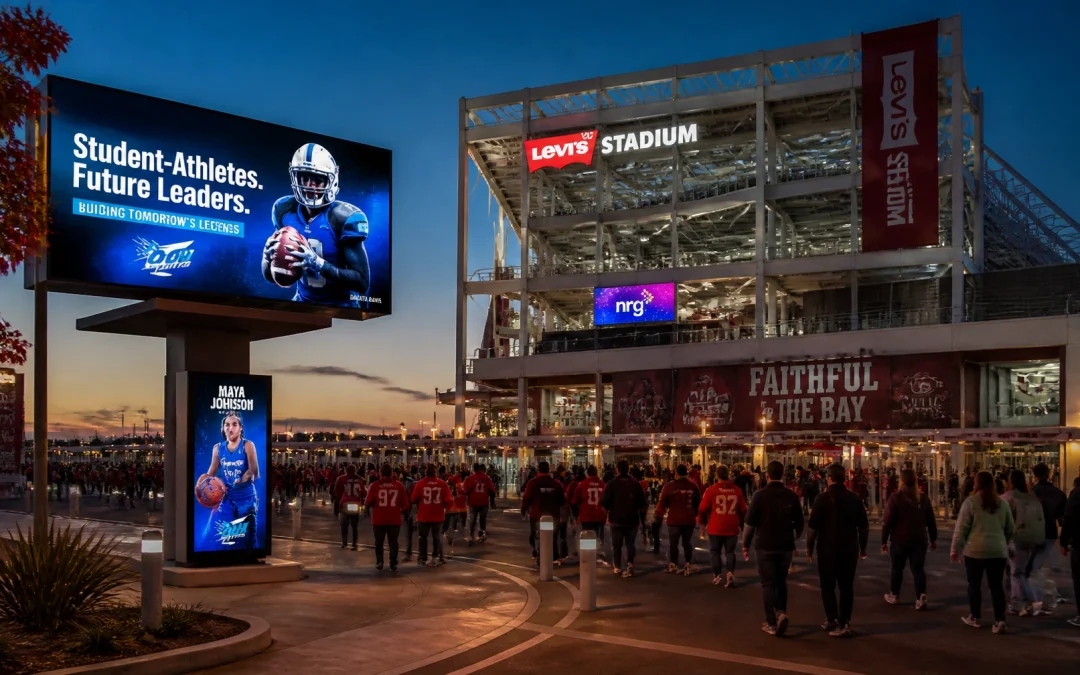
The landscape of sports marketing is undergoing a seismic shift as the industry moves toward Super Bowl 2026. While traditional 30-second television spots continue to command record-breaking prices, media buyers and brand managers are increasingly looking toward a more fragmented, authentic, and scalable alternative. This alternative is found at the intersection of Name, Image, Likeness (NIL) and Programmatic Digital Out-of-Home (DOOH) advertising.
The strategy focuses on mobilizing over 20,000 student-athlete voices to create a cultural ecosystem that surrounds the big game. For media planners and chief marketing officers, the objective is no longer just a single moment of mass reach. Instead, the goal is to build a sustained presence that resonates within a 10-mile perimeter of the host venue, Levi’s Stadium, and extends nationwide through digital athlete networks.
Objective & Strategy: Beyond the 30-Second Spot
The primary objective of a modern Super Bowl campaign is to achieve high-frequency engagement across multiple touchpoints. Traditional television advertising offers massive reach but often lacks the hyper-local precision required to capture the physical energy of the host city. By integrating NIL athletes with DOOH, brands can execute a dual-layered strategy.
First, the strategy involves leveraging the trust and authenticity of student-athletes. These individuals act as micro-influencers who possess deep connections within their respective communities. Unlike professional sports legends, college athletes are often viewed as more relatable and accessible by Gen Z and millennial audiences.
Second, the strategy utilizes a programmatic DOOH network to ensure that brand messaging is visible exactly where the audience is moving. With the perimeter set to a 10-mile radius around the sports venue, brands can reach fans at transit hubs, retail centers, and restaurants. This localized approach ensures that the brand message is not just heard but is an integral part of the fan experience in Santa Clara and the surrounding Bay Area.

The Power of 20,000 Authentic Voices
The scale of the NIL platform is a critical component for media buyers. Accessing a network of over 20,000 student-athletes allows for a level of diversity and segmentation that was previously impossible. Media buyers can filter athletes based on several criteria to ensure a perfect brand match.
- Sport and Gender: Brands can align with specific sports categories, from football and basketball to emerging niche markets like women’s soccer or track and field.
- Geographic Influence: National brands can activate athletes from across the country to create a "hometown" feel for the Super Bowl, while local businesses can focus on athletes from the host region.
- Audience Demographics: Advanced analytics enable planners to match athletes with the specific age, interest, and lifestyle profiles of the target customer.
By treating every athlete activation as a measurable "mini-spot," brands can distribute their budget more effectively. This reduces the risk associated with a single high-cost investment and allows for real-time optimization based on which athlete voices are driving the most engagement.
Technology Partners and Platform Integration
Success in the NIL space requires a sophisticated technological infrastructure. OOH Sports utilizes specialized platforms to bridge the gap between digital content and physical advertising. The integration of NIL marketplaces with programmatic DOOH buying allows for a seamless campaign execution.
Media planners use these platforms to manage the logistics of thousands of individual athlete contracts simultaneously. The technology ensures compliance, manages content distribution, and tracks performance metrics. When combined with programmatic DOOH adoption, the campaign can be adjusted in near-real time. If a particular creative execution or athlete is performing exceptionally well, the system can automatically increase the frequency of that content on digital boards within the target perimeter.

Video Insight: The NIL Platform Evolution
To better understand how the NIL landscape is being transformed into a powerful media channel, watch the following overview of the Sports Media Inc. family of services.
https://www.youtube.com/watch?v=l6J-0zileKE
Logistics and Execution: The 10-Mile Perimeter
The execution of a Super Bowl NIL campaign is a logistical undertaking that requires precise planning. The 10-mile perimeter around the venue serves as the primary "hot zone" for DOOH activations.
- Pre-Game Build-Up: Two to four weeks before the game, NIL athletes begin releasing teaser content. This content is mirrored on digital billboards near campuses and major shopping hubs.
- In-Game Synchronization: On the day of the Super Bowl, the strategy shifts to real-time reactions. Digital boards display live content from athletes who are hosting watch parties or attending the event. This creates a bridge between the digital social feed and the physical environment.
- Post-Game Retention: The campaign does not end when the clock hits zero. Athletes continue to post recap content, unboxings, and "best of" reactions. This extends the campaign lifespan well beyond the traditional one-day window.
The use of digital video advertising boards allows for dynamic creative updates. Unlike static billboards, these digital assets can change content instantly to reflect the score of the game, weather conditions, or viral moments as they happen.
Results and Measurement: Quantifying Success
In the world of high-stakes sports advertising, data is the ultimate validator. Media buyers look for measurable outcomes such as brand lift, purchase consideration, and customer acquisition costs. Previous campaigns in the industry have shown significant results when combining authentic voices with DOOH.
- Purchase Consideration: Data from similar programmatic DOOH campaigns has shown a 74 percent lift in purchase consideration for new product launches.
- Brand Image: Successful integration of athlete UGC (User Generated Content) can lead to a 119 percent lift in positive brand image compared to traditional advertising methods.
- Engagement Rates: Athlete-driven content often sees engagement rates as high as 8.4 percent, which is significantly higher than the industry average for standard social ads.
- Retention: Customers acquired through athlete-led referrals have demonstrated 10.8 times higher retention rates, highlighting the value of trust in the message.
Media planners utilize device IDs exposed to the DOOH screens to track foot traffic to retail locations or app installs following the campaign. This attribution model provides a clear picture of the ROI, allowing CMOs to justify the shift in spend from traditional media to more innovative, athlete-led strategies.

Conclusion: The Future of Sports Media
As Super Bowl 2026 approaches, the brands that win the cultural conversation will be those that embrace the power of scale and authenticity. Moving away from the "single spot" model and toward a network of 20,000+ athlete voices provides a level of engagement that traditional media cannot match. By anchoring these digital voices in the physical world through programmatic DOOH, brands create an omnipresent experience that stays with the consumer long after the game is over.
For media buyers and planners, the tools are now in place to execute these complex, multi-layered campaigns with precision. The combination of hyper-local targeting, authentic storytelling, and advanced measurement makes Super Bowl NIL strategies the new gold standard in sports marketing.
To explore more about how DOOH can transform your next campaign, visit the OOH Sports blog or review our latest case studies.