
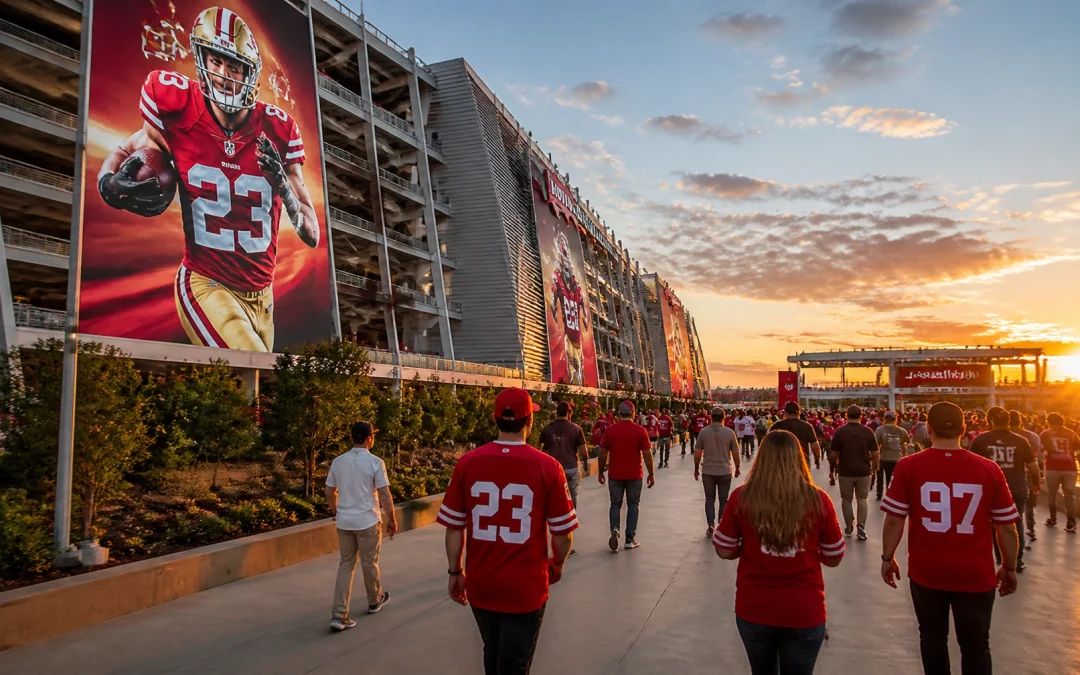
The countdown to Super Bowl LX in 2026 has officially begun. As the sports world sets its sights on Levi’s Stadium in Santa Clara, California, the competition for brand visibility is reaching a fever pitch. For many marketers, the challenge is not just about being present; it is about standing out in a sea of noise. This is where four decades of industry leadership becomes the ultimate competitive advantage.
Since its founding in 1985, Sports Media Inc. has spent 40 years perfecting the art of stadium advertising. Through its specialized division, OOH Sports, the company has pioneered strategies that allow brands to achieve total venue dominance. For the 2026 Super Bowl, the strategy is clear: provide a seamless, high-impact presence that follows the fan from the 10-mile perimeter around the stadium all the way to the arena floor.
Strategy: The 40-Year Playbook for Super Bowl LX
The core of the OOH Sports approach is a concept known as Implied Sponsorship. While official league sponsorships often come with astronomical price tags and strict category exclusivity, OOH Sports provides an alternative path. By saturating the environment around the venue and the physical space within it, a brand can create a powerful association with the event.
This strategy is built on 40 years of relationships and infrastructure. It is not about a single billboard or a solitary digital screen. It is about an integrated ecosystem. For Super Bowl 2026, the objective is to ensure that when a fan enters the Santa Clara area, the brand message is unavoidable. This is achieved through a combination of static displays, high-definition digital boards, and innovative floor graphics that capture attention at every level.
Objective & Strategy: Implied Sponsorship and Venue Saturation
The primary objective for any major Super Bowl campaign is brand recall and purchase consideration. Achieving this requires more than just a 30-second television spot. Research shows that fans are most receptive when they are in the "event mindset." By placing ads in and around the stadium, brands tap into the high-energy, positive emotions of the game day experience.
The saturation strategy for 2026 involves three distinct layers:
- The Outer Perimeter: Reaching fans as they travel to the San Francisco Bay Area via airports, transit hubs, and major highways.
- The 10-Mile Zone: Dominating the immediate vicinity of Levi’s Stadium using programmatic digital out-of-home (DOOH) assets.
- The Interior Venue: Utilizing every available surface, including floor graphics, concourse displays, and digital screens, to maintain a constant brand presence.

Technology Partners & Execution: From Ground Level to the Sky
Execution at this scale requires sophisticated technology and specialized materials. One of the most effective tools in the OOH Sports arsenal is the use of high-impact floor graphics. These are not simple stickers. They are engineered, non-slip, vibrant displays that leverage the natural human tendency to look down while walking through crowded concourses.
Studies in retail and venue settings have shown that floor graphics can drive significant sales lifts, sometimes as high as 50 percent for specific in-aisle promotions. In a stadium environment, these graphics serve a dual purpose. They guide fans through the venue while reinforcing brand identity at a point where traditional wall-mounted signage might be obscured by crowds.
Beyond the ground level, OOH Sports utilizes a network of Sportrons: large-scale digital screens and perimeter boards that offer dynamic content capabilities. For Super Bowl 2026, these assets will be connected via advanced programmatic platforms, allowing advertisers to adjust their creative in real-time based on game events, weather, or crowd demographics.
The 10-Mile Perimeter: Programmatic Precision
The true "secret" to dominating the Super Bowl venue lies in the 10-mile perimeter. This zone is a hive of fan activity, including fan zones, official parties, and hotel hubs. OOH Sports provides access to every digital video advertising board in every category within this radius.
By using programmatic DOOH, media buyers can target specific audiences with surgical precision. This is not "spray and pray" advertising. It is data-driven marketing that uses mobile device IDs to identify when target consumers are in proximity to a specific board. This allows for seamless retargeting; a fan who sees a billboard on their way to the stadium can later receive a coordinated ad on their mobile device while waiting for a concession.

Results: Quantifying the Impact of OOH Dominance
The success of these strategies is backed by measurable data. In previous campaigns executed by OOH Sports and its partners, the results have been transformative for brands.
For instance, a recent programmatic DOOH campaign for White Claw saw a 74 percent lift in purchase consideration. Similarly, a campaign for AB InBev’s Mike’s Hard Iced Tea resulted in a 119 percent lift in positive brand image. These metrics are achieved by moving beyond simple impressions and focusing on the quality of engagement within the sports environment.
For a detailed look at how these campaigns come to life, watch the video below:
https://www.youtube.com/watch?v=l6J-0zileKE
The video highlights the scale and energy that OOH Sports brings to every project. It demonstrates how 40 years of expertise translates into a physical presence that cannot be ignored or skipped like a digital pop-up ad.
Strategic Alignment and Measurement
To ensure that every campaign meets the high standards required for an event like the Super Bowl, OOH Sports employs a rigorous measurement framework. This includes:
- Brand Lift Studies: Partnering with research firms to measure changes in brand awareness and favorability post-campaign.
- Attribution Modeling: Tracking foot traffic and online conversions that result from exposure to OOH assets.
- Device ID Exposure: Quantifying the exact number of unique mobile devices that were in the presence of the advertising materials.
This level of detail is what separates a veteran agency from a newcomer. After four decades, the team understands the logistics of venue advertising: the permits, the material safety requirements, and the precise timing needed to execute a flawless takeover.

Why 40 Years of Leadership Matters for 2026
The landscape of sports marketing has changed drastically since 1985, but the fundamental need for human connection has stayed the same. OOH Sports has evolved from static painted signs to AI-driven programmatic networks, yet the mission remains to tell the story of a brand in the most passionate environment on earth.
For the 2026 Super Bowl, brands do not just need an agency; they need a partner with the "keys to the city." The deep-rooted relationships with stadium operators and media owners allow OOH Sports to secure inventory that others cannot. Whether it is a massive building wrap overlooking Levi’s Stadium or a clever floor decal near the VIP entrance, the 40-year history of the company ensures that every square inch of the venue is a potential opportunity for brand growth.
As the industry moves toward 2026, the focus will remain on the intersection of physical presence and digital intelligence. OOH Sports continues to lead this charge, proving that even in a digital world, the most powerful advertising is the kind you can walk on, stand next to, and see from a mile away.
To learn more about the history and vision of the company, visit the About Us page or explore our Case Studies to see the data behind the dominance.