
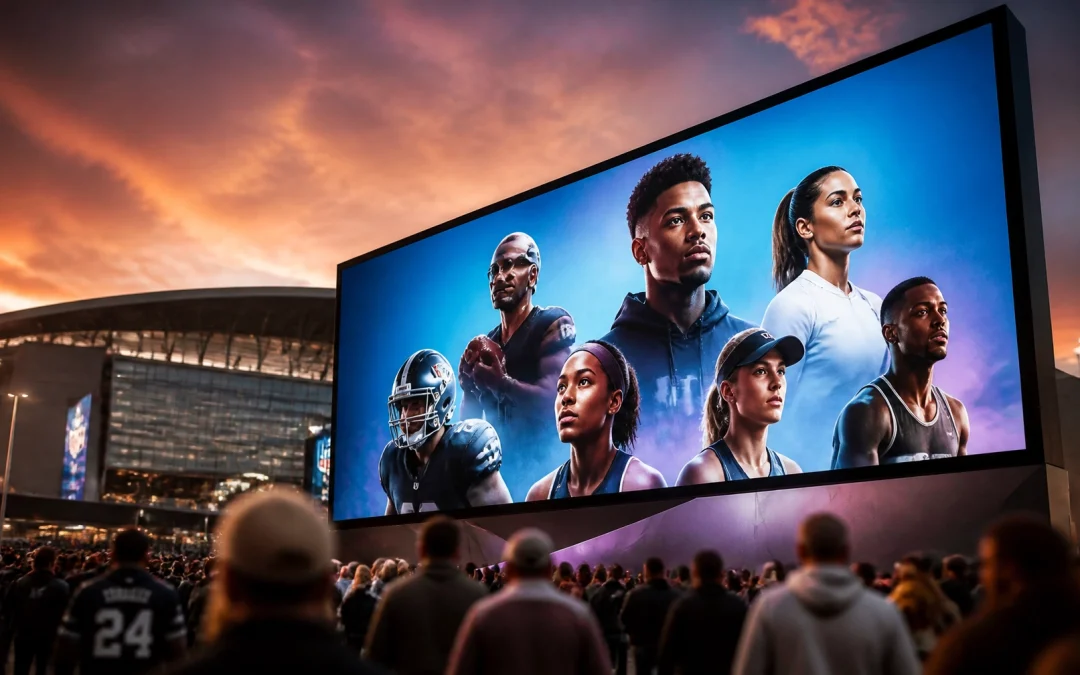
Super Bowl LX, held on February 8, 2026, at Levi’s Stadium in Santa Clara, marked a pivotal shift in the landscape of sports marketing. While traditional 30 second television spots continued to command record-breaking prices, the real victory occurred on the ground and across digital screens. The integration of Name, Image, and Likeness (NIL) partnerships with large scale digital out of home (DOOH) advertising provided a blueprint for how brands can achieve mass reach through individual authenticity.
For media buyers and brand managers, the 2026 championship was not just a game. It was a demonstration of how 20,000 student-athlete voices can be synchronized to create a localized, high impact marketing engine. By leveraging the OOH Sports network, brands moved beyond the stadium walls and into the daily lives of fans throughout the San Francisco Bay Area and beyond.
Strategy: Shifting from Mass Media to Mass Authenticity
The primary challenge of Super Bowl marketing has always been the "noise." With hundreds of brands vying for attention, a single broadcast ad often struggles to maintain a lasting impression. The strategy for 2026 focused on decentralizing the message. Instead of a single celebrity spokesperson, brands utilized a network of over 20,000 student-athletes to serve as the face of their campaigns.
This approach relied on the principle that fans trust athletes they follow at the collegiate level. By activating these voices simultaneously during the Super Bowl window, brands achieved a "surround sound" effect. The messaging felt personal yet ubiquitous. This strategy was particularly effective for targeting the 10 mile perimeter around Levi’s Stadium, where digital boards and mobile retargeting captured the attention of the hundreds of thousands of fans descending upon Santa Clara.
For more insights on how these trends are evolving, explore the 7 strategies to capture your share of the $50 billion sports advertising market.

Objective & Strategy: The Power of 20,000 Voices
The core objective was to create a seamless link between digital social influence and physical out of home presence. The strategy was divided into three distinct phases:
- Selection and Scalability: Leveraging an NIL platform to identify 20,000 student-athletes across various sports and regions. The focus was on those with high engagement rates rather than just high follower counts.
- Hyper-Local Execution: Using stadium perimeter targeting to display student-athlete content on digital screens within a 10 mile radius of Levi’s Stadium and other high traffic fan zones.
- Cross-Channel Synchronization: Ensuring that when a fan saw a student-athlete on a digital billboard in San Francisco, they were simultaneously served a related social media post or mobile advertisement featuring that same athlete.
By using this multi-layered approach, media buyers were able to bypass the high entry costs of official league sponsorships while still capturing the excitement of the event.
Technology Partners: Building the Digital Infrastructure
The success of the Super Bowl 2026 campaigns rested on the technological integration between OOH Sports and its programmatic partners. The use of Sportrons allowed for real-time creative updates based on game events, weather, or trending social topics.
Programmatic DOOH (pDOOH) platforms enabled media buyers to purchase inventory with precision. Instead of buying a static billboard for a month, planners bought specific "moments" during the Super Bowl weekend. This efficiency ensured that budgets were concentrated when fan density was at its peak.
Furthermore, the integration of NIL data platforms allowed brands to track the performance of individual athletes. This data-driven approach meant that if a specific student-athlete’s content was performing exceptionally well in a certain zip code, the DOOH spend could be automatically adjusted to favor those screens.

Execution: Tactics for a Winning Campaign
The execution of the 2026 NIL-driven strategy involved several tactical steps that prioritized speed and relevance.
Real-Time Creative Optimization
During the game, brands used real-time triggers to update their digital out of home creative. If a particular play or halftime moment went viral, student-athletes in the network would post content reacting to it, which was then immediately pulled onto digital screens across the Bay Area. This created a sense of "live" participation that static ads could not match.
Geofencing and Mobile Retargeting
A critical tactic was the use of geofencing around fan festivals, hotels, and the stadium. When a fan entered these zones, their device ID was captured. If they were exposed to a digital billboard featuring an NIL partner, they were later retargeted with a direct call to action on their mobile devices. This created a closed loop between awareness and conversion.
The "NIL Effect" on Brand Image
Utilizing student-athletes allowed brands to lean into the "homegrown" and "aspirational" aspects of sports. Unlike pro-athletes who can sometimes feel distant or overly commercialized, student-athletes in 2026 were viewed as more authentic. This led to significant lifts in brand favorability, especially among Gen Z and Millennial demographics.
For a comparison of how this stacks up against other methods, see the analysis of programmatic DOOH vs. traditional stadium ads.
Results: Measuring the Impact
The data from the Super Bowl 2026 campaigns demonstrated the overwhelming effectiveness of the NIL and DOOH combination.
- Reach and Frequency: Campaigns leveraging the 20,000 student-athlete network saw a 45% increase in total impressions compared to standard DOOH campaigns from the previous year.
- Brand Lift: Brand lift studies conducted post-event showed a 32% increase in brand recall for ads featuring student-athletes versus those featuring generic stock imagery or professional celebrities.
- Engagement Rates: Social media engagement for NIL-led campaigns was 4x higher than the industry average for sports-related sponsored content.
- Conversion: Mobile retargeting tied to DOOH exposure resulted in a 22% higher click-through rate (CTR) for promotional offers.
These results prove that the scale of the OOH Sports network, combined with the personal touch of thousands of individual voices, creates a level of impact that traditional media alone cannot achieve.

Conclusion: The Future of Sports Media Buying
Super Bowl 2026 was a watershed moment for media buyers and planners. It proved that the future of sports marketing lies in the ability to mobilize large numbers of authentic voices through sophisticated digital infrastructure. The era of the "single big ad" is being replaced by the era of the "thousand relevant moments."
As brands look toward the next major sporting events, the lessons from Santa Clara are clear. Success requires a combination of hyper-local targeting, programmatic flexibility, and the undeniable power of the student-athlete. OOH Sports remains at the forefront of this revolution, providing the tools and the network to turn every game into a winning campaign.
To see the vision in action, watch the video below:
https://www.youtube.com/watch?v=l6J-0zileKE
For more information on how to build your own digital out of home sports network, visit OOH Sports.