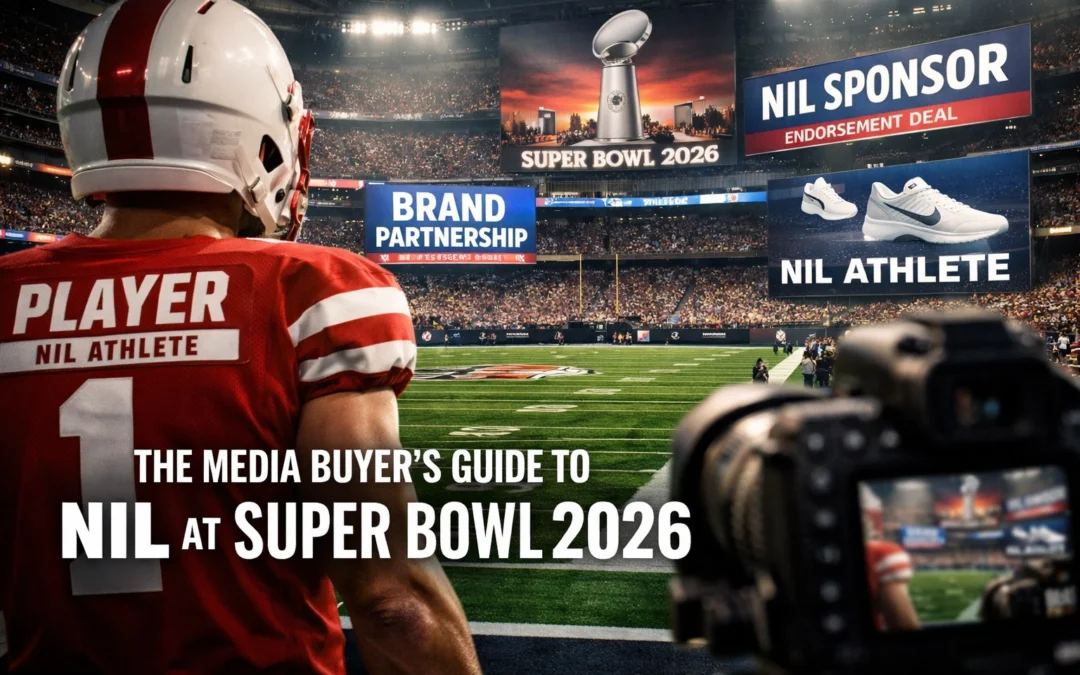
The landscape of Super Bowl advertising has undergone a fundamental transformation by March 2026. While the traditional 30 second television spot remains a prestigious milestone, media buyers now prioritize multi-channel integration that emphasizes authenticity and sustained engagement. The emergence of Name, Image, and Likeness (NIL) as a primary pillar of sports marketing has shifted the focus from singular celebrity endorsements to the collective power of thousands of student-athlete voices.
For the 2026 cycle, the most successful campaigns are not defined by a single creative execution but by their ability to scale personal connections across digital and physical environments. This guide examines the strategic implementation of NIL partnerships for the Super Bowl and how media buyers can leverage the OOH Sports platform to connect with over 20,000 authentic student-athlete voices.
The Evolution of NIL for Major Sporting Events
NIL began as a localized opportunity for student-athletes to monetize their personal brands. By 2026, it has matured into a sophisticated advertising category that rivals traditional endorsements in terms of reach and surpasses them in terms of trust. Media buyers now recognize that a single national ad can provide broad awareness, but it often lacks the community level resonance that student-athletes provide.
The 2026 Super Bowl serves as a proof of concept for hyper-localized national campaigns. By utilizing a network of thousands of athletes, brands can maintain a presence in every major college market simultaneously while the national game is being broadcast. This creates a "surround sound" effect where the brand is visible on the television screen, on social media feeds, and on digital out-of-home (DOOH) screens across the country.
Strategy: Scaling with 20,000 Student-Athlete Voices
The primary challenge for media buyers in previous years was the logistical nightmare of managing hundreds of individual contracts. OOH Sports has streamlined this process through a unified NIL platform. Instead of negotiating with 20,000 individuals, buyers can deploy a single campaign that activates an entire network of athletes.
Objective and Strategy
The objective for a Super Bowl NIL campaign is to achieve market saturation through a decentralized content model. Rather than forcing a scripted message, the strategy relies on the unique creative perspective of each athlete. This co-creation model ensures that the content feels organic to the athlete’s specific audience, which leads to higher engagement rates compared to standard brand-produced creative.
Tactical Execution
- Selection and Segmentation: Athletes are selected based on geographic relevance, sport, and audience demographics. For the Super Bowl, brands often target athletes from the home cities of the competing NFL teams as well as influential athletes in major metropolitan hubs.
- Creative Briefing: Athletes receive a flexible brief that outlines the core brand message but allows for personal interpretation.
- Synchronized Deployment: Campaigns are timed to hit specific windows: the pre-game hype, the live game-day "second screen" experience, and the post-game analysis.

The Three-Phase Campaign Structure
Successful media buyers structure their Super Bowl NIL investments into three distinct phases to maximize the return on investment (ROI) and extend the campaign's lifespan.
Phase 1: The Lead-Up (January 15 to February 7)
During the weeks leading up to the game, the goal is to build anticipation. Student-athletes share behind-the-scenes content that integrates the brand into their daily routines. This phase is critical for establishing a baseline of brand familiarity. Media buyers often pair these digital activations with programmatic DOOH placements in high-traffic areas near campuses and athletic facilities.
According to data on the sports DOOH gold rush, media planners are increasingly shifting budgets toward these integrated models to capture early-season momentum.
Phase 2: Game Day Activation
On the day of the Super Bowl, student-athletes act as digital ambassadors. While the game is the main attraction, the "second screen" (mobile devices) is where the most intense engagement occurs. Athletes provide real-time reactions and host digital viewing parties. This creates a distributed network of brand advocates who are interacting with their followers in real time, effectively turning 20,000 social feeds into 20,000 mini-broadcasts.
Phase 3: Post-Game Retention
The final phase involves extending the narrative. While a television spot is often forgotten 24 hours after the game, NIL content remains on social feeds and continues to generate impressions. Athletes share "day after" content, summarizing their experience and reinforcing the brand message one final time.
https://www.youtube.com/watch?v=l6J-0zileKE
Integration with Digital Out-of-Home (DOOH)
A significant trend in 2026 is the convergence of NIL and DOOH. By using the OOH Sports platform, media buyers can synchronize athlete-generated content with digital billboards and stadium screens. For example, a video created by a popular college quarterback can be repurposed for a DOOH screen in his university’s city, creating a powerful link between digital social content and physical advertising.
This omnichannel approach addresses many of the mistakes media buyers make with sports DOOH campaigns, such as failing to provide local relevance. By using athlete faces in the markets where they are most recognized, brands achieve a much higher level of recall.
Measuring Success: Metrics That Matter
In the past, Super Bowl success was measured primarily by Nielsen ratings and social media "sentiment." In 2026, the measurement framework is more rigorous. Media buyers now look at:
- Verified Reach: Total unique impressions across the athlete network.
- Engagement Depth: The ratio of comments, shares, and saves compared to passive views.
- Attribution: Tracking how NIL exposure leads to website visits or product purchases.
- Brand Lift: Measuring changes in purchase consideration and brand image.
Data from previous campaigns, such as AB InBev's use of programmatic DOOH, shows that these integrated approaches can lead to a 119 percent lift in positive brand image. For Super Bowl campaigns, where the competition for attention is fierce, these metrics provide the necessary evidence for budget allocation.

Scaling Beyond the Stadium
One of the common misconceptions is that Super Bowl advertising must happen inside the stadium or during the broadcast. However, stadium perimeter targeting and city-wide DOOH networks allow brands to dominate the host city without being an official sponsor.
By combining these physical placements with a massive NIL athlete network, a brand can create an "ambush" marketing effect. This strategy was famously used in the past to create the illusion of official sponsorship by simply being more visible in the places where fans congregate.
Technology and the NIL Platform
The OOH Sports NIL platform functions as a centralized hub for media buyers. It provides the tools necessary to manage the logistics of a 20,000 athlete campaign, including:
- Automated Content Review: AI-powered tools that ensure athlete content meets brand safety guidelines.
- Real-Time Analytics: Dashboards that track performance across the entire network in real time.
- Programmatic Integration: The ability to buy DOOH inventory that matches the athlete’s geographic footprint.
This technological infrastructure is what allows the sports advertising market to continue its rapid growth. Projections suggest that DOOH sports advertising will hit $58 billion by 2030, driven largely by the integration of NIL and real-time data.
Conclusion
The 2026 Super Bowl represents a new era for media buying. The traditional model of a single, high-cost creative execution is being replaced by a more resilient, distributed model. By leveraging the authentic voices of over 20,000 student-athletes through the OOH Sports NIL platform, brands can achieve a level of engagement and authenticity that was previously impossible.
For media buyers, the choice is no longer between "big" and "authentic." Through the strategic use of NIL and DOOH, it is now possible to achieve both. The brands that win in 2026 will be those that embrace the power of the collective athlete voice and use it to tell a story that resonates far beyond the final whistle of the game.