
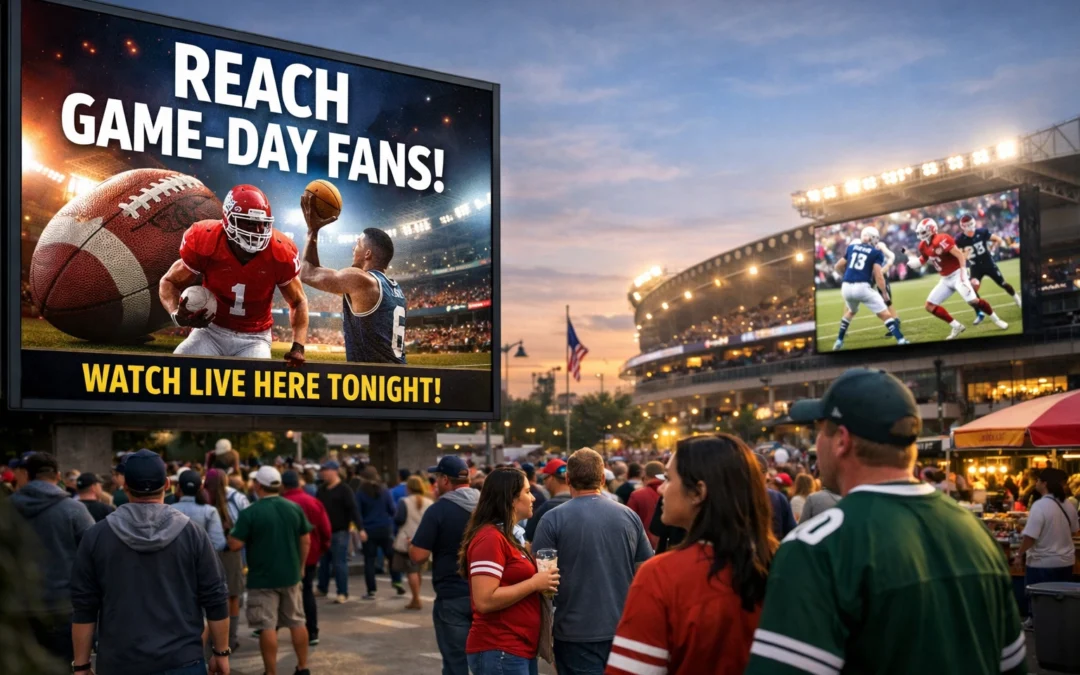
The landscape of sports marketing is undergoing a fundamental shift. As traditional television viewership fragments and ad-blocking software becomes standard on personal devices, brands are finding it increasingly difficult to capture the undivided attention of sports fans. Digital Out-of-Home (DOOH) advertising, specifically tailored to the sports environment, has emerged as the solution to this challenge. By placing dynamic, high-impact content where fans live, travel, and celebrate, sports DOOH transforms passive observers into active consumers.
The Strategy of the Game-Day Journey
Reaching a sports fan is no longer about a single thirty-second television spot. It is about appearing at every critical touchpoint of the game-day experience. This journey begins hours before the first whistle and continues long after the final score is posted.
Sports DOOH allows media buyers to intercept fans during their commute to the venue, at local transit hubs, and within the high-traffic areas surrounding stadiums. This multi-touch approach ensures that a brand becomes part of the ritual of the event. Unlike static billboards, digital screens offer the flexibility to change messaging based on the phase of the game day. A brand might display a "get ready" message in the morning and a celebratory "victory" creative in the evening.

Reaching the Unreachable Audience
One of the most significant advantages of sports DOOH is its ability to bypass the barriers of modern digital advertising. A growing segment of the population now resides in "ad-free" households, relying entirely on subscription-based streaming services that do not show traditional commercials.
Digital Out-of-Home advertising is unskippable and immune to ad-blockers. It exists in the physical world, making it a primary channel for reaching cord-cutters and younger demographics who have moved away from linear TV. According to research, OOH outperforms traditional digital and social channels across key metrics because it does not require a user to opt-in or navigate a crowded digital feed. It simply exists where the audience is already focused.
The Power of High-Emotion Environments
Sports fans are characterized by high levels of emotional engagement. When a fan is at a stadium or a sports bar, their receptivity to messaging is heightened by the excitement of the event. This creates a "halo effect" for brands that associate themselves with the game.
Data indicates that fans exposed to sports OOH are remarkably active. Approximately 90 percent of fans take some form of action after seeing an OOH ad, and 61 percent engage with the brand on social media. This engagement is often driven by real-time relevance, such as humor related to a rival team or creatives featuring star athletes. The physical presence of a digital screen in a high-energy environment serves as a catalyst for digital interaction, bridging the gap between the physical and mobile worlds.

Programmatic Precision and Flexibility
The transition from traditional out-of-home to programmatic DOOH has revolutionized how media buyers manage budgets. Programmatic technology allows for precision targeting that was previously impossible in the OOH space. Brands can now deploy campaigns based on specific triggers such as weather, game scores, or local traffic patterns.
For instance, a beverage brand can increase its ad frequency on screens near a stadium specifically when the temperature exceeds 80 degrees or when the home team wins. This level of automation ensures that the creative is always relevant to the current context of the fan. Furthermore, programmatic platforms allow for rapid adjustments. If a creative is underperforming, it can be swapped out in real-time, providing a level of agility usually reserved for search or social media advertising.
For more on the logistical advantages of this technology, explore the Ultimate Guide to Sports DOOH.
Quantifiable Impact and ROI
In the past, out-of-home advertising was often criticized for a lack of clear attribution. Modern sports DOOH has solved this through sophisticated measurement techniques, including mobile device ID tracking and brand lift studies. These tools allow brand managers to see exactly how many people saw an ad and subsequently visited a retail location or made a purchase online.
The results seen in the field are compelling. For example, White Claw’s programmatic campaign drove a 74 percent lift in purchase consideration for their vodka launch. Similarly, AB InBev’s Mike’s Hard Iced Tea saw a 119 percent lift in positive brand image through a targeted programmatic campaign. These figures demonstrate that sports DOOH is not just a brand awareness play, it is a significant driver of bottom-line results.

DOOH vs. Traditional Stadium Sponsorships
While traditional stadium sponsorships (such as naming rights or fixed signage) have their place, they often require massive capital outlays and long-term commitments. Digital Out-of-Home offers a more accessible and efficient alternative for many brands.
Traditional stadium ads are limited to the audience inside the venue. Conversely, a sports DOOH strategy can cover the "perimeter" of the event, capturing fans at bars, restaurants, and transit points. This extends the reach to the millions of fans who follow the game from nearby locations but may not have a ticket. By utilizing thousands of digital screens rather than a single fixed sign, brands achieve a much higher frequency of exposure at a fraction of the cost.
Further analysis on this comparison can be found in the discussion of DOOH vs. traditional stadium ads.
Omnichannel Integration
Sports DOOH is most effective when it is part of a unified omnichannel strategy. It serves as a powerful top-of-funnel awareness tool that reinforces messaging found on other platforms. For example, a fan might see a digital billboard for a sports betting app on their way to the game, receive a targeted mobile notification while at the stadium, and then see a follow-up ad on social media the next day.
This integrated approach ensures that the brand remains top-of-mind throughout the entire consumer lifecycle. The ability to retarget audiences who have been exposed to a DOOH screen is a game-changer for media buyers. By capturing the device IDs of fans in the vicinity of a digital screen, marketers can continue the conversation on the fan’s smartphone, leading to higher conversion rates and a more cohesive brand story.

Maximizing Dwell Time in Sports Venues and Bars
One factor that sets sports DOOH apart is the extended dwell time. In a typical street-side environment, a consumer might see a billboard for three to five seconds. In a sports bar or a stadium concourse, the audience is often stationary for hours.
Digital screens in these environments provide consistent brand reinforcement. Fans are not just passing by; they are living with the content for the duration of the event. This provides an opportunity for more complex messaging and storytelling that would not be effective on a highway billboard. Brands can utilize short-form video content that entertains as much as it informs, taking advantage of the "captured" nature of the sports-watching audience.
The Shift in Media Planning
Industry trends indicate that media planners are moving away from legacy formats in favor of high-tech, data-driven solutions. Current projections suggest that a significant majority of media planners are shifting their budgets toward programmatic DOOH. This shift is driven by the demand for transparency, flexibility, and measurable ROI.
As the "gold rush" for sports-related ad space continues, brands that adopt DOOH strategies early will have a distinct advantage. They will be able to secure the best locations and build the most robust data sets, allowing them to refine their targeting and creative execution over time. For more on this industry shift, see the report on why 67 percent of media planners are shifting budgets.

Conclusion: The Future of Fan Engagement
The way fans consume sports has changed, and the way brands reach them must change as well. Sports DOOH offers a unique combination of physical presence and digital intelligence. It allows brands to be part of the most exciting moments in a fan's life, providing relevant, timely, and impactful messaging that drives real-world action.
By leveraging programmatic technology, multi-touch journeys, and high-emotion environments, media buyers can achieve a level of engagement that traditional channels simply cannot match. In the competitive world of sports marketing, DOOH is no longer just an option: it is a strategic necessity for any brand looking to win on game day.