
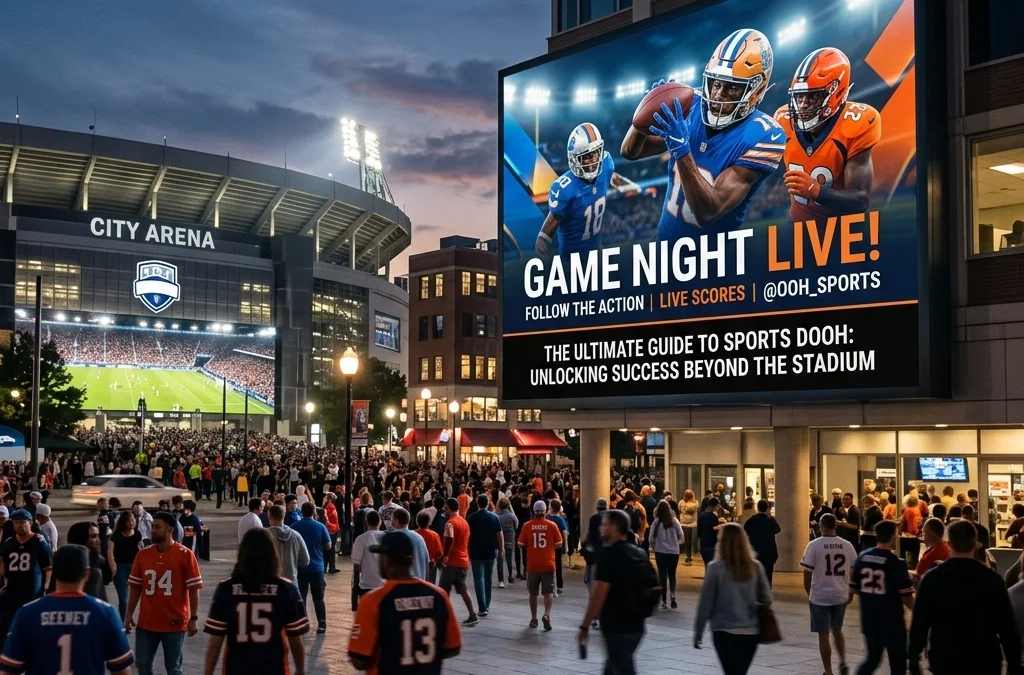
Digital Out-of-Home (DOOH) advertising has evolved into the connective tissue linking brands to the daily lives of sports fans. While traditional stadium sponsorships once dominated the landscape, the modern marketing strategy recognizes that the vast majority of fan engagement happens outside the venue walls. In fact, research indicates that a staggering percentage of fan attention exists in the streets, transit hubs, and social congregation points surrounding the game.
This guide explores how brands can capture that attention, leveraging the shift from static signage to a dynamic, data-driven advertising ecosystem. By focusing on the 99 percent of fans who are not inside the stadium at any given moment, advertisers can achieve massive scale and measurable impact.
The Shift in Fan Engagement
The landscape of sports marketing is no longer confined to the 30-second television spot or the static billboard behind the end zone. Fans today are hyper-connected and mobile. They consume content across multiple screens and engage with their favorite teams long before the first whistle blows.
Sports fans are uniquely receptive to brand messaging. Studies show that over 80 percent of fans feel more positive toward brands that sponsor sports, and nearly half of consumers discuss sporting events with peers after seeing an out-of-home advertisement. This receptiveness creates a fertile ground for DOOH campaigns that meet fans where they are.
With networks now encompassing over 25,000 digital screens strategically placed across high-traffic transit hubs and fan congregation points, the opportunity for reach is unprecedented. This expansion allows brands to move away from the high costs and limited inventory of traditional stadium sponsorships. For more on how this shift is occurring, explore how 25,000 digital screens are changing sports marketing.

The Extended Impression Window
Unlike traditional broadcast advertising, which relies on narrow windows of time, DOOH campaigns operate across an extended timeframe. This journey-based approach captures fans throughout their entire routine. Impressions are accumulated at multiple touchpoints:
- Travel and Transit: Airports, train stations, and bus shelters capture fans as they arrive for big events or commute to watch parties.
- Hospitality: Hotel check-ins and lobbies engage fans staying in the city for the game.
- Retail and Dining: Bars, restaurants, and shopping districts capture the pre-game build-up and post-game celebrations.
- The "Perimeter" Strategy: Targeting screens just outside the stadium gates engages the crowd as they wait to enter or exit.
This multi-moment activation ensures that a brand is buying moments in a fan's routine rather than just a single placement. By coordinating messaging across these touchpoints, a brand creates a narrative that follows the fan from their doorstep to the venue and back again.
Strategic Activation Windows: The 48-Hour Rule
Success in sports DOOH requires meticulous planning across three distinct phases. The most critical period is often the 48 hours leading up to kickoff. During this phase, fans are in planning mode. They are checking logistics, looking at betting lines, and building anticipation.
Screens in transit hubs and office districts are particularly valuable here. Delivering practical value, such as broadcast schedules, countdown clocks, or live weather updates, positions a brand as a helpful participant in the fan experience.
During the event itself, the focus shifts to real-time engagement. This is where communal reaction and the "fear of missing out" (FOMO) create peak engagement. For brands in the sports betting space, this is the prime time to trigger ads based on live game flow. For a deeper look at this process, see how to launch real-time sports betting DOOH campaigns.
Technology as the Catalyst for ROI
The true power of modern DOOH lies in the technology that powers it. There are three key pillars that drive success in this space:
Programmatic DOOH (pDOOH)
Programmatic technology allows for the automated buying and selling of ad space. This provides flexibility that traditional OOH simply cannot match. Brands can pause, pivot, or scale campaigns in real time based on game results or audience movement. Platforms like the StackAdapt DSP are driving this adoption, allowing for seamless integration into omnichannel campaigns. More details can be found on driving programmatic DOOH adoption.
Dynamic Creative Optimization (DCO)
DCO technology allows creative assets to change based on external triggers. This could mean a beverage brand showing a "refreshing drink" ad when the temperature exceeds 80 degrees, or an apparel brand promoting rain gear the moment a storm is detected near the stadium. This level of contextual relevance is what separates a standard ad from a high-performing engagement tool.
AI-Powered Analytics
Measurement has historically been a challenge for OOH, but AI-powered analytics have solved this issue. By using device IDs and location intelligence, brands can now connect DOOH exposure to real-world outcomes, such as foot traffic or online purchases. This data-backed approach proves the success of the campaign and helps avoid common measurement mistakes.

Case Studies: Proof in the Numbers
The effectiveness of sports-centric DOOH is best demonstrated through measurable campaign results. High-impact visuals combined with contextual relevance create powerful incentives for action.
- White Claw: To support a vodka launch, a programmatic DOOH campaign was deployed to reach fans in high-intent environments. The results showed a 74 percent lift in purchase consideration. View the full study on White Claw's programmatic campaign.
- Mike’s Hard Iced Tea: By leveraging specific audience targeting around sporting events, the brand achieved a 119 percent lift in positive brand image. Read more about the Mike’s Hard Iced Tea campaign.
- Sea-Doo: Even brands not directly related to stadium sports can win by targeting the "outdoor" mindset of fans. Sea-Doo's first digital OOH campaign increased purchase consideration by 144 percent. Explore the Sea-Doo case study.
Avoiding the "Official Sponsor" Trap
One of the most effective strategies for non-sponsoring brands is "perimeter targeting" or "ambush" marketing through DOOH. This allows a brand to appear as an integral part of an event without the multi-million dollar price tag of an official partnership.
A notable example occurred during the NYC Marathon, where Nike utilized DOOH to create a massive brand presence despite not being the official sponsor. This strategy proves that smart brands can scale with perimeter DOOH for significantly less than traditional sponsorships. For insight into this tactic, look at how Nike dominated the NYC Marathon.

The Road to $50 Billion
The sports advertising sector is projected to hit $50 billion by 2030, and DOOH is a major driver of that growth. As more media planners shift budgets away from traditional channels and toward digital out-of-home, the competition for premium inventory will increase.
Success requires a winning formula that combines early planning, dynamic creative, and audience-led targeting. Brands that implement these strategies now will be well-positioned to capture their share of the market. To learn more about the long-term outlook, check out 7 strategies to capture your share of the DOOH market.
Maximizing ROI with Smart Targeting
When comparing traditional stadium ads to programmatic DOOH, the ROI often favors the latter. Traditional ads are static and limited to the people physically inside the stadium. In contrast, DOOH reaches fans at every step of their journey, providing more impressions for every dollar spent.
Geographically targeted strategies have been shown to boost fan engagement by as much as 90 percent. By focusing on where fans live, work, and play, brands can build a more sustainable and impactful relationship with their audience. For a direct comparison on budget efficiency, see how smart brands scale with perimeter DOOH.

The future of sports marketing is not just about the game, it is about the entire experience surrounding it. By embracing DOOH, brands can ensure they are part of that experience, delivering the right message at the right time to the right fan. For more insights and campaign strategies, visit OOH Sports.