
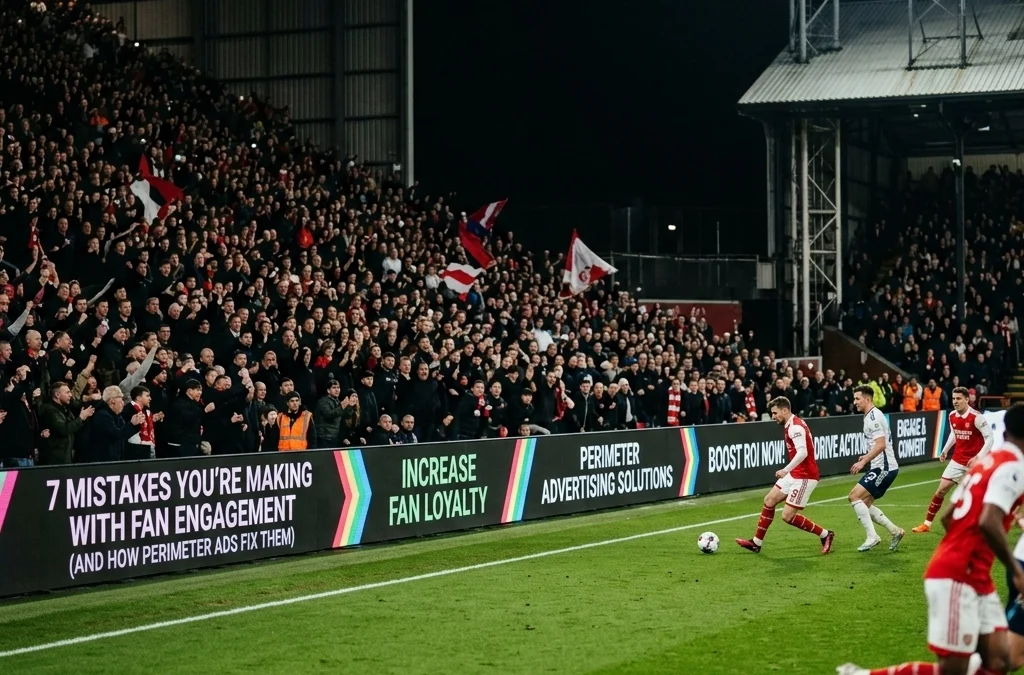
The challenge of capturing the attention of a modern sports fan is more complex than it has ever been. CMOs and creative directors are operating in a landscape where every second of a fan's attention is fought for by social media, mobile notifications, and streaming services. Despite the digital noise, the physical stadium remains the epicenter of emotional engagement. However, many brands fail to capitalize on this live environment because they apply traditional advertising logic to a high-energy, tribal atmosphere.
When fan engagement strategies miss the mark, the result is wasted spend and lost brand affinity. Stadium perimeter advertising, specifically through OOH Sports, offers a strategic fix to these common errors. By understanding the psychology of the spectator and the mechanics of the field of play, brands can turn passive viewing into active brand recognition.
Below are seven frequent mistakes marketers make with fan engagement and the ways stadium perimeter ads provide a solution.
1. Treating Sports Fans Like Generic Consumers
One of the most frequent errors in sports marketing is failing to recognize tribal loyalty. Sports fans are not typical consumers walking through a mall or scrolling through a news feed. They are emotionally invested participants in a live narrative. When a brand uses generic creative that could just as easily appear in a suburban airport, it fails to resonate with the specific energy of the crowd.
Perimeter ads fix this by providing a platform for venue specific and team specific messaging. Because these ads are integrated into the environment of the game, they are perceived as part of the event rather than an interruption. Aligning brand creative with the colors, spirit, or location of the home team creates an immediate psychological bond with the audience.

2. Over-Reliance on Social Media for Live Engagement
A common misconception in the digital age is that fans spend the entire game looking at their phones. While social media is an excellent tool for pre-game hype and post-game analysis, it loses its grip during the moments that matter most. When a goal is scored, a buzzer-beater is shot, or a touchdown is made, eyes are fixed firmly on the field, not on a screen.
Stadium perimeter ads offer unskippable visibility during these peak moments of action. They are positioned exactly where the eyes naturally focus. Unlike a mobile app, a perimeter board cannot be closed, swiped away, or blocked. This ensures that the brand is present during the most intense periods of fan focus. For brands looking to maximize their reach, OOH Sports provides the necessary infrastructure to stay in the line of sight when digital channels go quiet.
3. Ignoring the Power of the Emotional Peak
The value of an advertisement is often tied to the emotional state of the person seeing it. Many brands deliver their messages at times when fans are distracted or emotionally neutral. Missing the "peak" of the game means missing the moment when the brain is most primed for memory encoding.
Perimeter ads allow brands to be physically present when the crowd reaches its highest emotional state. When a stadium erupts in cheers, the brands on the perimeter boards are visually associated with that surge of dopamine. This association is a powerful driver for brand lift. Research into programmatic digital out of home (DOOH) campaigns has shown significant increases in brand image when messaging is delivered in high impact environments, as seen in the Mike’s Hard Iced Tea case study.
4. Maintaining a Static Messaging Strategy
In the past, stadium advertising was a static affair. A brand bought a board, and that board stayed the same for the entire season. In a fast moving market, this lack of flexibility is a major mistake. It prevents brands from reacting to real-time events, player performance, or changing weather conditions.
Modern perimeter advertising through OOH Sports utilizes digital technology to allow for dynamic creative. This means a brand can change its messaging based on the score, the time of day, or even specific game triggers. This level of agility ensures that the content remains relevant and engaging throughout the entire duration of the event. Transitioning from static to digital allows for a programmatic approach that can significantly increase purchase consideration.
5. Neglecting the Broadcast Angle
Many creative directors focus solely on the fans inside the stadium, forgetting that the perimeter boards are often the most visible elements in a television or streaming broadcast. A mistake is made when creative is designed only for the live attendee, ignoring how it will look through a camera lens.
Perimeter ads are strategically placed to be in the "Golden Zone" of the broadcast. This is the area surrounding the action where the camera spends 90 percent of its time. By optimizing creative for both the live and the viewing audience, brands can achieve a massive multiplier effect on their reach. This dual visibility is a core reason why sports advertising is projected to grow substantially in the coming years, a topic explored in depth in this industry analysis.

6. Overcomplicating Creative for High-Speed Environments
In an attempt to be clever, some brands pack their stadium ads with too much text, small logos, or complex imagery. In a high-speed sports environment, the human eye only has a few seconds to process an ad. If the message is not clear at a glance, it is lost.
Perimeter ads fix this by forcing a discipline of simplicity. Successful brands use high-contrast colors, bold typography, and a single, clear call to action. Because these boards are often moving or seen in the background of fast action, the "less is more" philosophy is essential. Creative directors should focus on iconic brand assets that can be recognized instantly, even in the blurred background of a fast break or a sprint.

7. Failing to Connect Stadium Presence with Long-Term ROI
The final mistake is treating stadium advertising as an isolated tactic rather than part of an omnichannel strategy. Marketers often struggle to measure the direct impact of a perimeter board on their bottom line, leading to the false assumption that it is purely a "brand awareness" play with no measurable ROI.
Modern DOOH technology allows for sophisticated attribution. By using device IDs and location data, brands can track when a fan who was exposed to a stadium ad later visits a website or makes a purchase. This bridges the gap between the physical experience and the digital conversion. Case studies, such as the Sea-Doo campaign, demonstrate how targeted DOOH can drive a massive lift in purchase consideration by connecting with the right audience at the right time.
The Strategic Shift to Perimeter Advertising
For CMOs looking to refine their fan engagement strategy, the focus must shift from simply "being seen" to "being relevant." Stadium perimeter ads provide a unique solution because they sit at the intersection of live emotion, unskippable visibility, and modern digital flexibility.
By avoiding these seven mistakes, brands can ensure that their presence in the stadium is not just background noise but a core driver of brand growth. Whether it is through the use of programmatic DOOH or high-impact sportrons, the goal remains the same: capturing the heart of the fan while their eyes are on the game.
The transition toward digital integration in sports venues is not just a trend; it is the new standard for effective engagement. Those who master the perimeter will find themselves at the winning end of the fan's attention span.
To learn more about how to implement these strategies for your next campaign, visit the OOH Sports contact page or explore more insights on the OOH Sports blog.