
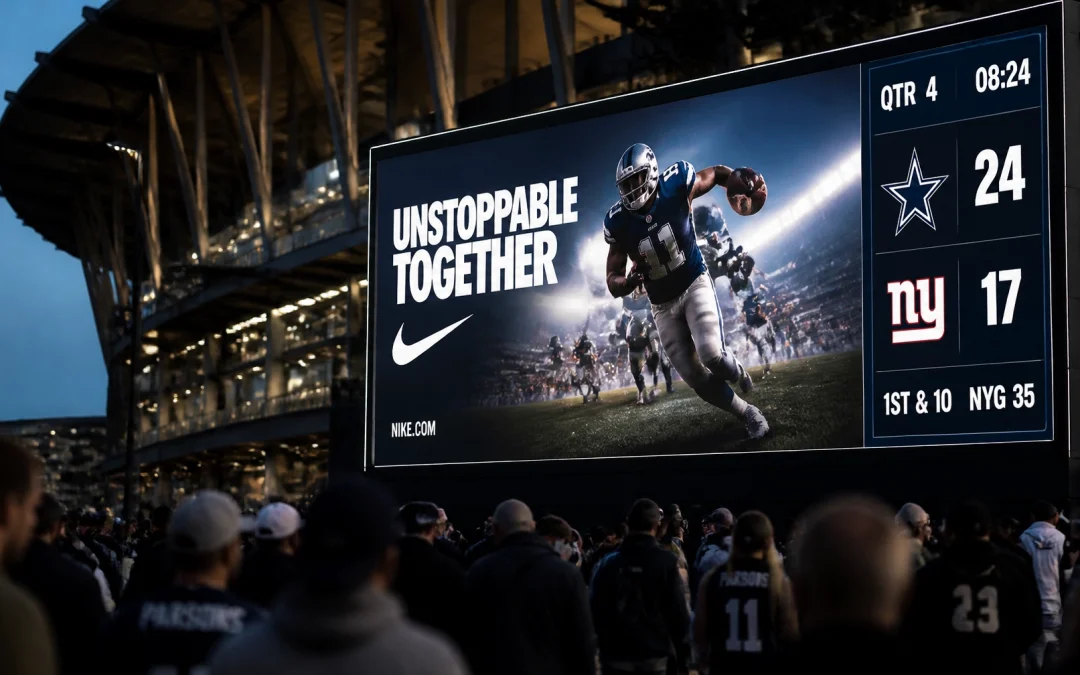
The landscape of sports marketing is undergoing a significant transformation. As traditional advertising channels face increasing fragmentation, digital out-of-home (DOOH) advertising has emerged as a powerhouse for reaching fans where they are most engaged. The intersection of high-stakes athletics and cutting-edge display technology provides a unique opportunity for brands to capture attention and drive measurable results. By 2026, programmatic DOOH is projected to account for over 65 percent of all DOOH expenditures, reflecting a shift toward more automated, data-driven strategies.
For media buyers and brand managers, the challenge lies in moving beyond static placements to create campaigns that resonate with the passion of the sports environment. This article explores three innovative DOOH ideas that leverage real-time data, hyper-local targeting, and interactive technology to maximize return on investment (ROI).
1. Real-Time Dynamic Creative and Game-Day Triggers
The most successful sports campaigns capitalize on the "in-the-moment" emotion of the game. Programmatic DOOH (pDOOH) allows advertisers to move away from static scheduling and instead use live data feeds to trigger specific creative assets. This approach ensures that the messaging remains relevant to the unfolding action on the field or court.
Objective and Strategy
The primary objective is to increase brand relevance by aligning messaging with real-time sporting events. The strategy involves using specialized Demand-Side Platforms (DSPs) to set triggers based on live scores, player statistics, or even weather conditions. For example, a beverage brand might trigger a specific "celebration" ad immediately following a home team victory, or a sports apparel retailer could display rain-gear creative if a downpour begins during an outdoor stadium event.
Technology Partners
Execution of dynamic creative requires a robust technology stack. This typically includes:
- Programmatic DSPs: Platforms like StackAdapt facilitate the automated buying of inventory across multiple networks.
- Data Feed Integration: Real-time APIs providing sports scores, weather updates, and traffic conditions.
- Dynamic Creative Optimization (DCO): Systems that assemble creative elements on the fly based on the active trigger.
Expected Results
Data suggests that dynamic, contextually relevant creative significantly outperforms static ads. Industry benchmarks indicate that campaigns using real-time triggers can see a 30 percent lift in ad recall. In specific beverage sector applications, such as the Mike’s Hard Iced Tea campaign, the use of programmatic DOOH contributed to a 119 percent lift in positive brand image.

2. The "Stadium Halo" Strategy: Hyper-Local Targeting
Sports fans do not just exist inside the arena. They occupy a high-energy ecosystem that extends miles around the venue. The "Stadium Halo" strategy focuses on saturating the 10-mile perimeter around sports venues with synchronized digital messaging, capturing fans as they travel to the game, visit local sports bars, and head home.
Objective and Strategy
The goal is to create a dominant brand presence within the high-density "fan zone" surrounding a stadium. The strategy utilizes a network of digital screens in transit hubs, gas stations, convenience stores, and street furniture. By focusing on these high-traffic areas, brands can reach fans at multiple touchpoints throughout their game-day journey. This method is particularly effective for ambush marketing tactics, where a non-sponsor brand seeks to capture the attention of the event audience without the cost of an official sponsorship.
Execution Logistics
- Inventory Selection: Prioritize screens within a strict 10-mile radius of the target stadium.
- Dayparting: Increase bid multipliers and frequency in the four hours leading up to the game and the two hours following the final whistle.
- Mobile Retargeting: Use device IDs exposed to the DOOH screens to serve follow-up mobile ads, reinforcing the message and providing a direct link to a website or app.
Measurable Impact
A study by the Outdoor Advertising Association of America (OAAA) found that nearly 60 percent of U.S. adults recall seeing OOH ads for major sporting events. Furthermore, 99 percent of fans who attend a game after being exposed to OOH advertising spend money locally at food and retail establishments. This hyper-local focus directly supports local economic lift and sponsor visibility. For instance, a campaign for White Claw saw a 74 percent lift in purchase consideration by leveraging targeted programmatic placements.

3. The Shoppable Fan Experience: Transactional DOOH
In 2026, DOOH is no longer just an upper-funnel awareness tool. It has evolved into a transactional platform. Shoppable DOOH integrates interactive elements like QR codes, NFC (Near Field Communication), and augmented reality (AR) to turn public screens into point-of-sale terminals.
Objective and Strategy
The objective is to shorten the path from brand exposure to conversion, particularly for ticketing, merchandise, and sports betting. The strategy involves placing clear, high-contrast QR codes on digital kiosks and billboards in areas where fans have "dwell time," such as transit platforms or stadium entrances. These codes link directly to a mobile-optimized checkout page or a dedicated app download.
Technology and Creative
- Interactive Kiosks: Utilization of sportrons and other venue-based digital displays that support high-resolution interactive content.
- Frictionless Payments: Integration with digital wallets (Apple Pay, Google Pay) to allow for near-instant transactions once the QR code is scanned.
- AR Filters: Using billboards as triggers for augmented reality experiences where fans can "try on" team jerseys or view 3D player stats on their phones.
Performance Benchmarks
Transactional DOOH delivers a significantly higher audience ROI than many other digital channels. Research suggests that OOH delivers a marginal ROI of 7.58 dollars per incremental dollar spent, compared to an average of 5.52 dollars across other media. For brands in the outdoor recreation space, such as Sea-Doo, the integration of targeted DOOH messaging resulted in a 144 percent increase in purchase consideration.

Advanced Measurement and Attribution
The shift toward DOOH is driven by the ability to provide rigorous, data-backed proof of performance. Modern campaigns are measured using a variety of sophisticated methodologies:
- Brand Lift Studies: Surveying exposed versus unexposed audiences to measure changes in awareness, favorability, and intent.
- Footfall Attribution: Using anonymized mobile location data to track how many people visited a specific retail location or stadium after being exposed to a DOOH ad.
- Device ID Matching: Connecting DOOH exposure to online conversions, such as app installs or website purchases.
By analyzing performance by location, daypart, and creative execution, advertisers can optimize campaigns in real-time. This level of precision ensures that sports marketing budgets are allocated to the highest-performing placements, maximizing the overall ROI of the sports network.
Conclusion
Innovation in sports advertising is no longer just about who has the biggest logo on the jersey. It is about who can most effectively use data and technology to engage the fan at the right moment and in the right place. By implementing real-time dynamic creative, saturating the stadium halo, and enabling shoppable experiences, brands can transcend traditional advertising boundaries. The results, as seen in recent industry data and campaign outcomes, confirm that DOOH is an essential component of a high-performance sports marketing strategy.