
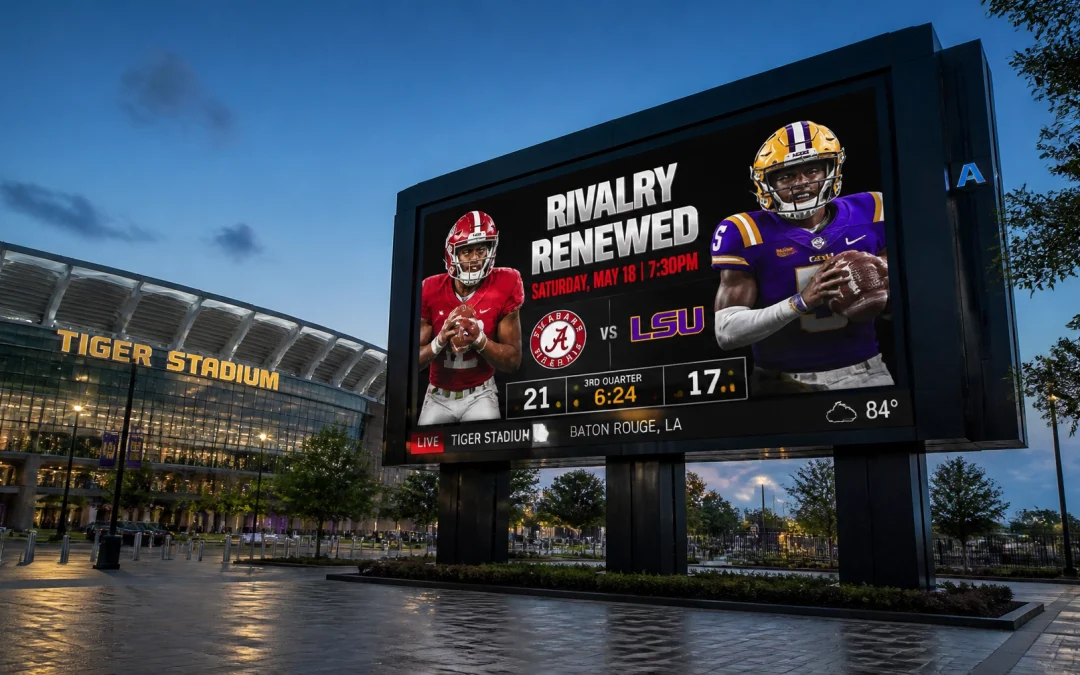
Digital out-of-home advertising is moving from a broad-reach awareness channel toward a more flexible, audience-informed part of the sports media mix. The change is being driven by programmatic buying, real-time creative, mobility data, and stronger measurement standards.
For media buyers, planners, brand managers, and creative directors, the opportunity is practical: sports DOOH can now be planned around fan movement, activated around live conditions, and evaluated against outcomes beyond estimated impressions.
This newsletter outlines the trends shaping the channel and the actions advertisers can take to build more effective sports campaigns.
The Programmatic DOOH Market Is Moving Toward Mainstream Adoption
Programmatic DOOH is becoming a standard component of omnichannel planning. According to VIOOH research, programmatic DOOH appeared in 34% of campaigns among recent buyers during the latest measured period. Buyers expect that share to increase to 48% over the following 18 months.
The same research reports an anticipated 44% increase in programmatic DOOH investment. Among recent buyers, 99% expect to either increase or maintain spending.
The implications for sports advertising include:
- More access to digital screen inventory through DSPs and private marketplaces
- Faster activation around games, tournaments, and fan travel periods
- Greater flexibility to adjust budgets, timing, and audience criteria
- Easier integration with mobile, CTV, social, and search campaigns
- More consistent reporting across markets and venue environments
The growth is not limited to traditional OOH budgets. VIOOH reports that 95% of marketers planning to increase programmatic DOOH investment expect to reallocate budget from other digital channels, including DOOH. This indicates that pDOOH is increasingly competing for core digital media budgets rather than serving only as an additional awareness tactic.
For sports marketers, the planning question is no longer whether programmatic DOOH belongs in the media mix. The more relevant question is how to use it alongside direct venue placements, mobile retargeting, CTV, and social content.
Strategy: Plan Around the Fan Journey
Sports audiences are not concentrated in one place. A fan’s journey can include transit routes, parking areas, restaurants, sports bars, retail locations, hotels, and the venue itself.
A venue-based campaign can use mobility and geofencing signals to organize this journey into practical planning zones:
- Arrival zone: Transit hubs, major intersections, parking areas, and roads leading toward the venue.
- Pre-game zone: Restaurants, bars, retail districts, and entertainment areas where fans gather before the event.
- Venue zone: Digital perimeter boards and screens within the immediate stadium or arena area.
- Post-game zone: Transportation corridors, hospitality areas, and late-night dining locations.
- Return or retargeting zone: Digital channels that reconnect with audiences after exposure to the physical screen.
This audience-first model is more useful than selecting screens based only on size or proximity. It gives media planners a structure for sequencing messages and managing frequency across the entire event experience.
The OOH Sports network is designed to support this type of planning through digital advertising boards and screens within the perimeter surrounding sports venues. The OOH Sports network updates provide additional detail on venue coverage, fan zones, and market-by-market planning.

Real-Time Creative Makes Sports DOOH More Relevant
Sports create a continuous stream of context. Scores change, weather shifts, traffic builds, and fan sentiment develops across the event cycle. Dynamic creative optimization allows approved creative variations to respond to those conditions.
Common triggers include:
- Weather, such as heat, rain, snow, or temperature changes
- Time of day, including morning travel, pre-game, game time, and post-game periods
- Traffic and transit conditions
- Live scores, game status, or match results
- Team affiliation and local market
- Event phase, such as pre-game, in-game, or post-game
- Social sentiment or approved trend signals
- Retail availability, pricing, or limited-time offers
A beverage brand could promote a cold product during a warm afternoon. A restaurant could shift from pre-game dining to post-game delivery messaging. A streaming service could use tune-in creative when a game reaches a decisive moment. A financial brand could connect a campaign message to a major tournament without relying on a single static execution.
DCO should support the campaign objective rather than operate as a novelty. Each variation needs a clear purpose, an approved data source, and a defined fallback creative if the trigger is unavailable.
VIOOH reports that 65% of marketers associate programmatic DOOH with DCO, while 66% expect to make greater use of DCO. However, the report also identifies training, budget, and creative resources as barriers. This creates an opportunity for advertisers that build modular creative systems before launch.
The OOH Sports guide to sports DOOH innovation tactics includes examples of score-based, weather-based, and event-triggered creative execution.
Technology Partners Support Faster, More Connected Buying
Programmatic sports DOOH depends on coordination across several technology and data layers:
- Demand-side platforms: Used to define budgets, audiences, timing, and inventory eligibility.
- Supply-side platforms: Connect buyers with available digital screen inventory.
- Data providers: Supply aggregated mobility, location, weather, traffic, and audience signals.
- Dynamic creative platforms: Manage approved creative variations and trigger logic.
- Measurement partners: Evaluate exposure, visitation, brand lift, and downstream actions.
- Venue and network operators: Provide screen access, scheduling, quality assurance, and local market knowledge.
Curated marketplaces are also becoming more important. VIOOH reports that 58% of marketers are likely to use curated marketplaces in the future. These marketplaces can simplify fragmented inventory by grouping screens under a single deal ID or structured buying arrangement.
This model is especially useful for sports campaigns that need consistent access across multiple cities, teams, or venue types. It can also support stronger brand-safety controls and more predictable execution than an entirely open inventory approach.
Measurement: Connect Exposure to Real-World Outcomes
Measurement is one of the most important developments in DOOH sports advertising. Campaign reporting can now extend beyond impressions and screen delivery to evaluate what audiences did after exposure.
Depending on the campaign objective, measurement may include:
- Delivered impressions and pacing
- Reach and frequency by market
- Exposed versus control audience comparisons
- Brand awareness, recall, and preference
- Purchase consideration and intent
- Website visits, app activity, or QR code scans
- Foot traffic to stores, restaurants, or event locations
- Retargeting audience creation and digital response
- Sales or visitation lift where data access permits
A strong measurement plan begins before the campaign launches. The buyer should define the exposed audience, control methodology, geographic boundaries, reporting cadence, and primary KPI in advance.

For example, a QSR campaign near a stadium may prioritize visitation lift during pre-game and post-game windows. A national sponsor may focus on brand lift across priority markets. A sports app may evaluate downloads, registrations, or active users among exposed audiences.
Industry examples show the range of measurable outcomes available through programmatic DOOH. OOH Sports has reported a 74% lift in purchase consideration for a White Claw campaign and a 119% lift in positive brand image for an AB InBev campaign. These examples are discussed in the OOH Sports DOOH insights article.
Measurement does not make every campaign directly attributable to a sale. It does, however, give advertisers a more structured way to compare exposure with brand and behavioral outcomes.
Sports Tentpoles Increase Demand for Digital Inventory
Major sports tentpoles create concentrated demand for digital inventory near venues and along fan routes. Playoffs, championship events, season openers, rivalry games, international tournaments, and large fan festivals can produce predictable surges in travel, dining, retail, and entertainment activity.
These events create several planning opportunities:
- Build reach before inventory becomes constrained
- Secure coverage across arrival and departure routes, not only the venue
- Use event calendars to plan longer flights around anticipation and follow-up
- Reserve flexible inventory for real-time creative
- Coordinate local and national messaging
- Align DOOH exposure with CTV, social, audio, and mobile schedules
- Establish measurement baselines before the event period begins
The strongest tentpole plans avoid treating the event as a single media moment. Instead, they use a sequence of exposures that begins before fans arrive and continues after the event ends.
Research from the Out of Home Advertising Association of America and The Harris Poll found that nearly six in ten U.S. adults recalled seeing an OOH ad connected to a major sporting event. Among those exposed, 90% took a follow-on action, such as watching the event, discussing it, or engaging on social media. The study also reported that 99% of fans who attended a game after seeing an OOH ad spent money locally.
The findings reinforce the value of planning around the full sports ecosystem, not only the stadium entrance.
Actionable Checklist for Sports Advertisers
A practical sports DOOH plan can begin with the following checklist:
- Define the campaign objective, awareness, consideration, visitation, or conversion.
- Select priority venues, markets, sports, and event types.
- Map fan movement around each venue and identify key transit and entertainment corridors.
- Set radius and proximity rules before selecting inventory.
- Create pre-game, in-game, and post-game messaging.
- Establish DCO triggers and approved fallback creative.
- Coordinate DOOH timing with mobile, CTV, social, and audio.
- Confirm programmatic access, deal structure, and brand-safety requirements.
- Define exposed and control audiences for measurement.
- Select a reporting partner and establish the reporting schedule.
- Review results by market, environment, daypart, and event phase.
The Next Stage of DOOH Sports Advertising
The direction of the market is clear. Programmatic buying is expanding, audience signals are becoming more useful, creative is becoming more responsive, and measurement is moving closer to real-world outcomes.
For advertisers, the benefit is greater control over when and where messages appear. For agencies and media planners, the benefit is a more repeatable way to build sports campaigns across markets. For venue and network partners, the benefit is stronger integration with the broader digital media ecosystem.
Sports DOOH is most effective when the screen, audience, message, timing, and measurement plan are connected. The technology makes that connection possible. Strategy determines whether it produces a meaningful result.
Explore the OOH Sports blog for additional insights, or visit OOH Sports to learn more about venue-based digital advertising opportunities.