
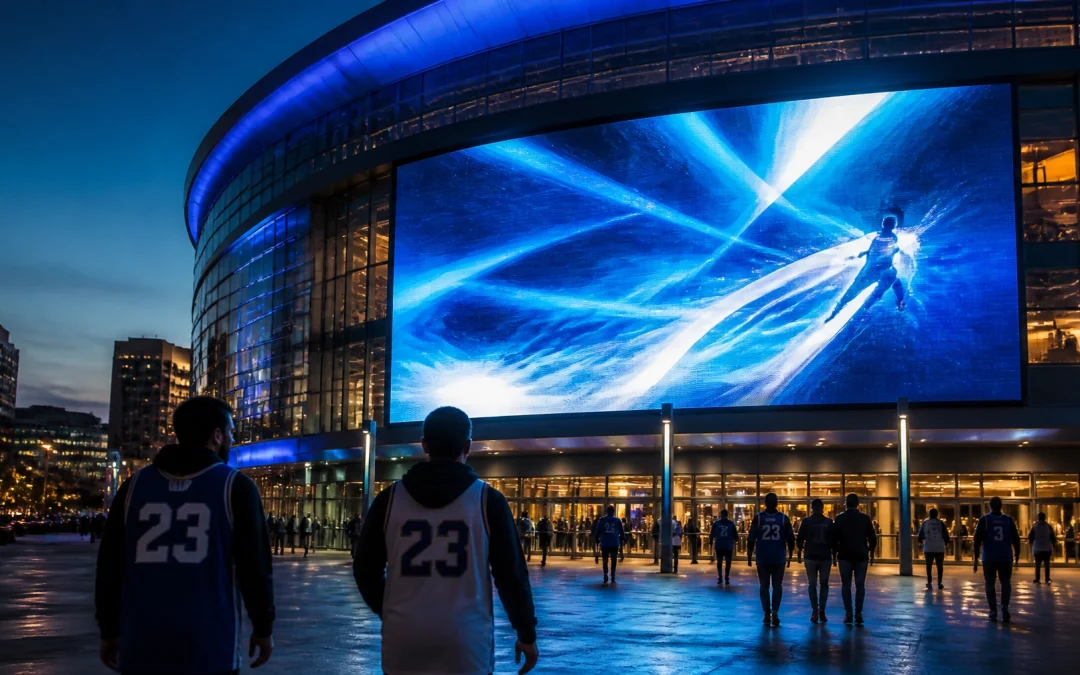
Digital out-of-home advertising continues to move from a supporting media channel to a central part of the modern media mix. For sports advertisers, that shift creates new opportunities to reach fans before, during, and after an event across the physical environments that shape the fan journey.
The most important developments involve programmatic buying, dynamic creative, improved measurement, omnichannel activation, and expanded access to venue-adjacent inventory. Together, these changes allow brands to plan sports media with greater precision while preserving the visibility and cultural relevance of out-of-home advertising.
This edition highlights the trends that media buyers, brand managers, agencies, and sports properties should be tracking.
Industry Snapshot: DOOH Is Driving OOH Growth
Out-of-home advertising remains a resilient channel, supported by continued audience movement through public spaces, entertainment districts, retail locations, and sports venues.
According to the Out of Home Advertising Association of America, total U.S. OOH revenue reached a record $9.46 billion, while DOOH represented 36.3% of total OOH revenue and increased 10.5% year over year.
Several factors are contributing to this growth:
- More digital screens are being installed in high-traffic environments.
- Programmatic buying is making premium inventory easier to access.
- Advertisers can use data to select locations, time windows, and audience environments.
- Measurement providers are connecting exposure with brand and business outcomes.
- DOOH can support both broad awareness and targeted activation.
For sports marketers, the expansion of digital inventory means that a campaign no longer needs to be limited to a single stadium or sponsorship placement. A network approach can connect the venue with surrounding streets, restaurants, retail locations, transit routes, and other fan destinations.
Trend Watch: Programmatic DOOH Becomes More Practical
Programmatic DOOH allows advertisers to purchase digital screen inventory through automated platforms using defined audience, location, timing, and budget parameters.
The model is especially useful for sports campaigns because fan behavior changes quickly around events. A planner may need to coordinate media across multiple venues, markets, and screen types while maintaining a consistent campaign objective.
Programmatic buying can help manage:
- Venue selection and geographic coverage
- Perimeter radius around stadiums and arenas
- Pre-game, in-game, and post-game time windows
- Audience composition and location context
- Frequency across multiple screen environments
- Creative rotation and delivery rules
- Budget allocation across markets
- Retargeting audiences for mobile, video, or CTV
This approach also helps reduce the administrative burden associated with buying inventory from multiple media owners. Curated packages can combine billboards, urban panels, place-based screens, sports bars, and in-venue displays within a single planning framework.
The OOH Sports Network is designed to support this type of connected planning by providing access to digital advertising boards across sports environments and venue categories.
Sports Opportunity: Plan Around the Full Fan Journey
Sports audiences are not confined to the stadium. The fan journey often includes several physical locations, each offering a different media opportunity.

A venue perimeter strategy can reach fans in stages:
- Before departure: Reach local fans near homes, offices, and retail areas.
- During travel: Activate screens along roads, transit routes, and rideshare corridors.
- Before entry: Use nearby restaurants, bars, parking areas, and entertainment districts.
- Inside the venue: Reinforce the message through concourse screens, LED boards, and digital signage.
- After the event: Extend the campaign through nearby hospitality, retail, and transportation environments.
- After exposure: Retarget eligible audiences through mobile, online video, social, or CTV.
Each environment can perform a distinct role. Exterior screens may build reach and brand association. In-venue displays can reinforce recognition during high-attention moments. Nearby retail or restaurant placements can support a more direct call to action.
The Sportrons network provides another example of how digital video boards, LED screens, sponsored features, and other fan-facing placements can support a connected sports media plan.
Creative Insight: Relevance Matters More Than Complexity
Dynamic creative optimization, or DCO, allows advertisers to adjust messaging based on approved data signals. In sports environments, those signals can include:
- Game start and end times
- Pre-game countdowns
- Live scores
- Team results
- Venue proximity
- Weather conditions
- Traffic patterns
- Time of day
- Promotional availability
A beverage brand might use anticipation-focused creative before an event, a product offer during peak venue traffic, and a post-game message after a home-team win. The campaign can retain a consistent visual identity while adapting to the moment.
Effective sports DOOH creative remains simple:
- One dominant visual
- One clear headline
- A recognizable brand cue
- A single call to action
- A QR code or short URL when an action is required
The objective is not to place every campaign detail on one screen. The objective is to communicate quickly in an environment where the audience may only have a few seconds to view the message.
The White Claw Vodka campaign provides a relevant example. Developed with Haworth Marketing + Media and activated through Broadsign’s supply-side platform, the campaign used static and digital inventory across multiple markets and venue types. Creative featuring JB Smoove supported the “Smooove Thoughts” omnichannel platform.
According to the OOH Sports case study, the campaign generated a 74% lift in purchase consideration among measured audiences. The campaign also used exposed device IDs to support follow-up online video and CTV tactics.
Measurement: Build the Framework Before the Campaign
Measurement should be established during planning, not added after delivery. The correct methodology depends on the business objective.
Brand and awareness metrics
- Reach and frequency
- Impressions by venue and location
- Ad recall
- Brand awareness
- Brand favorability
- Purchase consideration
- Brand preference
Engagement metrics
- QR code scans
- Website visits
- App downloads
- Contest entries
- Offer redemptions
- Social interactions
- Video views
Physical-world outcomes
- Store visits
- Restaurant visits
- Foot traffic near a venue
- Visit rates among exposed device IDs
- Attendance or ticketing actions
- Sales lift by market or location
Business outcomes
- Conversion rate
- Incremental sales
- Revenue lift
- Return on ad spend
- Cost per completed action
- Customer acquisition
Brand lift studies can compare exposed and control groups to evaluate changes in awareness, recall, preference, or purchase consideration. Location-based attribution can assess whether anonymized device IDs exposed to a DOOH placement later visited a selected store, restaurant, or other point of interest.
A study cited by StackAdapt, conducted by OAAA and The Harris Poll, found that 73% of consumers viewed DOOH advertising favorably and 76% took an action after seeing a DOOH ad. The same research reported that 80% of consumers were more likely to act when the creative was considered funny, clever, creative, or visually engaging.
These findings support a practical conclusion: creative quality and measurement design should be treated as connected parts of the campaign.
Data and Privacy: Target Segments Without Overreaching
Sports advertisers increasingly use first-party data from ticketing systems, loyalty programs, merchandise sales, mobile applications, and streaming platforms. These data sources can help define relevant audience segments for activation across DOOH and other channels.
Useful segments may include:
- Recent ticket purchasers
- Fans who attended a specific venue
- Merchandise buyers
- High-value loyalty members
- Local sports enthusiasts
- Adults visiting entertainment districts
- Consumers near participating retail locations
Activation should remain privacy-conscious. Segment-level targeting, anonymized identifiers, approved data partnerships, and clear governance procedures are important components of a responsible DOOH strategy.
For planners, the key question is not simply whether a data set is available. The more useful questions are:
- Is the data relevant to the campaign objective?
- Can the segment be activated consistently across channels?
- Is the methodology privacy-safe?
- Can the audience be measured after exposure?
- Does the data improve planning decisions or only add complexity?
Planning Checklist for Sports DOOH Campaigns
Before launch, advertisers and partners should confirm the following:
- Objective: Is the campaign designed for awareness, engagement, visitation, sales, or brand lift?
- Audience: Which fan segments and consumer behaviors matter most?
- Geography: Which venues, markets, and perimeter locations should be included?
- Inventory: Which screens will reach fans before, during, and after the event?
- Creative: What message is appropriate for each environment and time window?
- Data signals: Will weather, traffic, game status, or promotional availability affect delivery?
- Omnichannel plan: How will DOOH connect with mobile, CTV, online video, social, or search?
- Measurement: Which partner will manage brand lift, attribution, footfall, or sales analysis?
- Optimization: Which performance indicators will guide in-flight budget and creative changes?
Partner Takeaway
The strongest sports DOOH campaigns are built as connected systems rather than isolated screen purchases. Programmatic access improves control. Venue-perimeter planning expands reach. Dynamic creative increases contextual relevance. Omnichannel activation extends the message beyond the physical screen. Measurement gives media buyers a clearer view of impact.
For sports properties, agencies, and brands, the opportunity is to make every part of the plan work together, from the selected venue radius to the final attribution report.
The next useful conversation within the DOOH sports community should focus on practical execution: which inventory combinations create the strongest fan journey, which creative triggers improve relevance, and which measurement approaches provide the clearest evidence of value. OOH Sports case studies offer a starting point for that discussion, while the latest sports DOOH innovation insights provide additional examples of how the channel is developing.
For advertisers and partners evaluating their next sports media plan, DOOH belongs in the initial strategy conversation, not as an afterthought.