
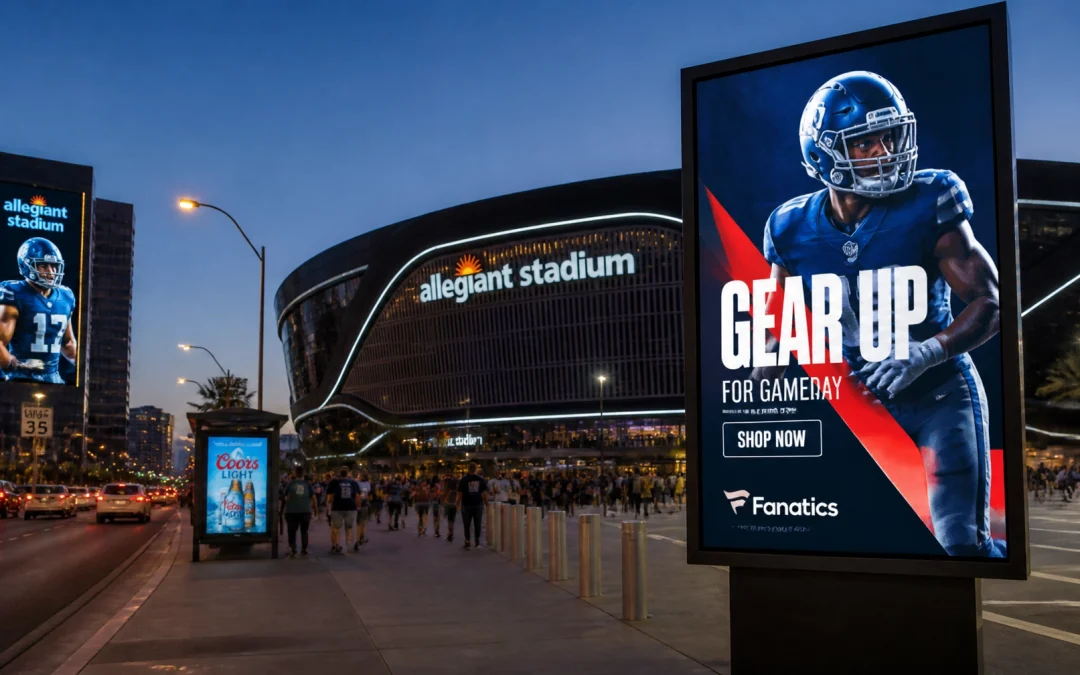
Sports marketing is moving beyond traditional sponsorship placements and static signage. Digital out-of-home advertising, or DOOH advertising, gives brands a more flexible way to reach fans across the full sports journey.
Instead of limiting exposure to a single venue or broadcast window, digital out of home sports campaigns can connect stadium perimeters, transit routes, sports bars, retail areas, and in-venue screens. Programmatic buying, dynamic creative, location data, and attribution tools allow media buyers to plan these touchpoints with greater precision.
For brand managers and marketing teams, the opportunity is clear: use OOH sports media to make branding more relevant, more connected, and easier to measure.
What Is Sports DOOH?
Sports DOOH is the use of digital screens and video boards in environments connected to sports audiences. These placements can include:
- Stadium perimeter screens
- Digital billboards near arenas
- Transit displays along fan routes
- Screens in sports bars and restaurants
- Retail and convenience store displays
- Fitness centers and recreation facilities
- In-venue LED boards and concourse displays
- Digital video networks around sports venues
The channel combines the broad visibility of out-of-home media with the flexibility of digital advertising. Creative can be scheduled by location, time of day, audience density, game status, weather, or other approved data signals.
This makes sports DOOH more than a branding channel. It can support awareness, fan engagement, foot traffic, app downloads, purchase consideration, and other measurable outcomes.
Innovation 1: Extending the Fan Journey Beyond the Stadium
Traditional sports advertising often focuses on the venue itself. Sports DOOH innovation expands that approach by treating the stadium as the center of a wider media ecosystem.
A perimeter strategy can reach fans:
- Before they leave home.
- While traveling toward the venue.
- In parking areas and entertainment districts.
- At nearby restaurants, bars, and retail locations.
- Inside the stadium.
- After the game, when fans continue socializing or commuting home.
OOH Sports supports access to digital advertising boards across sports environments, with the ability to define a custom radius around selected venues. This approach helps advertisers build repeated exposure across high-intent locations rather than relying on a single impression at the stadium entrance.
Practical applications
- A beverage brand can use pre-game messaging near restaurants and sports bars, followed by in-venue creative.
- A quick-service restaurant can promote a limited-time offer on screens near the stadium and nearby retail locations.
- An apparel brand can show product-focused creative along transit routes, then reinforce the message on screens inside the venue.
- A financial services brand can use perimeter advertising to reach local fans without committing to a full official sponsorship.
This form of stadium perimeter advertising is particularly useful for brands that want sports relevance without limiting the campaign to official team or league inventory.

Innovation 2: Using Dynamic Creative Around Game Moments
Static creative can establish recognition, but dynamic creative can make a campaign feel connected to the immediate fan experience.
Programmatic DOOH allows advertisers to set rules for when and where creative appears. Dynamic Creative Optimization, commonly known as DCO, can then adjust the message based on approved data feeds.
Potential triggers include:
- Pre-game countdowns
- Game start and end times
- Live scores
- Team results
- Game phase
- Weather conditions
- Traffic patterns
- Time of day
- Venue proximity
- Promotional availability
For example, a brand can use an anticipation-focused message before the game, a product promotion during peak venue traffic, and a celebration message after a home-team win. The brand identity remains consistent, while the message adapts to the moment.
Effective dynamic creative should remain simple. The most useful formats typically include:
- One clear visual
- A short headline
- A recognizable brand cue
- A single call to action
- A QR code or short URL when a response is required
The goal is not to fill the screen with information. It is to make the message immediately relevant to fans who may only have a few seconds to view it.
Innovation 3: Connecting In-Venue and Out-of-Venue Inventory
Sports marketing innovation is increasingly based on connected inventory rather than isolated placements.
OOH Sports marketing solutions include digital displays and interactive signage on stadium properties. The Sportrons network extends that capability inside and around sports venues through digital video boards, LED screens, sponsored features, and other fan-facing placements.
A connected campaign can assign different roles to each environment:
Outside the stadium
- Build awareness
- Establish brand association with the game
- Reach fans who are not attending in person
- Promote nearby offers or locations
- Create frequency along travel routes
Inside the stadium
- Reinforce brand recognition
- Support sponsored features
- Deliver real-time messages
- Encourage participation through QR codes
- Connect the brand with high-attention moments
After the event
- Drive retail or restaurant visits
- Deliver a follow-up offer
- Retarget exposed audiences through mobile, video, or social media
- Extend the campaign into post-game conversations
This structure helps brands maintain message continuity while adapting creative to the environment. The same campaign platform can support broad branding outside the venue and more action-oriented messaging inside it.
Innovation 4: Making Fan Engagement Useful
Fan engagement does not always require a complex interactive experience. In many cases, utility creates the strongest reason to pay attention.
Useful DOOH content can include:
- Live scores and game updates
- Team or player statistics
- Weather information
- Venue directions
- Transportation alerts
- Fan zone schedules
- Promotional codes
- Product availability
- Event countdowns
- Polls, contests, or trivia
A brand can sponsor this utility while maintaining a clear connection to its own objective. For example, a sports drink may support a hydration-themed fan challenge, while a transportation service may sponsor directions and post-game travel information.
QR codes can connect the physical screen to a mobile action. Possible destinations include:
- A product page
- A ticketing platform
- A loyalty program
- A coupon
- A contest entry
- A mobile application
- A store locator
The landing experience should match the context. A fan walking through a venue may be willing to scan a code for an immediate offer, while a commuter may be more likely to visit a short, mobile-friendly product page.

Innovation 5: Integrating DOOH With Omnichannel Media
DOOH advertising is most effective when it is planned as part of a broader omnichannel campaign.
A media buyer can use the same audience strategy across:
- Programmatic DOOH
- Mobile display
- Online video
- Connected TV
- Social media
- Search
- Audio
The role of DOOH is to provide high-visibility exposure in the physical world. Mobile and digital channels can then continue the conversation with more detailed information or a direct conversion opportunity.
A practical sequence might look like this:
- A fan sees a brand message on a digital screen along the route to the venue.
- The fan encounters a related creative execution near the stadium.
- In-venue signage reinforces the offer or sponsorship.
- An exposed device becomes eligible for follow-up mobile or video messaging.
- The advertiser measures website activity, store visits, app actions, or brand lift.
This sequential approach gives each channel a defined purpose. It also helps reduce the risk of fragmented creative, inconsistent branding, and duplicated frequency.
OOH Sports has outlined this model in its guide to integrating programmatic DOOH with an omnichannel sports strategy. The central principle is straightforward: the physical and digital parts of the campaign should operate as one connected plan.
Measurement: Moving From Exposure to Impact
Sports DOOH campaigns should establish measurement before launch. The correct methodology depends on the campaign objective.
Awareness and branding
- Reach and frequency
- Impressions by venue or location
- Video completion metrics
- Brand awareness
- Ad recall
- Brand favorability
- Purchase intent
Fan engagement
- QR code scans
- Website visits
- App downloads
- Contest entries
- Social interactions
- Content views
- Offer redemptions
Physical actions
- Store visits
- Restaurant visits
- Foot traffic near the venue
- Stadium attendance
- Visit rate among exposed device IDs
- Sales lift by market or location
Business outcomes
- Purchase consideration
- Conversion rate
- Revenue lift
- Return on ad spend
- Cost per completed action
- Incremental sales
Brand lift studies can compare exposed and control groups to assess changes in awareness, preference, or purchase consideration. Location-based attribution can evaluate whether anonymized device IDs exposed to a DOOH placement later visited a store, restaurant, or other target location.
OOH Sports case studies provide examples of measurable brand impact. A White Claw programmatic DOOH campaign reported a 74 percent lift in purchase consideration. An AB InBev Mike’s Hard Iced Tea campaign reported a 119 percent lift in positive brand image. These results illustrate how DOOH can support both performance and brand objectives when measurement is built into the campaign design.
A Practical Sports DOOH Planning Framework
Media buyers and brand managers can use the following process to develop a sports DOOH campaign:
1. Define the business objective
Decide whether the campaign is designed to build awareness, increase fan engagement, drive visits, support a product launch, or improve brand preference.
2. Select the sports environment
Identify the venues, teams, sports categories, and fan locations that align with the target audience.
3. Map the fan journey
Review the routes, transit hubs, restaurants, bars, retail areas, and in-venue spaces surrounding each target location.
4. Build the inventory package
Combine perimeter screens, digital billboards, place-based displays, and in-stadium assets according to budget and audience priorities.
5. Create a dynamic messaging plan
Define which creative executions will run before, during, and after the game. Establish rules for any live or contextual triggers.
6. Connect the campaign to other channels
Prepare matching mobile, video, social, search, or CTV assets for sequential retargeting and consistent branding.
7. Set measurement requirements
Confirm the KPI framework, attribution partner, brand lift methodology, audience definitions, and reporting schedule before activation.
8. Optimize during delivery
Review performance by location, time window, audience segment, creative version, and conversion behavior. Shift budget toward the combinations producing the strongest results.
The Role of OOH Sports in Sports Marketing Innovation
Digital out of home sports advertising gives brands a way to combine the scale of public media with the targeting and flexibility associated with digital platforms.
The strongest campaigns do not treat screens as standalone placements. They use location, timing, creative, and measurement to create a connected fan experience. Stadium perimeter advertising extends the campaign beyond the venue. Dynamic creative makes messages more relevant. In-venue inventory reinforces the brand. Omnichannel retargeting continues the interaction after exposure.
For media buyers and brand managers, the strategic advantage is control. A campaign can be planned around specific venues, audience environments, game-day windows, creative triggers, and measurable outcomes.
That combination makes sports DOOH a practical foundation for modern fan engagement and a valuable addition to sponsorship, branding, and performance media strategies.