
Sports marketing has moved beyond static stadium signage and broad audience estimates. Digital out-of-home advertising gives media buyers more control over location, timing, creative, and measurement.
Sports DOOH can reach fans as they travel to a venue, gather at nearby businesses, enter the stadium, and continue their routines after the final whistle. When planned as part of an omnichannel campaign, digital screens can also connect physical exposure to mobile engagement, store visits, and brand lift.
For media buyers and brand managers, the opportunity is to treat sports environments as connected audience ecosystems rather than isolated venues. The following five tactics can help brands make sports DOOH more relevant, measurable, and useful.
1. Extend the Stadium Perimeter
A sports audience is not limited to ticket holders inside the venue. Fans often spend hours in nearby parking areas, restaurants, sports bars, transit hubs, retail locations, and entertainment districts.
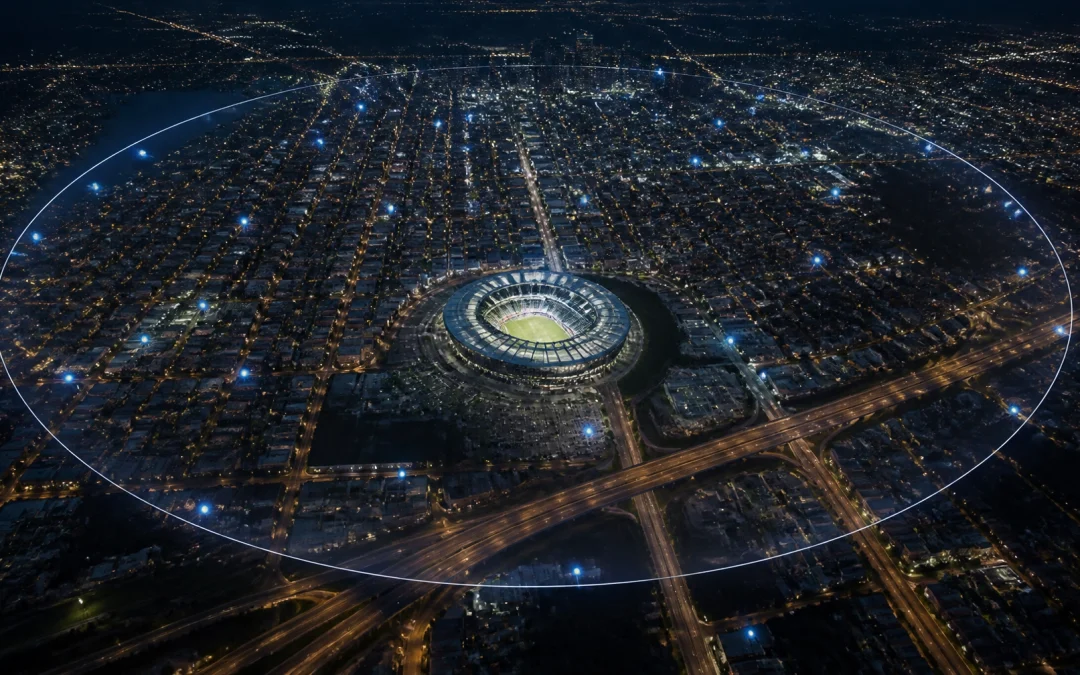
A perimeter-based DOOH plan expands the campaign beyond the stadium walls. OOH Sports provides access to digital video advertising boards across sports venues and surrounding locations, including inventory within a perimeter of up to 10 miles.
Objective and strategy
The objective is to build consistent brand presence across the complete fan journey.
A media buyer can:
- Identify priority venues and event categories.
- Define a radius around each stadium or arena.
- Select screens in high-traffic areas around the venue.
- Activate creative during pre-game, in-game, and post-game periods.
- Adjust messaging for fans traveling toward the venue and local audiences who are not attending.
- Apply frequency controls to balance visibility with budget efficiency.
This approach can be especially useful for restaurants, beverage brands, financial services, retail, travel, telecommunications, and sports-related products. A brand does not need to hold a formal stadium sponsorship to appear in the broader sports environment.

Practical example
A restaurant brand could use one message on screens near parking areas, another near transit routes, and a third near sports bars. The first message could promote a pre-game offer. The second could focus on convenience for fans traveling home. The third could encourage post-game visits.
The result is a connected campaign that follows fan movement instead of repeating the same message everywhere.
2. Plan Around Fan Journeys, Not Just Venues
Sports DOOH becomes more effective when the media plan reflects how fans move through the day.
A venue-only plan may reach fans at a high-attention moment, but a journey-based plan creates several opportunities to build awareness and prompt action. It can include screens along commuter routes, near hotels, in retail districts, inside gyms, and at locations where fans gather to watch games.
Objective and strategy
The goal is to assign a role to each screen environment.
A practical journey map might include:
- Pre-event awareness: Screens near workplaces, transit stations, gyms, and shopping districts introduce the campaign.
- Travel and arrival: Digital boards near parking areas, roads, and transit routes reinforce the message.
- Venue proximity: Screens near entrances and fan zones connect the brand to the event.
- Watch-party engagement: Screens in bars, restaurants, and entertainment districts reach fans outside the venue.
- Post-event action: Creative near retail locations or local businesses provides a direct next step.
Programmatic DOOH helps buyers select inventory by location, audience signals, daypart, and event context. OOH Sports can help brands organize these placements across the extended stadium environment and align creative with each stage of the journey.
This method also supports broader sponsorship strategies. A brand can use official team or league assets in one part of the campaign while using contextual DOOH to reach the surrounding fan base.
3. Use Live Data to Make Creative More Relevant
Sports are built around changing information. Scores, player performances, game status, weather, and time remaining can all influence what fans care about in a particular moment.
Dynamic creative allows digital screens to respond to those conditions. Instead of serving one static advertisement throughout the campaign, the media plan can use approved data feeds and predefined creative rules to adjust the message.
Objective and strategy
The objective is to make the advertisement feel connected to the live sports experience without distracting from it.
Dynamic sports DOOH can use:
- Live scores and game status.
- Player statistics and milestones.
- Countdown clocks.
- Team matchups.
- Weather conditions.
- Time of day.
- Location-specific offers.
- Pre-game and post-game triggers.
For example, a beverage brand could use a celebration-themed message after a scoring event. A quick-service restaurant could promote a late-night offer after the game. A financial brand could connect a player statistic to a message about performance or preparation.
Stats Perform’s overview of sports data in digital signage cites research from Clear Channel showing that 77% of sports viewers noticed brands around sporting events. The same overview reports a 33% increase in brand liking after viewers saw sports-related DOOH advertising.
The creative still needs to follow DOOH best practices:
- Use one clear message.
- Keep headlines short.
- Use high-contrast colors.
- Make logos and calls to action easy to recognize.
- Design separately for roadside, street-level, in-venue, and longer-dwell environments.
- Test creative variants before scaling the campaign.

Dynamic creative is most useful when the trigger adds meaning. A score or statistic should support the brand message rather than appear as decoration.
4. Connect DOOH Exposure to Mobile and Commerce
DOOH can create a large-scale physical impression, but the next action often takes place on a personal device. Connecting the two channels allows brands to continue the conversation after a fan passes a screen.
This tactic does not require the screen to carry a complex message. A simple brand statement, offer, QR code, or short URL can create a bridge to mobile.
Objective and strategy
The objective is to move from awareness to consideration or action.
A coordinated campaign may include:
- A DOOH message near the stadium.
- A mobile ad served to a privacy-compliant exposed audience.
- A landing page matched to the event or location.
- A QR code for a promotion, registration, or app download.
- A retargeting sequence focused on people who interacted with the campaign.
- A store, restaurant, or venue visit measurement study.
OOH Sports describes this approach as part of its broader sports DOOH capabilities. Brands can work with OOH Sports to select digital boards, coordinate campaign delivery, and connect exposure data with follow-up media.
The method is particularly useful for:
- Product launches.
- Retail promotions.
- App downloads.
- Restaurant visits.
- Ticketing and event information.
- Financial service sign-ups.
- Sports-related e-commerce.
- Brand sponsorship campaigns with digital extensions.
OOH Sports case studies provide examples of measurable outcomes from programmatic DOOH. A White Claw campaign reported a 74% lift in purchase consideration. An Ab InBev Mike’s Hard Iced Tea campaign reported a 119% lift in positive brand image.
These results demonstrate why DOOH should not be evaluated only as a standalone awareness placement. Its value can increase when it becomes part of a larger media sequence.

5. Build Measurement Into the Plan From the Start
Measurement should be defined before the campaign launches. A post-campaign report based only on impressions may not answer the questions most important to a brand manager or chief marketing officer.
The right measurement framework depends on the campaign objective.
Objective and strategy
Possible primary KPIs include:
- Brand awareness.
- Brand favorability.
- Purchase consideration.
- Website visits.
- App downloads.
- QR code scans.
- Store or restaurant visits.
- Ticketing activity.
- Sales or sign-ups.
- Cost per incremental visit.
- Return on advertising spend.
A standard exposure-versus-control design can compare people or geographic areas exposed to the campaign with similar groups that were not exposed. Depending on the campaign, measurement partners may use device exposure data, mobile location signals, survey panels, sales data, or foot-traffic analysis.
A strong measurement plan may include:
- Establishing a pre-campaign benchmark.
- Defining exposed and control groups.
- Tracking delivery by screen, venue, location, and daypart.
- Measuring digital actions after exposure.
- Comparing foot traffic or sales in exposed and control areas.
- Conducting a brand lift study for awareness and consideration.
- Applying the findings to creative, audience, and location optimization.

OOH Sports case studies include a Sea-Doo campaign that reported a 144% increase in purchase consideration. These types of comparisons help connect DOOH exposure with a measurable change in consumer response.
How OOH Sports Supports the Playbook
OOH Sports is designed to help brands plan sports-focused DOOH across a broad network of digital video advertising boards. The company can support campaign planning across venue perimeters, audience environments, and fan journey stages.
A typical activation process includes:
- Campaign objective: Define whether the priority is awareness, engagement, traffic, or conversion.
- Venue and market selection: Identify sports venues and surrounding markets that align with the audience.
- Inventory planning: Select digital boards across the relevant perimeter and fan journey.
- Creative development: Prepare standard and dynamic creative for each screen environment.
- Programmatic activation: Set targeting, timing, frequency, and trigger rules.
- Measurement: Evaluate brand, digital, foot-traffic, or sales outcomes.
- Optimization: Refine the campaign based on performance by location, audience, and message.
Brands can also review the Sportrons platform and the OOH Sports case study library for additional examples of sports advertising applications.
A Practical Checklist for Media Buyers
Before launching a sports DOOH campaign, the media plan should answer five questions:
- Which fan journey stages matter most?
- Which venues and surrounding locations support the objective?
- What live or contextual data can improve creative relevance?
- How will DOOH connect with mobile, social, CTV, or retail media?
- Which measurement method will demonstrate incremental impact?
Sports DOOH innovation does not require complexity for its own sake. The strongest campaigns use technology to improve a clear strategy. By combining perimeter coverage, journey-based planning, dynamic creative, cross-channel activation, and meaningful measurement, brands can make digital screens more useful to fans and more accountable to marketing teams.