
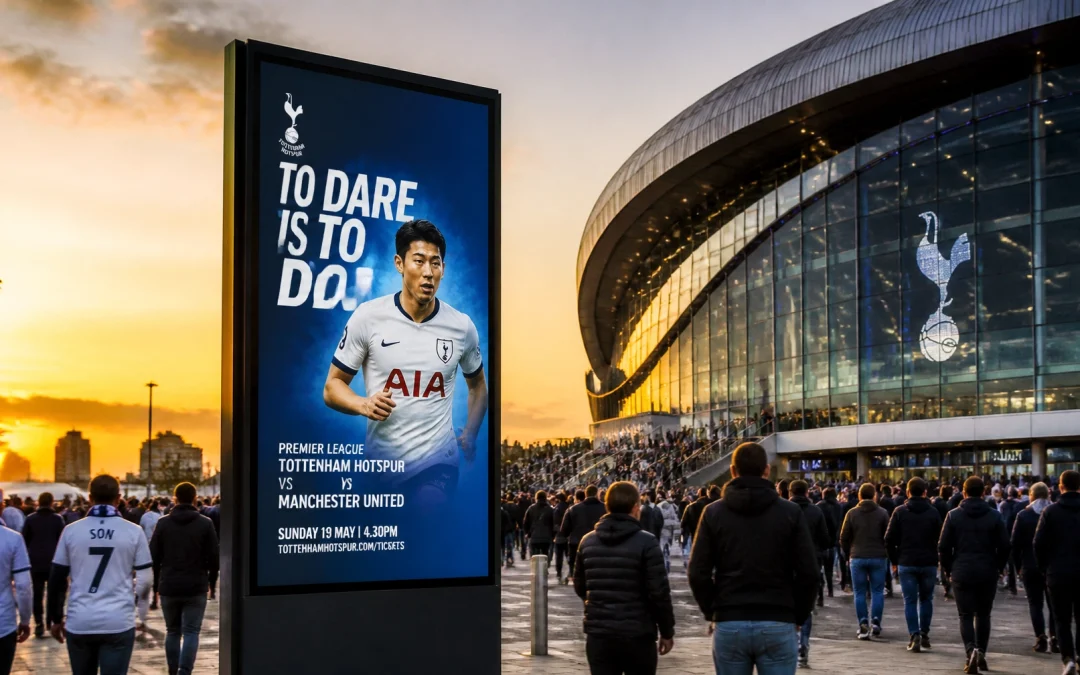
Sports marketing is built around attention, emotion, and shared experiences. Digital out-of-home advertising adds another layer by allowing brands to appear in the physical spaces where fans travel, gather, and watch the game.
From stadium perimeter advertising to digital screens near sports bars and transportation hubs, sports DOOH gives media buyers and brand managers more flexibility than traditional outdoor media. Creative can change by location, audience, game phase, or live event trigger. Campaigns can also connect with mobile, social, connected TV, and other digital channels.
The result is a more coordinated approach to fan engagement. Instead of treating the stadium as a single advertising placement, brands can build a connected media journey around the venue.
What Is Sports DOOH?
Sports digital out-of-home, or sports DOOH, includes digital video boards and screens placed in environments connected to sports audiences. Common locations include:
- Stadium concourses and entrances
- Stadium perimeter LED boards
- Parking areas and tailgating zones
- Roads and pedestrian routes near venues
- Public transportation hubs
- Sports bars and restaurants
- Retail locations near stadiums
- High-traffic areas within a defined radius around a venue
Traditional out-of-home advertising often relies on one static message running for an extended period. DOOH advertising allows multiple creative assets to rotate throughout the day. Messages can be updated quickly and scheduled around specific audience conditions.
For example, a brand can run one message before the game, another during the live event, and a third after the final whistle. A campaign can also use different creative near the stadium than it uses in a nearby retail district.
OOH Sports provides access to digital advertising opportunities on and around sports venues, including inventory within a custom-defined radius. This creates a broader planning opportunity for brands that want to reach fans before, during, and after the live experience.
Why Live Moments Matter
Sports fans do not experience a game in only one place. The fan journey may begin at home, continue through a commute, move into a parking area or stadium, and finish at a restaurant, bar, or retail location.
Each stage presents a different communication opportunity.
- Before the game: Build awareness, create anticipation, and promote products or services fans may need during the event.
- During the game: Use live context, branded features, and short calls to action to connect with the energy of the moment.
- After the game: Extend the conversation through offers, merchandise promotions, loyalty programs, or content tied to the result.
- Between games: Maintain brand presence around sports venues and in everyday fan environments.
This structure helps brands move from simple visibility to stronger fan engagement. A well-timed message can feel connected to the event rather than placed beside it.
Five Innovations Shaping Sports DOOH
1. Stadium Perimeter Advertising With Dynamic Creative
Stadium perimeter advertising has evolved beyond static banners and fixed electronic signage. Modern LED boards can display high-resolution video, animation, and multiple messages during a single event.
Perimeter boards can also support creative that changes based on game conditions. A campaign might use:
- A celebratory message after a scoring play
- A product offer during a break in play
- A branded statistic tied to the game
- A location-based message for fans inside the venue
- A synchronized creative sequence across the stadium and surrounding screens
These placements are valuable because they can reach fans inside the venue while also appearing in broadcast coverage. Creative should remain simple, bold, and readable, with limited copy and strong visual branding.

2. Programmatic DOOH Buying
Programmatic DOOH gives media buyers more control over when and where digital inventory appears. Through demand-side platforms, advertisers can define campaign rules based on location, time, audience conditions, and event activity.
A programmatic sports campaign can be planned around:
- Specific venues or venue groups
- A radius around a stadium
- Home games or other high-attendance events
- Pre-game and post-game windows
- Sports bars and fan gathering locations
- Budget, frequency, and pacing requirements
This approach can reduce the need for long-term, inflexible placements. It also allows campaigns to scale across multiple markets while maintaining consistent targeting rules.
OOH Sports can support campaigns that extend beyond the stadium itself. This makes it possible to build a digital out of home sports network around the broader fan journey, rather than limiting the campaign to one screen or one property.
3. Dynamic Creative Optimization
Dynamic Creative Optimization, or DCO, uses data and pre-approved creative rules to change the message displayed on a screen.
Sports campaigns can use DCO to respond to:
- Game status
- Time of day
- Weather conditions
- Venue location
- Team affiliation
- Product availability
- Audience density
- Event phase
A quick-service restaurant, for example, could promote a nearby location before the game and use a different offer after the game. An apparel brand could adjust creative based on weather. A financial services company could use fan-focused messaging before the event and a broader brand message after it.
The most effective DCO campaigns are not complicated for the audience. The technology operates in the background while the message remains clear and easy to understand.
4. Interactive Fan Experiences
DOOH advertising can also connect physical media with mobile engagement. QR codes, short URLs, polls, contests, and digital rewards give fans a reason to respond.
Practical examples include:
- A QR code linking to a branded game-day offer
- A fan vote displayed on stadium screens
- A digital coupon available after scanning a perimeter ad
- A social media prompt tied to a live moment
- An entry form for merchandise or ticket promotions
- A location-based experience for fans near the venue
Interactive elements should support a clear business objective. If the goal is app acquisition, the creative should drive directly to the app download page. If the goal is retail visitation, the landing page should show the nearest location and offer details.

5. Omnichannel Coordination
Sports DOOH becomes more effective when it works with other media channels. A brand can use the same campaign idea across stadium screens, mobile, social, connected TV, and digital video.
The message does not need to be identical in every channel. Instead, each placement can serve a different role:
- DOOH creates broad, visible awareness
- Mobile retargeting reaches devices exposed to the campaign
- Social extends the conversation and encourages sharing
- Connected TV reinforces the brand story at home
- Search and landing pages capture active interest
This coordinated approach helps brands maintain continuity across the fan journey. Exposure to a stadium perimeter ad can become the first step in a measurable digital sequence.
A Practical Planning Framework
Media buyers and brand managers can use the following process when developing a sports DOOH campaign.
1. Define the business objective
Start with one primary goal, such as:
- Brand awareness
- Sponsorship visibility
- Website traffic
- App downloads
- Retail visits
- Purchase consideration
- Lead generation
- Fan participation
The objective should determine the audience, creative, placement mix, and measurement plan.
2. Map the fan journey
Identify where the target audience is likely to be before, during, and after the event. Consider the venue, nearby streets, transportation routes, restaurants, sports bars, and retail areas.
A network that reaches fans within a defined area around the stadium can support a more complete campaign than a single in-venue screen.
3. Match creative to the moment
Create different assets for different stages of the event. Keep every message easy to understand in a few seconds.
Strong sports DOOH creative often includes:
- A recognizable brand element
- One clear message
- High contrast
- Minimal text
- A simple call to action
- Motion that supports, rather than distracts from, the message
4. Build the measurement plan before launch
Measurement should be connected to the campaign objective. Potential methods include:
- Estimated impressions and reach
- Screen delivery and pacing
- Device IDs exposed
- Website visits
- App downloads
- Foot traffic lift
- Brand lift studies
- Purchase consideration
- Sales or conversion data
For example, a brand awareness campaign may focus on recall and brand preference rating. A retail campaign may prioritize exposed device visits to nearby stores.
Results That Support the Model
OOH Sports case studies show how programmatic DOOH can be evaluated through brand lift and purchase consideration.
A Sea-Doo campaign reported a 144% increase in purchase consideration following a digital OOH campaign. A White Claw campaign reported a 74% lift in purchase consideration for a vodka launch. An AB InBev campaign for Mike’s Hard Iced Tea reported a 119% lift in positive brand image.
These results do not come from screen exposure alone. They reflect a combination of audience targeting, media placement, creative execution, and measurement methodology. The examples demonstrate why sports DOOH should be planned as a measurable media channel rather than treated only as a sponsorship decoration.
More examples are available through the OOH Sports case studies.

How Brands Can Start
A practical first campaign does not need to cover every possible screen or venue. Brands can begin with a focused test:
- Select one sports market or venue group.
- Define a radius around the stadium.
- Identify pre-game, in-game, and post-game inventory.
- Develop a small set of adaptable creative assets.
- Add one measurable call to action.
- Coordinate mobile or social retargeting.
- Compare exposed and unexposed audiences where possible.
- Use the results to refine the next activation.
For brands exploring flexible sponsorship options, Sportrons provides digital advertising opportunities inside and outside sports venues, including digital video boards, LED displays, sponsored features, and venue-based announcements.
Conclusion
Sports DOOH innovation is changing how brands approach fan engagement. Digital screens give campaigns the ability to respond to live moments, reach fans across the venue journey, and connect physical media with measurable digital actions.
Stadium perimeter advertising remains a high-impact format, but the broader opportunity includes transit routes, sports bars, retail areas, and other locations within the fan ecosystem. Programmatic buying, dynamic creative, interactive tools, and attribution make the channel more flexible and accountable.
For media buyers and brand managers, the key is to plan sports DOOH around a clear objective and a well-defined fan journey. When the placement, message, timing, and measurement work together, live moments can create lasting brand momentum.
To explore digital out-of-home sports opportunities, visit OOH Sports or review the company’s marketing services.