
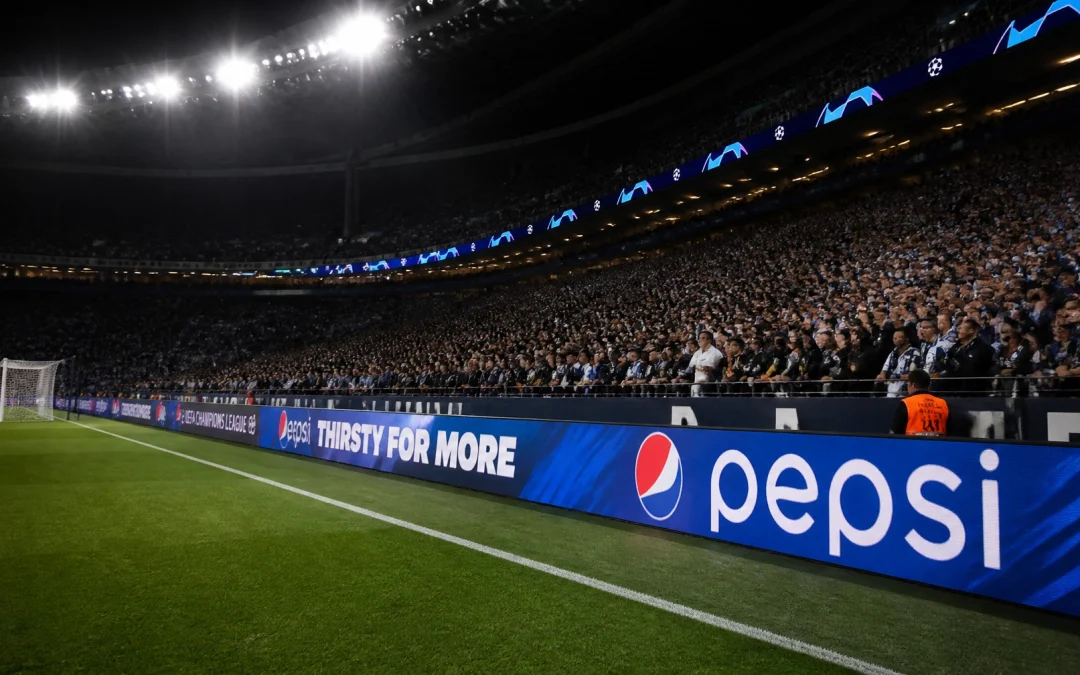
Digital out-of-home advertising is becoming a more connected part of the sports media plan. The strongest campaigns now combine stadium LED, perimeter displays, transit media, retail screens, mobile, connected TV, and social into one coordinated fan journey.
For media buyers, brand managers, and agency partners, the opportunity is clear: sports DOOH can deliver the visibility of traditional out-of-home while adding programmatic flexibility, dynamic creative, audience targeting, and measurable outcomes.
This edition highlights four developments shaping the channel:
- Virtual and perimeter LED extending the stadium experience
- Dynamic creative optimization tied to real-time conditions
- Programmatic DOOH and AI improving planning and activation
- Omnichannel campaigns connecting exposure to measurable action
Trend 1: The Stadium Perimeter Is Becoming a Larger Media Environment
Sports advertising no longer begins at the stadium entrance. It can begin on a commuter route, continue through a transit hub, appear near a sports bar, and finish on a perimeter LED board inside the venue.
This approach is often described as a virtual perimeter strategy. It uses digital inventory around a venue to expand the reach of the physical stadium perimeter. For sports advertisers, a focused radius around the venue can create repeated exposure during the most valuable parts of the fan journey.
A practical stadium-centered plan may include:
- Digital billboards on major arrival and departure routes
- Transit screens in stations used by fans
- Displays near parking facilities and fan zones
- Screens in sports bars, restaurants, and convenience stores
- Stadium concourse, ribbon, and perimeter LED
- Mobile retargeting after exposure to selected DOOH screens
The result is a campaign that connects pre-game anticipation, in-game engagement, and post-game activity. The stadium becomes the anchor, while the surrounding network creates additional reach and frequency.
OOH Sports provides access to digital video advertising boards across sports categories, with coverage extending up to 10 miles around sports venues. This gives planners a way to build campaigns around the full matchday environment rather than a single placement.
For additional planning guidance, see how stadium perimeter advertising can turn game day into a broader media opportunity.
Campaign Example: OUTFRONT and the New York Jets Extend the Fan Experience
The partnership between OUTFRONT and the New York Jets illustrates how sports sponsorship can move beyond the stadium.
According to the New York Jets partnership announcement, the agreement connects in-stadium sponsorships with OUTFRONT’s broader outdoor media, experiential, and creator-led offering.
The model connects:
- Transit hubs and commuter routes
- Neighborhoods and destinations where fans gather
- Premium outdoor media
- Experiential activations
- Creator-led storytelling
- MetLife Stadium sponsorship inventory
The partnership launched with a “Back to Football” campaign and a Penn Station takeover hosted by former Jets linebacker Bart Scott. More importantly, the structure provides Jets advertisers with a way to communicate before, during, and after game day.
For advertisers, this type of integration offers several advantages:
- Greater geographic reach: Campaigns can reach fans before they arrive at the venue and after they leave.
- More frequent exposure: Multiple environments reinforce the same message throughout the fan journey.
- Faster activation: Digital inventory can respond to sports moments, player milestones, and cultural conversations.
- Creative flexibility: Existing broadcast, digital, and social assets can be adapted for street, station, and stadium environments.
The broader lesson is that stadium sponsorship performs more effectively when treated as a connected media system. A virtual perimeter does not replace in-venue signage. It gives that signage a larger audience and a more consistent role in the campaign narrative.

Trend 2: Dynamic Creative Makes Sports DOOH More Relevant
Dynamic creative optimization allows advertisers to change messages based on real-time data. Instead of displaying one creative asset for the entire campaign, a brand can establish rules that trigger different versions based on context.
Common data inputs include:
- Live scores and game results
- Tournament leaderboards
- Weather conditions
- Traffic and travel patterns
- Time of day
- Venue proximity
- Player milestones
- Retail availability
- Game phase, such as pre-game, in-game, or post-game
The value of DCO comes from the connection between timing and audience mindset. A message shown before a game should not necessarily be the same message shown after a home-team victory.
A beverage advertiser, for example, might use:
- Pre-game creative focused on preparation and anticipation
- In-game creative tied to the current score or event
- Post-game messaging connected to celebration or recap content
- Weather-based variations that promote indoor or outdoor occasions
- Retail messaging linked to nearby stores or product availability
The creative still needs to remain simple. Fans may only have a few seconds to process a screen while walking, driving, or moving through a crowded venue. Strong contrast, short copy, recognizable branding, and one clear call to action remain essential.
Campaign Example: Elijah Craig Uses Live Tournament Data
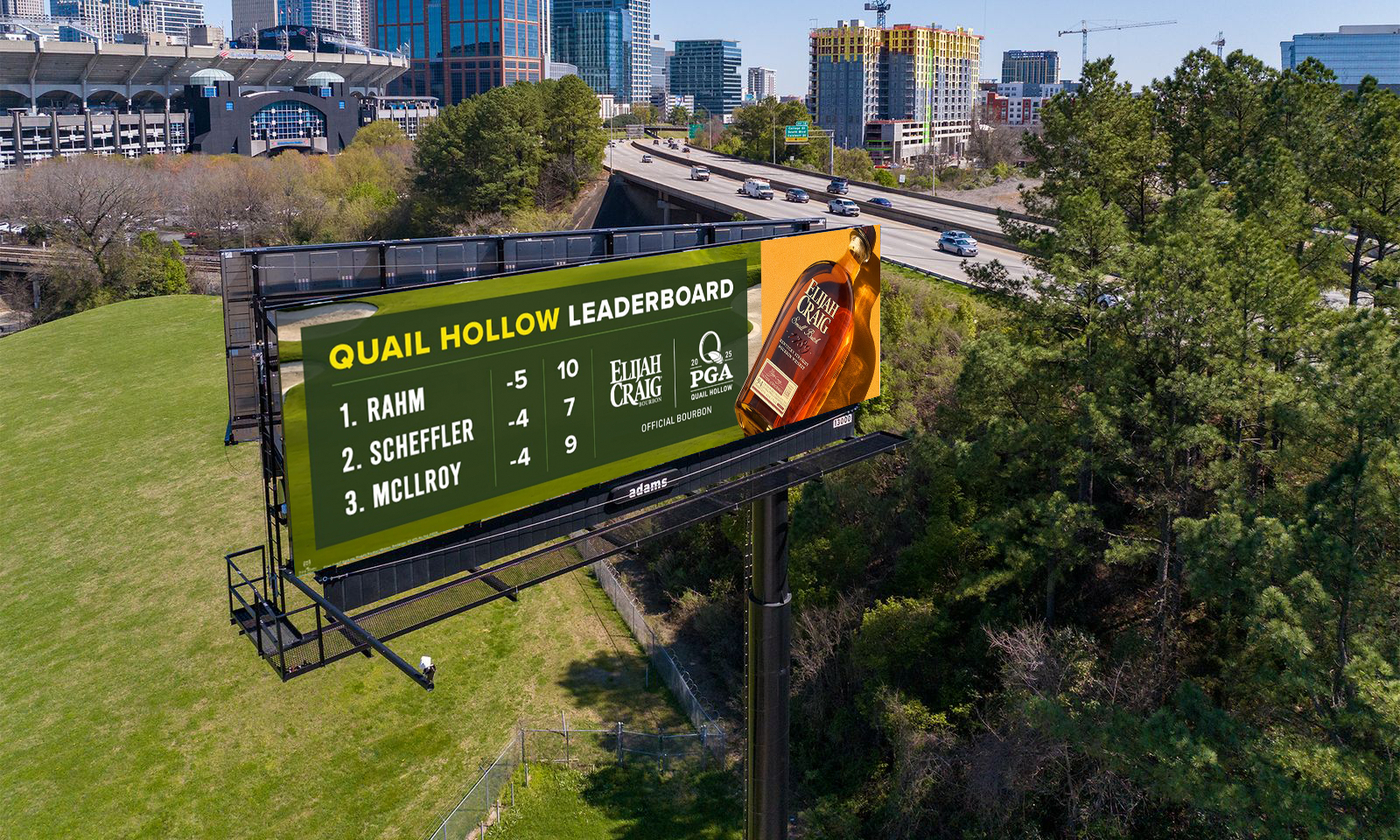
The Elijah Craig PGA Championship campaign demonstrates how live content and dayparting can create a more useful DOOH experience.
The campaign used 41 digital screens across Charlotte and was built to establish a citywide presence before, during, and after the golf tournament. The Vistar Media case study identifies Method 1, Adams Outdoor Advertising, and Vistar Media as key partners.
The campaign used:
- Countdown messaging before tournament play
- A live leaderboard that updated throughout the day
- Evening creative that shifted from sports content to happy hour messaging
- Audience targeting across premium digital inventory
- Real-time reporting and audience analytics
The campaign delivered:
- More than 15 million total impressions
- 5 million unique audience devices engaged
- More than 1.5 million impressions from top-performing screens
The campaign’s structure provides a useful blueprint for event advertisers. Live data created relevance during tournament play, while dayparting connected the event to the social occasions that followed.
Trend 3: Programmatic DOOH and AI Improve Planning
Programmatic DOOH gives media buyers access to digital inventory through automated platforms and demand-side technology. It can simplify the process of activating campaigns across multiple media owners, markets, and venue types.
Key benefits include:
- Faster campaign setup
- Flexible budget allocation
- Audience and location targeting
- Trigger-based buying
- Real-time optimization
- Easier multi-market expansion
- More consistent reporting
AI is increasingly supporting the planning process. Applications include audience modeling, inventory recommendations, creative versioning, forecasting, and optimization. AI does not replace campaign strategy, but it can help teams evaluate more variables and identify useful patterns faster.
For sports advertising, this is especially valuable because audience behavior changes quickly. A playoff run, unexpected rivalry, weather shift, or major player moment can change the value of a location within hours.
A practical programmatic workflow includes:
- Define the audience and business objective.
- Map the venue, fan routes, retail locations, and gathering points.
- Build a screen package across stadium, transit, roadside, and place-based inventory.
- Establish creative rules based on game phase, weather, or location.
- Set measurement requirements before launch.
- Review delivery and audience data during the campaign.
- Retarget exposed devices through mobile, online video, or CTV where appropriate.
The OOH Sports Network milestone update provides additional context on programmatic sports media and real-time fan engagement.
Trend 4: Omnichannel Planning Connects DOOH to Action
DOOH is most effective when it works with other channels. A fan may see a brand message on a stadium screen, encounter the same campaign on connected TV, and later receive a mobile ad after being exposed to a nearby digital display.
This creates a sequential communication path:
- DOOH: Builds awareness in a physical environment
- CTV or online video: Adds depth and storytelling
- Mobile or social: Provides follow-up engagement
- Retail or ecommerce: Supports conversion
- Measurement: Connects exposure to brand and business outcomes
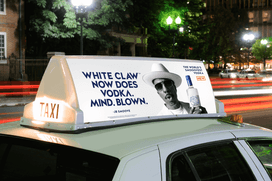
White Claw’s programmatic DOOH campaign for White Claw Vodka provides a clear example. The campaign ran across multiple U.S. markets and used billboards, urban panels, bars, restaurants, office buildings, apartments, rideshare environments, and other locations relevant to legal drinking-age adults aged 25 to 44.
The campaign was part of the broader “Smooove Thoughts” omnichannel effort, which included online video, CTV, paid social, and display. Device IDs exposed to programmatic OOH were used to build a retargeting audience for online video and CTV.
Brand lift studies conducted with Broadsign and Happydemics reported:
- +74% lift in purchase consideration
- More than half of ad recallers considered trying the product, compared with 31% of non-recallers
- +800% lift in brand preference, from approximately 1% among non-recallers to nearly 10% among ad recallers
- +144% lift in positive brand image during the summer flight
- +33% uplift in attribution
The complete White Claw case study from OOH Sports outlines the targeting, technology partners, and measurement approach.
Actionable Takeaways for Sports Advertisers
The current DOOH landscape supports a more disciplined approach to sports media planning.
Build around the fan journey
Start with the routes and environments fans use before, during, and after an event. A stadium-only plan may deliver visibility, but a perimeter strategy can create continuity and additional frequency.
Match creative to the moment
Use DCO when real-time data adds value. Scores, leaderboards, weather, and dayparting should support the message rather than distract from it.
Combine impact and scale
Use premium stadium LED and large-format screens for visual impact. Add transit, roadside, retail, and place-based screens to increase reach and frequency.
Plan measurement in advance
Define success through brand lift, device exposure, foot traffic, web activity, app downloads, sales, or another business outcome. Measurement should be built into the media plan before the first impression is delivered.
Keep the creative system flexible
A campaign should include multiple versions designed for different screen sizes, locations, moments, and audience contexts. A single master asset may not be enough for a dynamic sports environment.
Closing Note
Sports DOOH is moving from isolated signage to connected media infrastructure. Virtual perimeters extend stadium sponsorships, DCO creates real-time relevance, programmatic platforms simplify activation, and omnichannel measurement gives advertisers a clearer view of impact.
For partners and planners evaluating their next campaign, the most important question is no longer simply where the screen is located. It is how that screen fits into the full fan journey and how its contribution can be measured.
OOH Sports welcomes perspectives from media buyers, planners, agencies, venue partners, and brand teams. Which DOOH innovation is having the greatest effect on current sports campaigns: virtual perimeter coverage, dynamic creative, programmatic buying, AI planning, or omnichannel measurement? Share the insight with the OOH Sports community or contact the team to discuss upcoming opportunities.