
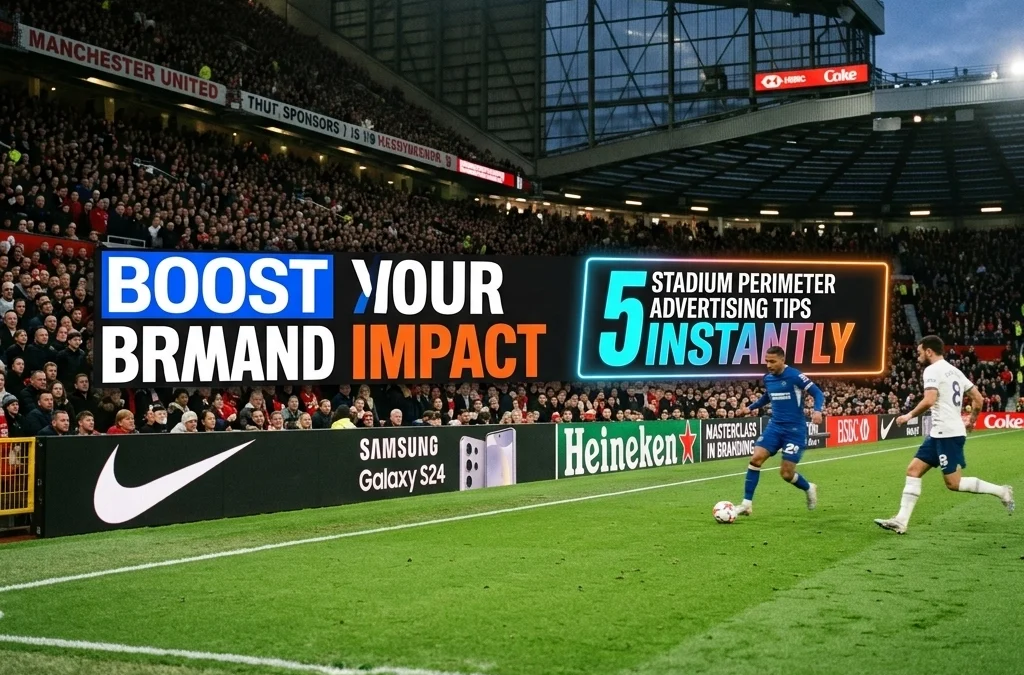
The landscape of sports marketing is undergoing a significant transformation. As global investment in sports advertising continues to climb toward a projected 50 billion dollar valuation by the end of the decade, the competition for fan attention has never been higher. For creative directors and Chief Marketing Officers, the stadium represents a unique environment where high emotion meets high dwell time. Among the various assets available, stadium perimeter advertising stands out as a critical tool for driving immediate brand impact and sustained recall.
Stadium perimeter boards are the digital and static displays that line the field of play. While they have been a staple of sports for decades, the transition to high definition LED technology and programmatic buying has changed how these assets are utilized. The goal is no longer just to "be seen" but to capture the specific moments that define a sporting event.
The Strategic Importance of Perimeter Visibility
The primary objective of any stadium campaign is to embed a brand into the narrative of the game. Unlike traditional television commercials that viewers might skip or ignore, perimeter advertising is part of the action. It exists in the background of every goal, every tackle, and every highlight reel. This creates a psychological association between the brand and the positive emotions of the sport.
Strategic implementation requires a move away from passive placement toward active, data driven decision making. By understanding the mechanics of fan engagement, brands can optimize their creative and technical approach to ensure that every second on the board contributes to the overall marketing goal.

1. Prioritize Design Clarity and High Contrast
The environment of a stadium is visually crowded. Between the action on the field and the thousands of fans in the stands, a brand has only a fraction of a second to register in a viewer's mind. Design clarity is the most important factor in determining whether an ad is successful or merely visual noise.
Design Tactics for High Impact:
- Logo Dominance: The brand logo should be the focal point of the creative. In a fast moving game, fans will recognize a familiar logo before they read a line of text.
- High Contrast Color Palettes: Use colors that stand out against the green of the grass and the often dark or neutral background of the stadium seating. Bright whites, vibrant yellows, and bold oranges often perform better than muted tones.
- Minimal Text: Limit copy to three words or fewer. A website URL or a simple call to action is sufficient. Complex messages are lost during rapid camera movements.
- Scale and Proportion: Ensure that the logo and text are large enough to be legible from the opposite side of the stadium and on small mobile screens during broadcast.
According to research in out of home advertising, simple messages placed in broadcast visible locations are significantly more effective for awareness than complex creative designs. Repetition of a simple, clear message leads to higher brand recall.
2. Leverage Dual Exposure for Broadcast and In-Stadium Reach
One of the greatest advantages of perimeter advertising is the ability to reach two distinct audiences simultaneously. The first is the live crowd within the stadium, providing a high energy, localized impact. The second, and often larger, audience consists of the millions of viewers watching the event via television or streaming services.
Maximizing the Broadcast Arc:
Perimeter boards are strategically positioned to remain within the "camera arc" for the majority of the match. For a brand to maximize its impact, the creative must be optimized for the lens. This means accounting for camera motion blur and the varying angles of the broadcast.
- Primary Camera View: Focus the most important messaging on the boards that face the main broadcast camera.
- Replay Value: During highlights and slow motion replays, perimeter ads often receive prolonged, close up exposure. This is a premium opportunity for brand recognition.
- Global Distribution: For major sporting events, the broadcast reach extends internationally. This allows brands to achieve global visibility through a single physical activation.
By targeting the dual exposure of perimeter boards, marketers can achieve a lower cost per thousand impressions compared to standalone television spots. More information on the reach and impact of these strategies can be found on the OOH Sports marketing page.

3. Strategic Placement and Dwell Time Optimization
Not all positions on the perimeter are created equal. The effectiveness of a board is directly tied to its proximity to the action and its duration in the camera's field of view. To boost brand impact instantly, a brand must secure locations that guarantee maximum "dwell time."
Identifying High Value Zones:
- The Midfield Line: This is the most frequently filmed area in sports like soccer and rugby. Boards located here receive the most consistent visibility throughout the duration of the match.
- The Goal Ends: While visibility here is less frequent, the intensity of the attention is much higher. When a goal is scored or a near miss occurs, every eye is fixed on this area, making it ideal for high impact branding.
- Corner Flags: These areas are prime for close up shots during corner kicks or set pieces, providing a clear, static view of the brand.
Placement within the camera's natural viewing arc ensures that the brand is not just seen, but that it "dwells" in the viewer's consciousness. This prolonged exposure is a unique feature of stadium environments that traditional billboards cannot easily replicate.
4. Utilize Dynamic LED Technology and Rotation Strategies
The move from static boards to Sportrons and LED technology has revolutionized the industry. Digital boards allow for movement, multiple messages, and programmatic updates that keep the content fresh and relevant.
Rotation Mechanics:
- Full Rotation: In this model, a single brand takes over the entire perimeter for a set period, usually 30 seconds. This creates a "clean" environment with no competing brands, significantly boosting impact.
- Split Rotations: Some formats use a 4:4 or 2:2 split, where multiple sponsors share the boards. This is a cost effective way to maintain a presence throughout the game without the investment of a full takeover.
- Motion Graphics: Subtle motion, such as a logo that gently pulses or a highlight that travels across the boards, can draw the eye toward the advertisement without distracting from the game itself.
Digital technology also allows for time based targeting. A brand might choose to display different messages during the first half versus the second half, or trigger specific creative when the home team scores. This level of flexibility is essential for modern, agile marketing departments.

5. Integrate Digital Formats with Experiential Activation
The final tip for boosting brand impact is to ensure that perimeter advertising is not an isolated tactic. For creative directors, the goal should be an omnichannel approach that connects the perimeter board to the fan's mobile device and the physical experience of the stadium.
Creating a Connected Experience:
- Mobile Synchronization: Use the perimeter boards to drive fans to a specific landing page or to participate in a live stadium poll via their smartphones.
- Fan Zone Alignment: Ensure that the branding seen on the perimeter is consistent with activations occurring in the concourse or fan zones.
- Social Media Amplification: Encourage fans to share photos of the action. When a brand is visible in the background of a fan's viral photo, the organic reach is amplified significantly.
This multi-touchpoint strategy ensures that the brand is seen during high action moments and engaged with during the dwell times of halftime and pre-match activities. The integration of digital and physical elements is a hallmark of successful sports marketing campaigns.
Measuring Results and ROI
For CMOs, the success of stadium advertising must be backed by data. Modern measurement techniques have moved beyond simple attendance figures to include sophisticated brand lift studies and digital attribution.
Key Performance Indicators (KPIs):
- Brand Recall: Surveys conducted after the event to measure how many fans remember seeing the brand.
- Media Value: Calculating the equivalent cost of the broadcast exposure if it were purchased as traditional commercials.
- Digital Engagement: Tracking increases in website traffic or social media mentions during and immediately following the event.
Recent case studies have shown that programmatic digital out of home (DOOH) campaigns in sports settings can lead to substantial increases in purchase consideration. For instance, some campaigns have seen a lift in positive brand image by over 100 percent when utilizing high impact stadium visuals. More detailed analysis of ROI can be reviewed in the comparison of programmatic versus traditional stadium ads.

The Future of Stadium Advertising
The evolution of stadium perimeter advertising is moving toward even greater personalization and data integration. With the rise of augmented reality and localized broadcast feeds, the ability to tailor messaging to specific demographics is becoming a reality.
For now, the fundamentals of design clarity, strategic placement, and technological leverage remain the most effective ways to boost brand impact. By focusing on the fan experience and the mechanics of the broadcast, brands can ensure that their presence in the stadium is both memorable and measurable.
As the sports industry continues to grow, those who master the art of perimeter advertising will find themselves at the center of the most engaged and passionate audiences in the world. Success in this space requires a blend of creative excellence and technical precision, a combination that defines the current era of sports marketing.