
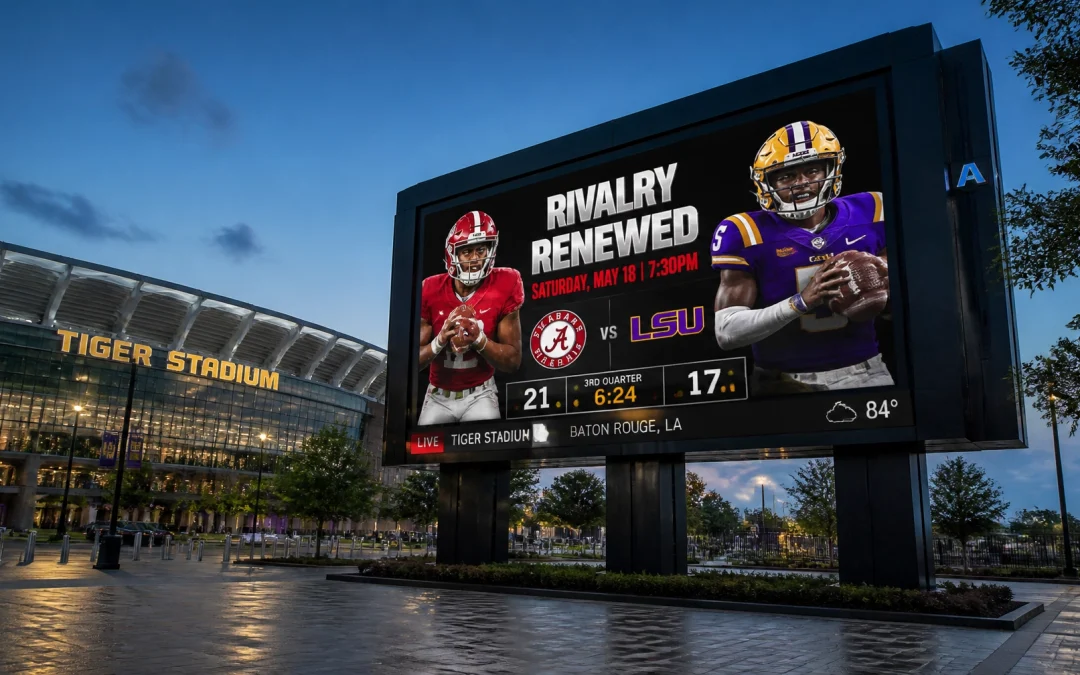
Digital out-of-home advertising is becoming a more connected part of the sports media mix. Programmatic buying, dynamic creative optimization, stadium perimeter targeting, first-party data, and improved attribution are giving advertisers more control over when, where, and how fans encounter a message.
For media buyers, planners, brand managers, and agency partners, the opportunity is not limited to placing an advertisement on a stadium screen. The larger opportunity is to build a coordinated fan journey across the venue, surrounding neighborhoods, transportation routes, sports bars, retail locations, and other high-traffic environments.
This edition outlines the core DOOH sports trends shaping campaign planning and provides practical steps for turning those trends into measurable activity.
Programmatic DOOH Becomes the Planning Layer
Programmatic DOOH allows advertisers to buy digital screen inventory using audience, location, timing, and contextual signals. Instead of committing to one fixed placement or a long-term loop, campaigns can be planned around specific moments and audience conditions.
For sports advertisers, this creates several advantages:
- Flexible scheduling: Campaigns can run before, during, or after games based on the fan journey.
- Contextual activation: Creative can respond to weather, traffic, game schedules, or local events.
- Audience-based buying: Inventory can be prioritized when relevant fan segments are present.
- Omnichannel coordination: DOOH can be planned alongside mobile, social, connected TV, and search.
- Budget control: Spend can be adjusted toward the locations, dayparts, and conditions producing the strongest results.
Programmatic buying also makes it easier to test a campaign before expanding it. A brand can begin with selected venues, audience segments, or game windows, evaluate exposure and response, and then refine the plan.
The distinction between traditional stadium advertising and programmatic DOOH is explored further in this comparison of programmatic and traditional stadium ads.
Dynamic Creative Makes the Message More Relevant
Sports audiences respond to moments. A message that is relevant before a game may feel out of place after a decisive play. Dynamic creative optimization helps advertisers adapt content to the conditions surrounding the fan.
A DCO campaign can use pre-approved creative templates that change based on signals such as:
- Game start and end times
- Score or team performance
- Time remaining
- Weather conditions
- Traffic near the venue
- Local team or event information
- Retail availability
- Audience presence or dwell patterns
For example, a beverage brand might promote a pre-game offer near a stadium entrance, then shift to a celebration-focused message after a home-team win. A quick-service restaurant could activate mobile ordering creative during post-game departure periods. A financial services brand might use local team references to reinforce community positioning without relying on a formal sponsorship.
The key is to build the creative system before the campaign launches. Effective DCO requires:
- A clear set of audience and contextual triggers.
- Modular creative assets that can be adapted quickly.
- Brand and legal approval for each variation.
- A defined process for managing live data feeds.
- Measurement that compares dynamic executions with standard creative.
A dynamic message should support the campaign objective rather than change simply for novelty. Relevance, timing, and clarity remain more important than the number of creative variations.
Stadium Perimeter Targeting Extends the Fan Journey
The stadium is only one part of the sports audience environment. Fans may encounter advertising while traveling to the venue, parking, visiting nearby restaurants, meeting friends at a sports bar, or leaving the area after the event.
A perimeter strategy can organize these touchpoints into practical zones:
- Outer travel zone: Highways, transit hubs, and commuter routes leading toward the venue.
- Arrival zone: Parking areas, rideshare locations, intersections, and pedestrian routes.
- Venue zone: Stadium entrances, concourses, digital video boards, and perimeter displays.
- Entertainment zone: Sports bars, restaurants, retail centers, and fan gathering areas.
- Departure zone: Routes and commercial areas where fans travel after the game.
OOH Sports supports campaigns that can reach digital video boards across sports categories, with targeting available within a defined area around sports venues. A radius of up to 10 miles can help planners connect stadium activity with the broader local sports ecosystem.

The strongest plans do not treat every location within a radius as equal. Each zone should have a specific role:
- Build awareness along travel routes.
- Reinforce the message close to the stadium.
- Provide an action or offer in high-dwell environments.
- Retarget exposed audiences through mobile or other digital channels.
- Measure activity by location and audience segment where possible.
This approach gives the campaign continuity without requiring the same creative execution in every environment.
Additional examples of venue-based activation are available through Sportrons, which outlines opportunities inside and outside sports venues, including digital video boards, LED displays, and custom-defined areas around stadiums.
First-Party Data Supports More Useful Audience Strategies
First-party data can make sports DOOH more precise when it is used responsibly and in accordance with privacy requirements. Useful data sources may include:
- Customer relationship management segments
- Loyalty program audiences
- App users
- Ticket purchasers
- Website visitors
- Product or content subscribers
- Existing high-value customer groups
These audiences can inform planning without turning DOOH into a one-size-fits-all channel. For example, a brand could prioritize current customers for a loyalty message, reach prospective customers near a venue, or build separate creative for frequent attendees and occasional fans.
Location intelligence and device-based exposure data can also help identify audiences who were likely exposed to a screen. Depending on the measurement partner and applicable privacy standards, those audiences may support follow-up analysis or coordinated activation across mobile, social, and connected TV.
A practical first-party data workflow includes:
- Define the business audience and campaign objective.
- Confirm that the audience can be onboarded through the selected platform.
- Apply geographic and contextual filters around relevant venues.
- Create messaging for each audience or fan-journey stage.
- Establish privacy, consent, and data-retention requirements.
- Measure exposure and downstream activity against an appropriate control group.
First-party data should improve relevance, not reduce scale unnecessarily. Broad contextual reach remains valuable for brand building, while audience data can help prioritize the most commercially important moments.
Measurement Should Be Designed Before Activation
Measurement is most useful when it is connected to the campaign objective from the beginning. A brand focused on awareness should not rely only on store visits, just as a performance campaign should not report only impressions.
Common sports DOOH measurement approaches include:
- Estimated impressions and reach
- Exposure by venue or perimeter zone
- Website visits and search lift
- QR code scans or short URL visits
- App downloads and registrations
- Store or restaurant visitation
- Ticket sales or event attendance
- Purchase consideration
- Brand recall and brand preference
- Exposed versus unexposed audience comparisons

Attribution can be especially valuable when the campaign includes clear geographic boundaries and defined activation windows. Device IDs exposed to a campaign may be compared with later visits to a store, venue, or other location. Brand lift studies can provide a separate view of changes in awareness, favorability, or purchase intent.
Results should be reported with transparent methodology. A useful campaign report identifies:
- Inventory purchased
- Venues and locations included
- Campaign dates and dayparts, where relevant to the original plan
- Audience definitions
- Exposure methodology
- Attribution window
- Control or comparison group
- Primary and secondary outcomes
- Limitations affecting interpretation
This level of detail helps partners compare campaigns and improve future planning.
Campaign Examples Show the Value of a Measured Approach
OOH Sports case studies demonstrate how programmatic DOOH can support both brand and performance objectives.
A programmatic campaign for Mike’s Hard Iced Tea used the Broadsign Ads DSP alongside channels including Meta, Snapchat, YouTube, Twitch, and Instacart. The campaign focused on increasing awareness and beverage sales in selected retail markets. A brand lift study conducted with Broadsign and Happydemics reported a 119 percent lift in positive brand image. The full example is available in the Mike’s Hard Iced Tea case study.
Sea-Doo used programmatic DOOH for its first digital out-of-home campaign, targeting personal watercraft, pontoon, and fishing enthusiasts. The campaign ran across outdoor and indoor place-based environments in key Florida markets and adapted creative for high-dwell locations. The campaign reported a 144 percent increase in purchase consideration. The Sea-Doo case study provides additional context.
These examples point to a broader lesson: DOOH performance depends on the connection between audience selection, creative relevance, channel coordination, and measurement design.

A Practical Checklist for Media Planners
Before launching a sports DOOH campaign, planners can use the following checklist:
- Define the objective: Awareness, consideration, visitation, sales, registrations, or another outcome.
- Map the fan journey: Identify where audiences travel, gather, and spend time before and after games.
- Select the right buying method: Use programmatic inventory when flexibility, targeting, or optimization is important.
- Build a DCO framework: Establish triggers, templates, approval rules, and fallback creative.
- Use data selectively: Combine first-party audiences with contextual and location-based signals.
- Coordinate channels: Align DOOH messaging with mobile, social, search, CTV, or retail media.
- Set measurement requirements: Confirm reporting, attribution, and brand lift capabilities before launch.
- Create a test plan: Compare locations, creative versions, dayparts, or audience groups.
- Document methodology: Make results understandable to brand, agency, and finance stakeholders.
The Next Conversation in DOOH Sports
The most valuable sports DOOH discussions now involve more than screen availability. They focus on how inventory connects to fan behavior, how creative responds to context, and how exposure can be tied to meaningful outcomes.
For existing OOH Sports partners, that may mean evaluating new perimeter zones, expanding programmatic access, or testing dynamic creative around selected venues. For new partners, the starting point is a clear objective and a realistic understanding of the audience journey.
The OOH Sports case study library provides additional examples of campaign strategy and measurement. For planning support, inventory questions, or partnership opportunities, visit the OOH Sports contact page.