
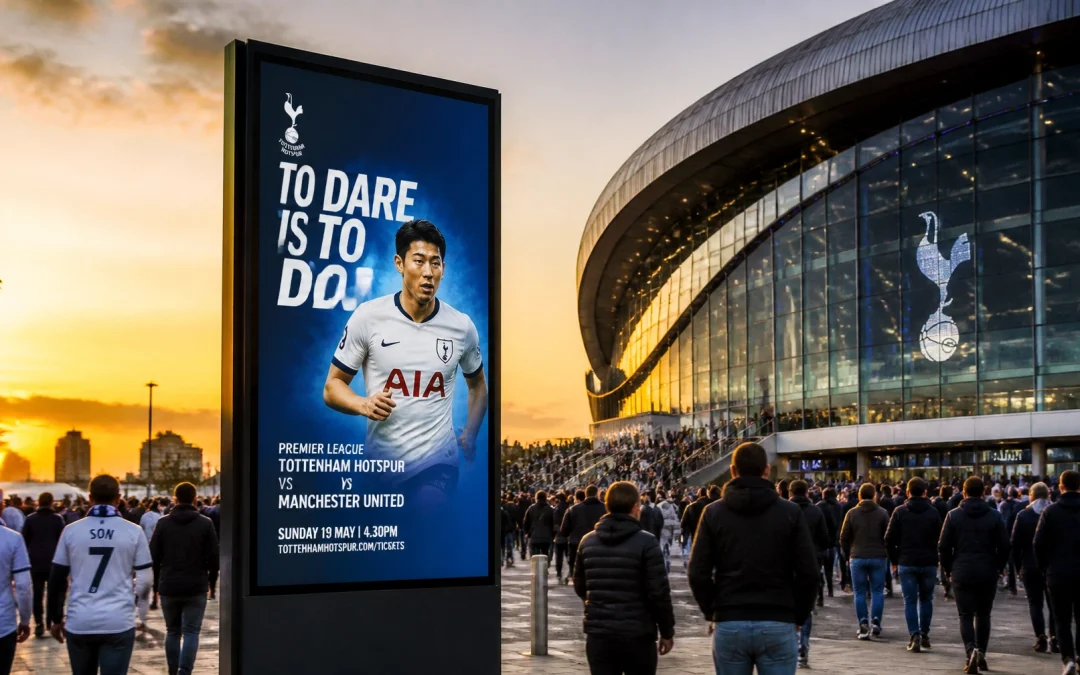
Digital out-of-home advertising continues to move closer to the center of sports media planning. The channel now combines premium physical visibility with programmatic buying, dynamic creative, venue-based targeting, and measurable outcomes.
For media buyers, brand managers, and agency partners, the opportunity is practical: sports DOOH can extend a campaign beyond the stadium and connect with fans during the full game-day journey.
This edition highlights the most useful industry signals, campaign examples, and planning actions for advertisers building modern sports media strategies.
Market Signal: DOOH Is Becoming More Accountable
Traditional out-of-home advertising has always offered scale and visibility. Digital out-of-home adds flexibility and more detailed measurement.
Current industry research from the Out of Home Advertising Association of America points to several important developments:
- Digital formats continue to drive growth across the OOH category.
- Advertisers increasingly use OOH to support purchase-driven campaigns.
- Device-level measurement can connect exposure with website visits, app downloads, store visits, and other conversion actions.
- Updated venue classifications are helping buyers compare inventory more consistently across media owners.
The shift is significant for sports advertisers. A campaign no longer needs to be evaluated only by estimated impressions. Depending on the objective, reporting can include:
- Reach and frequency by market
- Impression delivery and pacing
- Brand recall and brand preference
- Purchase consideration
- Foot traffic uplift
- Website visits and app activity
- QR code scans and other direct responses
- Retargeting audiences built from exposed device IDs
The OAAA and Kochava performance study provides additional evidence that OOH can support both physical and digital outcomes. For sports marketers, that makes DOOH easier to integrate into a broader measurement framework alongside CTV, paid social, mobile, and search.
Innovation Watch: Programmatic DOOH Adds Speed
Programmatic DOOH allows media buyers to access digital screens through automated platforms and curated inventory packages. In sports, this capability is especially useful because audience movement and attention change quickly around events.
Instead of treating a venue as a single media placement, planners can build a network of environments around the fan journey:
- Transit routes used for arrival and departure
- Entertainment districts and sports bars
- Hotels and hospitality zones
- Convenience stores and retail locations
- Parking facilities and pedestrian corridors
- Digital screens inside and outside the venue
Programmatic buying also allows campaigns to respond to event conditions. Depending on available data integrations, creative and delivery can be aligned with:
- Time to kickoff
- Pre-game and post-game traffic
- Team or league schedules
- Weather conditions
- Venue location
- Audience characteristics
- Live scores or other event signals

This flexibility helps advertisers avoid a one-size-fits-all approach. A restaurant may promote a pre-game offer during arrival windows, reinforce the brand during the event, and promote late-night ordering after the final whistle. A retailer may use the same footprint to promote snacks, beverages, merchandise, or limited-time promotions.
The strategic benefit is not simply faster buying. It is the ability to align media delivery with the moments when fans are most likely to make decisions.
Planning Opportunity: Own the 10-Mile Fan Footprint
Venue-based advertising is most effective when it reflects how fans actually move through a market.
The stadium or arena is the anchor, but the surrounding area often contains the highest-value decision points. Fans meet friends, choose where to eat, purchase drinks, stop for fuel, visit retail locations, and continue the conversation after the game.
A perimeter strategy extending up to 10 miles around sports venues can create repeated exposure across these environments. The objective is not to place the same message everywhere. The objective is to build a coordinated sequence.
A practical game-day structure
Pre-game
- Build awareness and anticipation.
- Promote products, offers, or viewing locations.
- Reach fans during commuting, dining, and shopping windows.
- Use local team references where rights and approvals permit.
In-game
- Reinforce sponsorship or brand association.
- Support second-screen behavior with short URLs, QR codes, or app prompts.
- Use concise, high-contrast creative that can be understood quickly.
- Connect messages to live moments when the technology and rights framework allow.
Post-game
- Promote late-night dining, transportation, retail, or entertainment.
- Extend the campaign to watch-party locations and departure routes.
- Retarget exposed audiences through mobile, CTV, or online video.
- Use results from the first event to improve the next flight.
The OOH Sports Network update outlines how expanded venue coverage can make this type of planning more repeatable across markets.

Creative Insight: Dynamic Messages Need a Clear Job
Dynamic creative optimization can make sports advertising more relevant, but the technology should support a clear communication goal.
A useful dynamic execution might change based on:
- The time remaining before an event
- The local weather
- The team or venue
- Product availability
- A game-day offer
- A live score or milestone
- A transition from pre-game to post-game messaging
The strongest creative remains simple. Fans may see an ad while walking, driving, entering a venue, or watching a game. Each execution should communicate one main idea.
Recommended creative principles include:
- Use a short headline.
- Keep the brand visible throughout the message.
- Limit the number of visual elements.
- Use strong contrast and readable type.
- Make calls to action specific.
- Build separate versions for arrival, in-game, and departure windows.
- Confirm all live data, trademarks, player references, and rights requirements before launch.
Dynamic creative is most valuable when it improves relevance without creating confusion. A changing message should help the audience understand why the ad matters at that moment.
Campaign Example: From Exposure to Brand Preference
Recent programmatic DOOH case studies demonstrate how sports advertisers and adjacent consumer brands can use the channel to influence more than awareness.
In one campaign for White Claw Vodka, the brand worked with Haworth Marketing + Media and Broadsign to deliver an omnichannel campaign featuring actor and comedian JB Smoove. The creative used the tagline, “White Claw Vodka Ain’t Smooth. It’s Smooove,” as part of a broader campaign across DOOH, online video, CTV, paid social, and display.
The campaign used contextual targeting across bars, casual dining locations, office buildings, residential environments, rideshare screens, billboards, and urban panels. It also incorporated points of interest around bars and liquor stores carrying the product.
According to the published OOH Sports case study:
- Purchase consideration increased by 74% during the summer flight.
- Brand preference increased by 800%, moving from 1% among non-recallers to nearly 10% among ad-recallers.
- Positive brand image increased by 144% during the summer campaign.
- Ad attribution increased by 33%.
- More than 57% of surveyed respondents recalled seeing the ads at least once.
The case illustrates several useful principles for sports advertisers:
- Context can extend beyond the venue. Relevant environments include the places fans visit before and after an event.
- Omnichannel planning increases continuity. DOOH can introduce or reinforce a message that appears later in CTV, mobile, or social.
- Exposure can support measurable brand outcomes. Brand lift studies help connect media delivery with changes in preference and intent.
- Audience design should reflect the product. Location, age, venue type, and points of interest can be combined to improve relevance.
A separate Mike’s Hard Tea campaign used programmatic DOOH in combination with Meta, Snapchat, YouTube, Twitch, and Instacart. The campaign measured ad recall, brand image, and purchase intention through a brand lift study conducted with Broadsign and Happydemics.
Measurement Checklist for Sports Advertisers
Before campaign launch, the measurement plan should be connected to the business objective.
For awareness
Track:
- Unduplicated reach
- Frequency
- Ad recall
- Brand awareness
- Video completion where applicable
For consideration
Track:
- Brand preference
- Purchase consideration
- Brand image
- Search activity
- Website visits
- Content engagement
For conversion
Track:
- Store visits
- App downloads
- Offer redemptions
- QR code scans
- Online sales
- Foot traffic uplift
- Retargeting performance
A strong plan also defines the comparison method. Possible approaches include exposed versus control groups, geographic testing, pre- and post-campaign analysis, or a third-party brand lift study.

Device IDs exposed to programmatic OOH can also support retargeting through mobile, online video, or CTV. This creates a measurable handoff between physical exposure and digital action, while helping advertisers understand how DOOH contributes to the wider media mix.
Action List: Three Steps for the Next Campaign
1. Start with the fan journey
Map the locations and time periods that matter before selecting screens. Identify arrival routes, retail areas, dining districts, watch-party locations, and post-game corridors.
2. Build creative around event phases
Prepare distinct pre-game, in-game, and post-game messages. Keep the structure consistent while adjusting the offer, call to action, or contextual detail.
3. Confirm measurement before buying
Define the primary KPI, reporting partner, audience methodology, and attribution window before campaign activation. Measurement should influence the media plan, not simply document it afterward.
Community Prompt: Compare Notes With Other Sports Marketers
The most useful DOOH strategies continue to develop through collaboration among brands, agencies, media owners, technology partners, and measurement providers.
Subscribers and partners can contribute to the industry conversation by considering:
- Which fan moments are hardest to reach through existing channels?
- Where does venue-adjacent inventory add value to a sponsorship?
- Which live data signals improve relevance without distracting from the brand?
- What outcome is most important to the next campaign, recall, consideration, visitation, or conversion?
For planning support, inventory questions, or campaign development, visit the OOH Sports marketing page, review the case study library, or contact OOH Sports.
Sports DOOH is becoming more useful because it is no longer limited to a screen or a single event. With programmatic access, venue-based coverage, dynamic creative, and outcome measurement, the channel can function as a connected layer across the entire fan experience.