
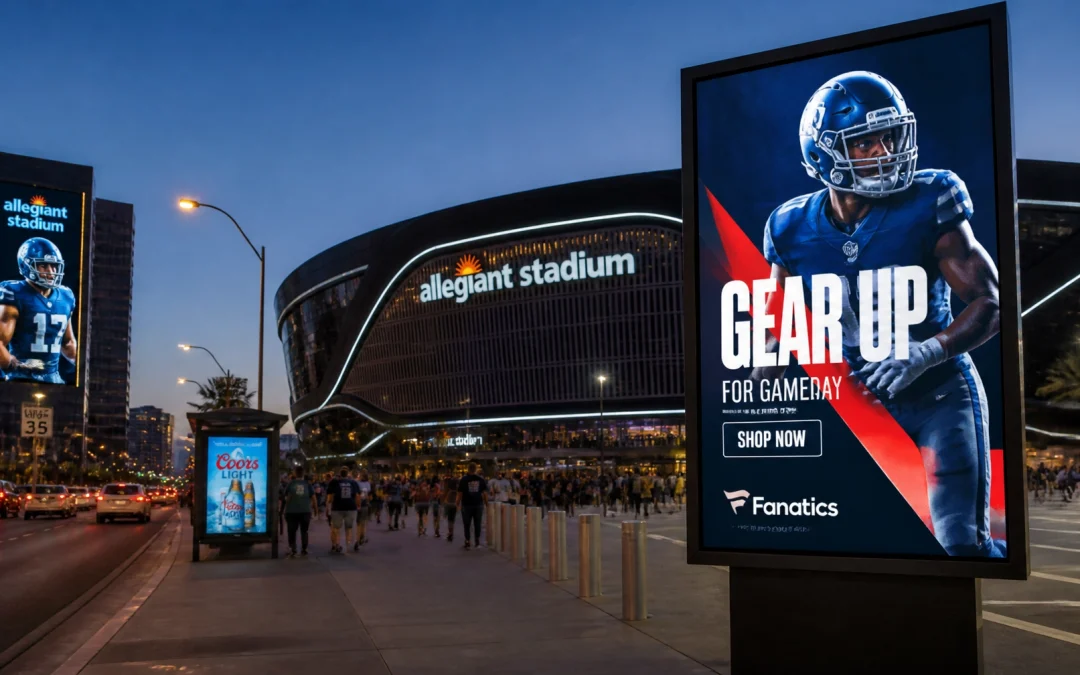
Sports advertising has always relied on strong visuals, recognizable talent, and a clear connection to the fan experience. Digital out-of-home sports adds another layer: the ability to change the message, timing, and call to action based on what is happening around the venue.
That flexibility makes DOOH advertising more than a digital version of a traditional billboard. It gives brands a creative system for telling stories across the fan journey, from the approach to the stadium through the game and the trip home.
For media buyers and brand managers, the opportunity is to plan creative as carefully as the media placement. A strong sports DOOH campaign can combine dynamic creative, sequential messaging, QR engagement, live data triggers, and connected in-venue and out-of-venue screens.
Start With the Fan Journey
The most effective creative begins with a simple question: what is the fan doing when the message appears?
A person traveling toward a venue has different needs and attention levels than someone seated inside the stadium. A fan leaving after the game may respond better to a nearby offer, a loyalty prompt, or a message connected to the result.
A practical fan journey may include:
- Before the game: Build anticipation, promote tune-in, or introduce the brand story.
- Near the venue: Reinforce the connection between the brand and the event.
- Inside the stadium: Support sponsored features, live moments, and interactive experiences.
- After the game: Extend the conversation through offers, content, or follow-up actions.
This structure helps creative teams avoid running one general message across every screen. Instead, each placement has a role within a larger story.

1. Use Dynamic Creative to Make Branding More Relevant
Dynamic creative allows specific elements of an ad to change based on approved data signals. The overall brand identity remains consistent, while the message responds to the surrounding context.
In sports marketing, potential creative triggers include:
- Game start and end times
- Team matchups
- Live scores
- Game phase
- Weather conditions
- Time of day
- Venue proximity
- Traffic conditions
- Nearby store or restaurant availability
- Promotional inventory
For example, a beverage brand could use one creative execution during the pre-game period, another during peak arrival times, and a third after the final whistle. The campaign remains visually connected, but each message meets the fan at a more relevant moment.
A creative system may include:
- Anticipation message: “Game day starts here.”
- Arrival message: “Refresh before kickoff.”
- In-game message: “Your team. Your moment.”
- Post-game message: “Keep the night going.”
Real-time sports data can make these messages more specific. Vistar Media describes dynamic creative capabilities that integrate matchups, live scoring, and game results into DOOH advertising. This approach can help brands connect creative to the immediate sports environment without rebuilding every asset manually.
The key is restraint. Dynamic creative should not turn a screen into a wall of statistics. One strong visual, one relevant message, and one clear action usually create a better viewing experience.
2. Build Sequential Messaging Across Multiple Screens
A single impression can create awareness. A sequence of impressions can create a story.
Sequential messaging uses a series of related creative executions that appear across different locations or stages of the fan journey. Each message builds on the previous one.
A campaign for a sports apparel brand might follow this pattern:
- Transit or roadside screen: Introduce the new collection with a close-up product image.
- Stadium perimeter advertising: Show the product in a game-day setting.
- Entrance or concourse screen: Present a QR code for product details or a nearby retail location.
- Post-game screen: Reinforce the brand with a fan-focused message and a limited offer.
This approach supports stronger branding because the audience sees a consistent visual identity while receiving new information at each step.
For media planners, sequential creative also creates a clearer framework for buying inventory. Screens can be grouped by:
- Distance from the venue
- Fan movement patterns
- Dwell time
- Game-day phase
- Audience type
- Expected attention level
Fast-moving roadside placements may need bold, simple messages. Pedestrian areas and concourses can support more detail, interactive prompts, or product information.
3. Connect In-Venue and Out-of-Venue Creative
Sports DOOH innovation works best when screens operate as part of one connected system.
The OOH Sports digital out-of-home sports network can help brands plan digital video advertising boards across sports environments, including the perimeter around venues. A custom-defined radius, such as an area extending up to 10 miles around a venue, can connect the stadium to nearby travel routes, hospitality locations, retail areas, and fan gathering places.
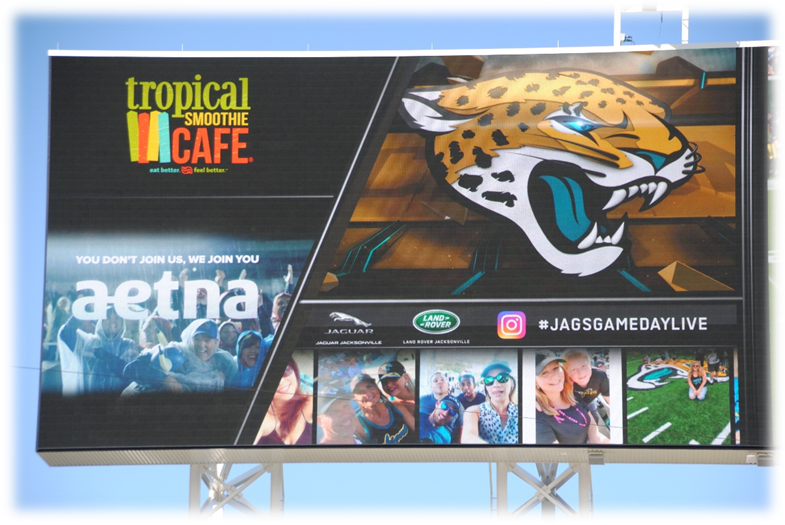
Inside the venue, the Sportrons in-venue network adds another creative layer through digital video boards, LED screens, sponsored features, and other fan-facing placements.
Each environment can perform a different job:
Out-of-venue screens
- Establish awareness before fans arrive
- Create repeated exposure along travel routes
- Reach local fans who are not attending the game
- Promote nearby products, services, or locations
- Build association between the brand and the sports environment
In-venue screens
- Reinforce the brand during high-attention moments
- Support sponsored features and announcements
- Deliver live data or game-related creative
- Introduce contests, polls, or fan challenges
- Move fans toward a mobile action
Post-game placements
- Promote a nearby restaurant or retailer
- Deliver a celebration or consolation message
- Encourage loyalty sign-ups
- Extend the story through highlights or follow-up content
- Retarget exposed audiences through mobile or video
This connected approach is useful for both official sponsors and brands using implied sponsorship strategies. The OOH Sports marketing solutions page outlines how digital displays and interactive signage can support campaigns around sports venues.
4. Use QR Codes as a Simple Bridge to Action
QR codes give DOOH creative a measurable connection to mobile behavior. The best QR experiences are simple, fast, and directly related to the message on screen.
Useful QR destinations include:
- Product pages
- Digital coupons
- Ticketing platforms
- Store locators
- Loyalty programs
- Contest entries
- Mobile applications
- Live statistics
- Fan polls and prediction games
The creative should focus on one main action. “Scan for the fan challenge” is clearer than presenting several competing instructions.
QR placement also depends on the environment:
- Roadside: Use only when the screen is visible to passengers or pedestrians with enough dwell time.
- Stadium entrances: Promote an immediate offer, contest, or event guide.
- Concourse areas: Use a larger QR code with more detailed instructions.
- Sports bars and restaurants: Connect the message to ordering, loyalty, or a product promotion.
The landing page should be mobile-friendly and should continue the visual language of the DOOH ad. A disconnected landing experience can weaken the creative impact.
5. Turn Live Data Into Creative, Not Noise
Live data can create relevance, but it should support the brand story instead of replacing it.
Possible data-led creative ideas include:
- A food delivery brand responding to game breaks with a simple ordering prompt
- A sports drink connecting player performance to hydration messaging
- An apparel brand changing creative after a team victory
- A transportation brand displaying post-game travel information
- A restaurant promoting nearby availability during the arrival window
- A financial services brand using fan milestones to support a savings or rewards message
The most useful executions follow a clear cause-and-effect structure:
- If the game is about to begin, show a tune-in or arrival message.
- If a key moment occurs, show a reaction tied to the brand.
- If rain begins, promote an indoor location or service.
- If the game ends, provide a next-step offer or loyalty prompt.
Creative teams should establish trigger rules before launch. The plan should define which data sources are approved, how quickly assets update, who monitors delivery, and what happens if a feed becomes unavailable.
6. Design for Distance, Motion, and Attention
A creative idea can be strong and still fail if it is difficult to understand in the real world.
DOOH creative should account for viewing distance, traffic speed, screen size, lighting, and dwell time. Basic design principles include:
- Use one primary visual.
- Keep headlines short.
- Use high-contrast colors.
- Make the logo easy to recognize.
- Limit the number of information points.
- Use a single call to action.
- Keep QR codes large enough to scan.
- Match the layout to the screen environment.
A stadium perimeter screen can support a bold brand moment that is visible from multiple angles. A concourse display may allow for more detailed information. A roadside board generally requires the fastest possible read.
The goal is not to make every screen identical. The goal is to make every screen recognizable as part of the same campaign.

7. Measure the Creative, Not Just the Placement
Measurement should evaluate how different creative choices influence results.
Useful KPIs may include:
Branding
- Ad recall
- Brand awareness
- Brand favorability
- Purchase consideration
- Brand preference
Fan engagement
- QR scans
- Contest entries
- Poll responses
- App downloads
- Content views
- Social interactions
Physical actions
- Store visits
- Restaurant visits
- Offer redemptions
- Foot traffic near the venue
- Visits among exposed device IDs
Business outcomes
- Ticket sales
- Product sales
- Revenue lift
- Conversion rate
- Return on ad spend
OOH Sports case studies include a White Claw campaign that reported a 74 percent lift in purchase consideration and a Mike’s Hard Iced Tea campaign that reported a 119 percent lift in positive brand image. These examples show how programmatic DOOH can support brand outcomes when creative, media delivery, and measurement are planned together.
Media buyers should compare performance by creative version, location, game phase, audience segment, and trigger. A post-campaign review can reveal whether dynamic messages outperformed static assets, whether QR engagement was stronger inside or outside the venue, and which parts of the fan journey produced the most valuable actions.
A Practical Creative Checklist
Before launching a sports DOOH campaign, brand and media teams should confirm:
- Is the campaign objective clearly defined?
- Does each screen environment have a specific role?
- Is the fan journey mapped from arrival through departure?
- Are dynamic triggers tied to a useful message?
- Does the campaign include a clear creative sequence?
- Is the in-venue and out-of-venue branding consistent?
- Does every QR code lead to a fast mobile experience?
- Are creative versions designed for distance and dwell time?
- Are data feeds and backup plans confirmed?
- Are brand lift, attribution, and engagement metrics established?
The Creative Advantage of Sports DOOH
DOOH advertising gives sports marketers more control over the relationship between message and moment. Dynamic creative can respond to live conditions. Sequential messaging can build a story. QR codes can turn attention into action. Connected screens can make the brand present across the full fan journey.
For media buyers and brand managers, the creative opportunity is practical. Sports DOOH does not require a campaign to be louder or more complicated. It requires the right message, in the right environment, at the right point in the fan experience.
With access to the OOH Sports network, stadium perimeter advertising, and the Sportrons in-venue network, brands can build a digital out-of-home sports campaign that feels connected, useful, and measurable. That is the foundation of effective fan engagement and lasting sports marketing innovation.