
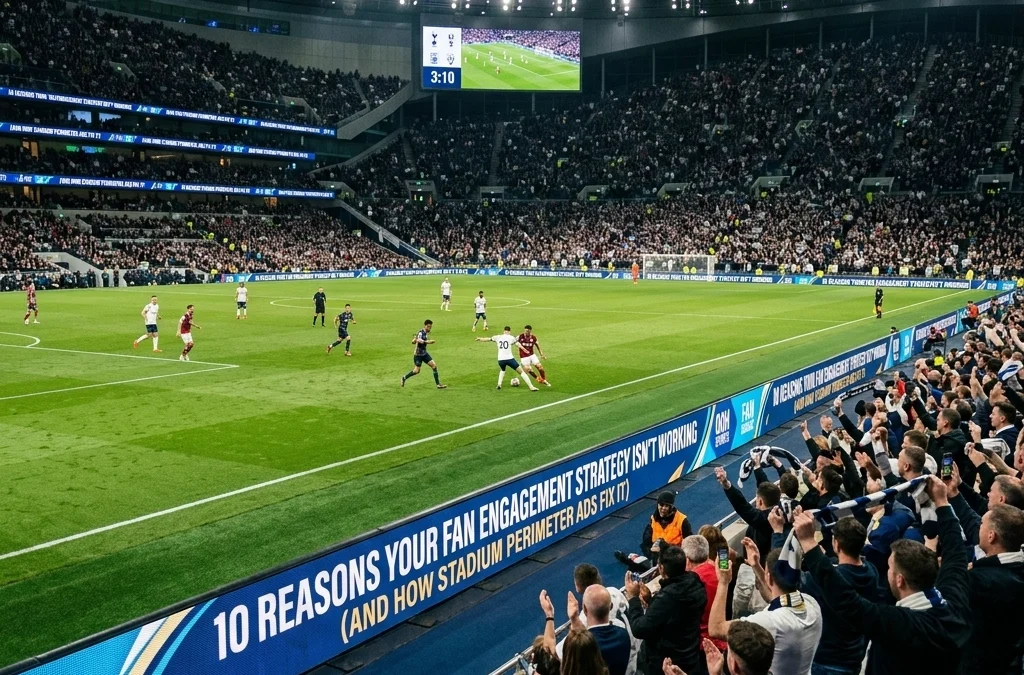
Fan engagement is the cornerstone of modern sports marketing, yet many brands find that their traditional strategies are hitting a ceiling. For creative directors and CMOs, the challenge is no longer just reaching an audience. It is about capturing attention in a world where fans are constantly distracted by second screens, social media notifications, and a literal sea of advertising noise.
When engagement numbers stall, the culprit is rarely a lack of budget. More often, it is a mismatch between how fans consume sports and how brands deliver messages. This analysis explores ten specific reasons why traditional fan engagement strategies fail and how stadium perimeter advertising provides a direct, high impact solution.
1. The Saturation of Digital Channels
Digital ad fatigue is real. The average fan is bombarded with thousands of digital impressions daily, leading to a phenomenon known as banner blindness. When marketing relies solely on social media feeds or mobile banners, the message often gets lost in the scroll.
Stadium perimeter ads fix this by existing in a physical space that cannot be scrolled past or closed with an "X." Because these ads are integrated into the field of play, they occupy the primary focus of the fan. Whether the fan is watching the game live in the stands or via a broadcast, the perimeter boards remain a constant, unblockable part of the visual experience.
2. Generic Messaging and Lack of Personalization
Research indicates that generic campaigns to loosely targeted segments no longer yield high conversion rates. Fans expect content that feels relevant to the moment. If a brand delivers a generic "buy now" message while a fan is experiencing the tension of a tie game, the message feels tone deaf.
Dynamic stadium perimeter advertising allows for real-time creative updates. Messages can change based on game triggers, such as a goal, a home run, or a time-out. This ensures the brand message aligns with the fan’s current emotional state, significantly increasing the relevance of the engagement.
3. The "Data Silo" Delay
One of the biggest hurdles in modern marketing is the time it takes to process fan data. Many organizations struggle with slow segmentation processes where data from ticketing, CRM, and mobile apps must be manually integrated. By the time a segment is ready for a targeted ad, the opportunity has often passed.
Programmatic Digital Out-of-Home (DOOH) platforms solve this by allowing brands to execute campaigns based on real-time data. Instead of waiting days for data teams to export lists, marketers can use automated triggers to display ads exactly when and where they are most effective.
4. High Friction and Low Reward
Many engagement strategies require too much effort from the fan. Asking a fan to download an app, fill out a form, or enter a contest while they are trying to watch a live game creates friction. Most fans will choose the game over the brand interaction every time.
Perimeter ads provide a low friction alternative. They build brand equity through consistent, high frequency exposure without demanding an immediate, complex action from the fan. This passive engagement builds a foundation of trust that makes future direct interactions much more successful.

5. Treating Fans as Data Points, Not Stakeholders
There is a growing disconnect in sports marketing where fans feel treated like "anonymous customers" rather than members of a community. If a strategy is purely brand centric, focusing only on the company’s goals rather than the fan’s experience, engagement will naturally drop.
Successful campaigns shift toward a fan-centric approach. Using stadium perimeter ads to celebrate fan culture, display real-time social media mentions, or provide helpful game info transforms the ad from an intrusion into a contribution to the game day atmosphere. For a deeper look at this shift, consider the analysis on fan-centric vs brand-centric sports campaigns.
6. The Disconnect Between Physical and Digital Worlds
Many brands run excellent digital campaigns and decent in-stadium activations, but the two rarely talk to each other. This fragmentation results in a disjointed brand experience. A fan might see one message on their phone and a completely different one on the stadium big screen.
Stadium perimeter advertising acts as the bridge. By using geographically targeted DOOH, brands can synchronize their stadium presence with mobile retargeting. A fan who sees a perimeter ad during the game can be served a follow-up offer on their mobile device later that evening, creating a seamless omnichannel journey.
7. The Rising Cost of Traditional Sponsorships
For many brands, the barrier to entry for fan engagement is the price tag. Traditional title sponsorships and long term stadium contracts can cost millions of dollars, often locking out creative brands with smaller, more agile budgets.
The digital evolution of perimeter boards has changed the math. Brands can now buy space programmatically, appearing in major stadiums for a fraction of the cost of a traditional sponsorship. This shift allows smart brands to scale their presence across multiple venues without the multi-million dollar commitment. Learn more about how brands scale with perimeter DOOH for 80 percent less.
8. Failure to Capture the "Live" Moment
Sports are consumed live because of the unpredictability. A strategy that relies on pre-recorded, static content misses the "magic" of the live event. If a brand is showing a standard product shot while the stadium is erupting after a last-second win, that brand has missed a massive engagement window.
Perimeter ads allow for "moment marketing." Brands can pre-program creative assets for specific scenarios. When a specific player scores, the boards can instantly switch to a congratulatory message featuring that player. This makes the brand a participant in the celebration, leading to much higher brand recall.
9. Lack of Scalability Across Venues
A common mistake is focusing all engagement efforts on a single local team or stadium. While this builds deep local roots, it limits the overall reach of the brand. Manual coordination with dozens of different stadiums to run a national campaign is a logistical nightmare for most marketing teams.
OOH Sports simplifies this by providing a single point of access to thousands of digital screens across various sports and locations. This allows a CMO to launch a coordinated fan engagement strategy in New York, Los Angeles, and Chicago simultaneously, all managed through one central platform.
10. Measurement and Attribution Blind Spots
If you cannot measure it, you cannot improve it. Traditional fan engagement tactics like handing out flyers or running unlinked radio spots make it nearly impossible to calculate a precise ROI. Creative directors often struggle to prove that their "engagement" efforts actually led to a lift in sales or brand perception.
Modern stadium perimeter advertising is backed by AI-powered analytics. Marketers can now track device IDs exposed to specific ads and tie those exposures to later actions, such as visiting a website or making a purchase. This level of attribution turns sports marketing from a "best guess" into a data-driven science.

Strategic Implementation: How to Pivot
Correcting a failing fan engagement strategy requires a shift in tactics. Instead of trying to force fans into a brand’s ecosystem, the brand must enter the fan’s ecosystem.
Step 1: Audit Current Touchpoints
Identify where the "leak" in engagement is happening. Are fans seeing the ads but not clicking? Or are they not seeing the ads at all due to digital clutter?
Step 2: Integrate Perimeter Advertising
Incorporate DOOH perimeter boards into the media mix. Use them not just as a logo placement, but as a dynamic storytelling tool. Coordinate the creative with the live game flow to ensure maximum relevance.
Step 3: Leverage Programmatic Buying
Use programmatic platforms to gain flexibility. This allows the brand to turn ads on or off based on performance, game schedules, or even weather conditions, ensuring the budget is always spent during peak engagement windows.
Step 4: Measure and Refine
Use exposure data to understand which creative resonated most. Did the "celebration" creative drive more web traffic than the "standard" product creative? Use these insights to iterate the strategy for the next game.
The Results of a Modern Approach
When brands move away from generic, high-friction strategies and toward dynamic stadium advertising, the results are measurable. Campaigns utilizing these tactics have seen significant lifts in purchase consideration and brand image. For example, beverage brands and automotive companies have reported triple-digit increases in positive brand perception by simply being present and relevant during live sporting events.
The power of the stadium environment is that it provides a captive, emotionally charged audience. By fixing the common mistakes of the past and leveraging the technology of stadium perimeter ads, brands can stop chasing engagement and start creating it.

Final Thoughts for Marketing Leaders
The fan engagement landscape is changing, but the goal remains the same: to create a lasting connection between the brand and the audience. Stadium perimeter advertising offers a unique combination of scale, impact, and precision that traditional digital or print channels simply cannot match.
By addressing these ten common pitfalls and adopting a more dynamic, perimeter-focused strategy, brands can ensure they are not just spectators, but a central part of the fan experience. For more insights on optimizing your sports marketing spend, explore the resources and case studies at oohsports.com.